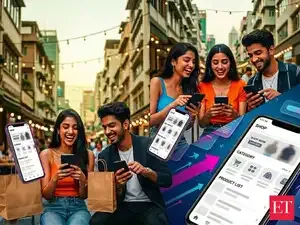
Gen Z is powering India's online retail in a major way and forcing companies to change their strategies. This trend can dismantle the decades-old foundational concept of marketing. Around half of India’s online fashion and beauty shoppers are now Gen Z, and platforms are rapidly realigning to keep pace, as per a TOI report. This cohort also boasts 1.5x the e-retail spend share on categories such as lifestyle, beauty and electronics compared to other age groups, driving growth in a market that has more than doubled over five years to $66 billion in gross merchandise value, Bain & Co data showed.
Online platforms, including Amazon, Nykaa, Myntra and Shein, as well as consumer brands are sharpening their strategies around this cohort’s fast-evolving tastes and high-engagement behaviour. At Amazon Fashion, the shift is visible with Gen Z’s share surging to 52% from about 30% two years ago, according to its director, Nikhil Sinha. Beyond penetration, engagement across browsing, visits and transactions is up two-and-a-half times YoY, he told TOI. A significant chunk of the growth and engagement is now coming from tier-2 and tier-3 cities. “Gen Z (shopper) growth in tier 2 and 3 cities is happening at twice the rate compared to the rest of the country. Customers in cities such as Indore, Lucknow, Chandigarh, Kochi, Nagpur, Jaipur and Surat now have access to the same global trends, creators and content as customers in metros like Mumbai or Bengaluru,” Sinha added. For Myntra too, Gen Z accounts for nearly half the customer base and contributes almost half of all new customers in 2025, says Suman Saha, CXO House of Brands and FWD, Myntra.
According to a recent report published jointly by Deloitte and Google, 'The $250 Billion Commerce Frontier', India's e-retail market is projected to skyrocket nearly threefold from $90 billion in 2025 to surpass $250 billion by 2030. This monumental explosion in digital value is not merely a story of rising internet access or economic growth. It is primarily propelled by Gen Z -- a massive, digitally native demographic cohort that is fundamentally changing how goods are discovered, evaluated and bought.
Gen Z, a hyper-connected population of 220 million, is effectively shattering the traditional linear shopping funnel, the report says. As these consumers completely bypass conventional purchasing steps, brands are discovering that the sequential path from awareness to purchase has transformed into an immediate, non-linear loop of instant gratification.
At the absolute center of this compounding growth is the Gen Z consumer base. Numbering 220 million individuals who have never known a world without high-speed mobile data and seamless digital transactions, this cohort is expected to single-handedly account for nearly 45% of all e-commerce spend by 2030. They do not view online retail as a modern alternative to the physical store. For them, the screen is the baseline starting point of all commercial life. Consequently, their unique collective habits, demand for immediate fulfillment and reliance on peer validation are acting as the primary catalysts rewriting the code of retail engagement.
The report highlights that this linear shopping funnel is dead, being replaced by an always-on loop of simultaneous discovery and validation. Because Gen Z spends their time immersed in digital environments where entertainment and utility merge, they no longer participate in isolated shopping journeys. A consumer does not see an advertisement on television, browse a web browser for reviews days later and then eventually visit an e-commerce platform to check out. Instead, the journey has become highly compressed. The moment a consumer becomes aware of a product is now frequently the exact same moment they purchase it, collapsing a multi-day psychological journey into a frictionless, multi-second event.
Inspired commerce represents the shift where product discovery originates through creator-led ecosystems rather than active search queries. The data reveals a staggering trajectory for this trend. Creator-led commerce is projected to contribute approximately $25 billion in Gross Merchandise Value (GMV) by 2030, with digital creators directly influencing one in every three retail purchases. This phenomenon is incredibly potent because it leverages the psychological mechanism of communal trust. When a trusted creator showcases a product via short-form video or a live stream, the traditional consideration phase is instantly bypassed because the creator has already validated the product for their audience.
Sunder Balasubramanian, an industry expert quoted in the report, captures the exact mechanism of this phenomenon. He states that the creator economy is actively reshaping how purchase decisions are made, with discovery and intent increasingly driven by trusted creators and a growing share of demand originating through creator-led ecosystems. He emphasises that moving ahead, the winning strategies for brands will involve precision, aligning the right creators to the product, and equipping them with commerce tools enabling shoppable content, in-app checkout, and clear attribution to insights. He notes that this is especially powerful beyond metros, where video-first, local-language creators drive engagement at scale. Crucially, Balasubramanian concludes that as these interactions become measurable and instantly shoppable, the funnel will collapse, turning influence into transaction in a single, seamless interaction.
This collapse is further accelerated by Immersive commerce, which uses spatial computing, augmented reality (AR), and virtual reality (VR) to eliminate the traditional physical evaluation barrier. Historically, a consumer hesitated at the consideration phase because they could not touch or try on the product online. By utilizing interactive AR try-ons and synchronised online-to-offline touchpoints, modern retail removes this imagination gap entirely. The report notes that these immersive digital tools not only drive a 20% incremental revenue boost for adaptive brands but also provide immediate cognitive validation, allowing the shopper to transition from curiosity to transactional execution in seconds.
Instant commerce, defined primarily by the meteoric rise of quick commerce platforms, is fundamentally reshaping consumer habit loops. According to the report, India’s quick commerce market is projected to experience an explosive sixfold growth, surging to a massive $50 billion market serving roughly 70 million shoppers by 2030. Delivery timelines have dramatically compressed from days and hours down to mere minutes. Furthermore, this model is rapidly diversifying beyond groceries into a 40% to 45% non-food mix, encompassing fashion, cosmetics, electronics, and lifestyle goods. When a Gen Z consumer experiences an impulse of intent, quick commerce fulfills that intent almost instantaneously. This instant gratification closes the transaction loop so fast that it prevents the consumer from entering a prolonged consideration phase or abandoning their cart, a behavior that traditional e-commerce models frequently suffered from.
Binding this entire non-linear loop together is Intelligent commerce, powered by the systemic integration of Agentic Artificial Intelligence across the retail value chain. On the backend, predictive AI automation analyses real-time hyperlocal demand signals to ensure inventory is exactly where it needs to be, boosting overall retail profitability by 30% to 35%. On the frontend, Gen Z consumers would be rapidly embracing AI agents as proactive shopping companions. Rather than requiring a human user to manually navigate multiple application screens, compare prices, and fill out shipping forms, generative AI engines will collapse these multi-step search journeys into a singular, highly context-aware conversational interface. The AI agent acts as an autonomous advisor that instantly narrows choices, optimises carts and executes transactions.
To win in this $250 billion market, enterprises must construct integrated, always-on commerce engines. They must move away from ad-hoc influencer sponsorships and instead build native, shoppable media ecosystems. They must transition their logistics to support hyper-local micro-markets that can satisfy the impulse loops of quick commerce. Ultimately, the brands that thrive by 2030 will be those that accept the complete destruction of the linear funnel, restructuring their entire operational models to catch the Gen Z buyer.
Online platforms, including Amazon, Nykaa, Myntra and Shein, as well as consumer brands are sharpening their strategies around this cohort’s fast-evolving tastes and high-engagement behaviour. At Amazon Fashion, the shift is visible with Gen Z’s share surging to 52% from about 30% two years ago, according to its director, Nikhil Sinha. Beyond penetration, engagement across browsing, visits and transactions is up two-and-a-half times YoY, he told TOI. A significant chunk of the growth and engagement is now coming from tier-2 and tier-3 cities. “Gen Z (shopper) growth in tier 2 and 3 cities is happening at twice the rate compared to the rest of the country. Customers in cities such as Indore, Lucknow, Chandigarh, Kochi, Nagpur, Jaipur and Surat now have access to the same global trends, creators and content as customers in metros like Mumbai or Bengaluru,” Sinha added. For Myntra too, Gen Z accounts for nearly half the customer base and contributes almost half of all new customers in 2025, says Suman Saha, CXO House of Brands and FWD, Myntra.
According to a recent report published jointly by Deloitte and Google, 'The $250 Billion Commerce Frontier', India's e-retail market is projected to skyrocket nearly threefold from $90 billion in 2025 to surpass $250 billion by 2030. This monumental explosion in digital value is not merely a story of rising internet access or economic growth. It is primarily propelled by Gen Z -- a massive, digitally native demographic cohort that is fundamentally changing how goods are discovered, evaluated and bought.
Gen Z, a hyper-connected population of 220 million, is effectively shattering the traditional linear shopping funnel, the report says. As these consumers completely bypass conventional purchasing steps, brands are discovering that the sequential path from awareness to purchase has transformed into an immediate, non-linear loop of instant gratification.
The multi-billion dollar frontier and the Gen Z engine
To understand the scale of this behavioral shift, one must first understand the macroeconomic framework laid out in the Deloitte and Google research. Between 2019 and 2025, India built a formidable digital retail foundation. This period witnessed the influx of 110 million new online shoppers, a doubling of the online merchant base, and the creation of a powerful digital payment spine supporting over 400 million Unified Payments Interface (UPI) users. Building directly upon this robust infrastructure, the next five years will absorb an additional 150 million online shoppers while individual e-commerce spending is projected to double.At the absolute center of this compounding growth is the Gen Z consumer base. Numbering 220 million individuals who have never known a world without high-speed mobile data and seamless digital transactions, this cohort is expected to single-handedly account for nearly 45% of all e-commerce spend by 2030. They do not view online retail as a modern alternative to the physical store. For them, the screen is the baseline starting point of all commercial life. Consequently, their unique collective habits, demand for immediate fulfillment and reliance on peer validation are acting as the primary catalysts rewriting the code of retail engagement.
The death of the linear shopping funnel
For nearly a century, marketers operated under the absolute certainty of the linear consumer funnel. A buyer moved predictably down a vertical pipeline that began with awareness, transitioned into consideration, crystallised into intent, and finally culminated in a purchase. This structural sequence gave brands time and space to deploy distinct advertising strategies at different stages of the customer journey.The report highlights that this linear shopping funnel is dead, being replaced by an always-on loop of simultaneous discovery and validation. Because Gen Z spends their time immersed in digital environments where entertainment and utility merge, they no longer participate in isolated shopping journeys. A consumer does not see an advertisement on television, browse a web browser for reviews days later and then eventually visit an e-commerce platform to check out. Instead, the journey has become highly compressed. The moment a consumer becomes aware of a product is now frequently the exact same moment they purchase it, collapsing a multi-day psychological journey into a frictionless, multi-second event.
Inspired and immersive commerce as tools of collapse
This structural collapse of the upper funnel -- where awareness and consideration used to be separate steps -- is driven by what the report identifies as 'Inspired' and 'Immersive' commerce. Gen Z consumers are turning away from institutional corporate advertising, opting instead for narrative-driven, discovery-based shopping.Inspired commerce represents the shift where product discovery originates through creator-led ecosystems rather than active search queries. The data reveals a staggering trajectory for this trend. Creator-led commerce is projected to contribute approximately $25 billion in Gross Merchandise Value (GMV) by 2030, with digital creators directly influencing one in every three retail purchases. This phenomenon is incredibly potent because it leverages the psychological mechanism of communal trust. When a trusted creator showcases a product via short-form video or a live stream, the traditional consideration phase is instantly bypassed because the creator has already validated the product for their audience.
Sunder Balasubramanian, an industry expert quoted in the report, captures the exact mechanism of this phenomenon. He states that the creator economy is actively reshaping how purchase decisions are made, with discovery and intent increasingly driven by trusted creators and a growing share of demand originating through creator-led ecosystems. He emphasises that moving ahead, the winning strategies for brands will involve precision, aligning the right creators to the product, and equipping them with commerce tools enabling shoppable content, in-app checkout, and clear attribution to insights. He notes that this is especially powerful beyond metros, where video-first, local-language creators drive engagement at scale. Crucially, Balasubramanian concludes that as these interactions become measurable and instantly shoppable, the funnel will collapse, turning influence into transaction in a single, seamless interaction.
This collapse is further accelerated by Immersive commerce, which uses spatial computing, augmented reality (AR), and virtual reality (VR) to eliminate the traditional physical evaluation barrier. Historically, a consumer hesitated at the consideration phase because they could not touch or try on the product online. By utilizing interactive AR try-ons and synchronised online-to-offline touchpoints, modern retail removes this imagination gap entirely. The report notes that these immersive digital tools not only drive a 20% incremental revenue boost for adaptive brands but also provide immediate cognitive validation, allowing the shopper to transition from curiosity to transactional execution in seconds.
Instant and intelligent forces flattening execution
If inspired and immersive technologies collapse the top half of the funnel, then Instant and Intelligent commerce flatten the bottom half, combining intent and fulfillment into one immediate feedback loop. Gen Z exhibits an unprecedented appetite for immediacy, which has birthed a massive structural shift in how products are distributed.Instant commerce, defined primarily by the meteoric rise of quick commerce platforms, is fundamentally reshaping consumer habit loops. According to the report, India’s quick commerce market is projected to experience an explosive sixfold growth, surging to a massive $50 billion market serving roughly 70 million shoppers by 2030. Delivery timelines have dramatically compressed from days and hours down to mere minutes. Furthermore, this model is rapidly diversifying beyond groceries into a 40% to 45% non-food mix, encompassing fashion, cosmetics, electronics, and lifestyle goods. When a Gen Z consumer experiences an impulse of intent, quick commerce fulfills that intent almost instantaneously. This instant gratification closes the transaction loop so fast that it prevents the consumer from entering a prolonged consideration phase or abandoning their cart, a behavior that traditional e-commerce models frequently suffered from.
Binding this entire non-linear loop together is Intelligent commerce, powered by the systemic integration of Agentic Artificial Intelligence across the retail value chain. On the backend, predictive AI automation analyses real-time hyperlocal demand signals to ensure inventory is exactly where it needs to be, boosting overall retail profitability by 30% to 35%. On the frontend, Gen Z consumers would be rapidly embracing AI agents as proactive shopping companions. Rather than requiring a human user to manually navigate multiple application screens, compare prices, and fill out shipping forms, generative AI engines will collapse these multi-step search journeys into a singular, highly context-aware conversational interface. The AI agent acts as an autonomous advisor that instantly narrows choices, optimises carts and executes transactions.
The implications for modern brands
The implications of the Deloitte and Google report are clear for any business aiming to survive the decade. The traditional methods of slowly guiding a consumer down a structured marketing funnel are no longer viable in a world dictated by Gen Z buying power. Because this digital-first generation demands that entertainment, trust, evaluation, and delivery occur simultaneously, brands can no longer treat marketing, supply chain, and retail storefronts as separate corporate silos.To win in this $250 billion market, enterprises must construct integrated, always-on commerce engines. They must move away from ad-hoc influencer sponsorships and instead build native, shoppable media ecosystems. They must transition their logistics to support hyper-local micro-markets that can satisfy the impulse loops of quick commerce. Ultimately, the brands that thrive by 2030 will be those that accept the complete destruction of the linear funnel, restructuring their entire operational models to catch the Gen Z buyer.