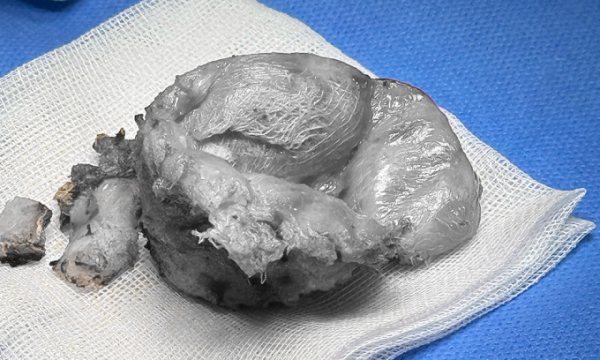
The foreign body was identified as a contributing factor to the patient’s prolonged neck and shoulder pain following the original procedure.
The patient, identified as Ngan (name changed), sought treatment after experiencing breast deformity and chronic pain in her left shoulder.
According to her medical history, she underwent breast augmentation in 2022 through a periareolar incision. Over time, the right implant showed signs of displacement, while the left breast became firm and visibly deformed due to Grade IV capsular contracture, the most severe form of fibrous capsule tightening around an implant.
|
Surgical gauze was found in the left axillary region. Photo courtesy of Dr. Cao Vu |
Following examination, Dr. Vu diagnosed severe capsular contracture and recommended implant removal, total capsulectomy, and reconstruction of both implant pockets, with plans for possible secondary augmentation after recovery.
During surgery on the right breast, doctors found the implant pocket to be thin, although the Motiva 255cc implant remained intact. Pocket deficiency and pocket displacement had caused the implant to shift downward and outward. The surgical team reconstructed the implant pocket for potential future use.
The left breast presented more extensive complications. Surgeons found thickened inflammatory tissue surrounding an older Motiva 255cc implant that showed surface folds and yellow discoloration of the gel.
Surgeon also identified severe Grade IV capsular contracture and discovered retained surgical gauze in the axillary region surrounded by dense fibrotic tissue.
The gauze had triggered what doctors described as an organized fibrotic reaction, in which fibrous tissue gradually encapsulates the foreign material over time. Significant inflammation and tissue thickening were also observed around the implant pocket.
Gossypiboma refers to a mass formed when surgical gauze is unintentionally left inside the body after surgery.
|
A fibrotically encapsulated gossypiboma with extensive adhesions and inflammatory changes. Photo courtesy of Dr. Cao Vu |
Doctors say the body generally reacts to retained gauze in two ways.
One is an exudative or suppurative reaction, which may lead to abscesses, swelling, pain, or pus drainage. The other is a fibrotic reaction, in which the body surrounds the material with fibrous tissue, forming a firm mass that may remain undetected for long periods.
In this case, the patient’s symptoms were relatively limited, consisting mainly of shoulder pain and firmness in the left breast. Ultrasound imaging did not clearly identify the retained gauze because it had become encapsulated within surrounding tissues near the armpit.
Dr. Vu said the case was uncommon, even within his more than 20 years of surgical practice.
To remove the foreign body and fibrous tissue, surgeons used an ultrasonic scalpel designed to improve cutting precision and bleeding control. Combined with point dissection techniques, the method allowed removal of the fibrotic mass while minimizing damage to nearby healthy tissue.
The removed tissue was sent for histopathological examination.
 |
|
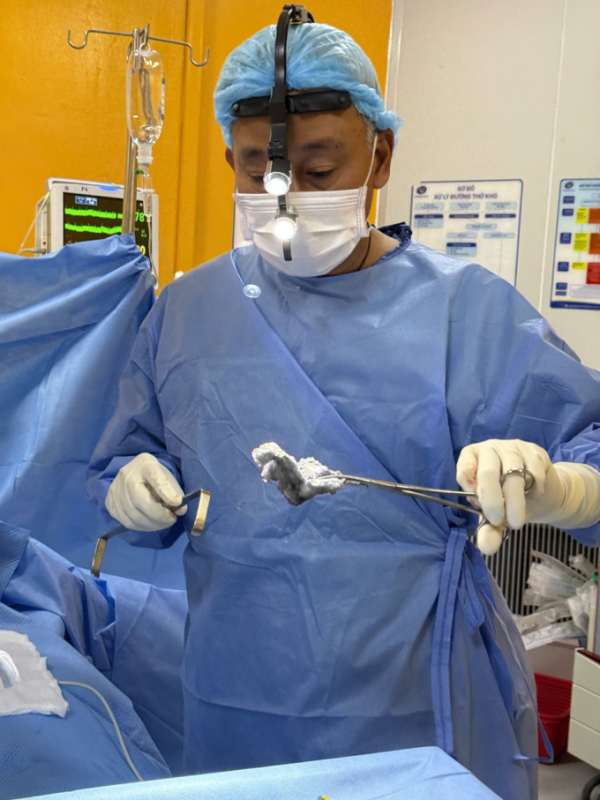
Dr. Ho Cao Vu during a surgery. Photo courtesy of Dr. Vu |
According to Dr. Vu, use of the ultrasonic scalpel also reduced bleeding and fluid accumulation, allowing the patient to recover without postoperative drainage.
One notable outcome was the disappearance of the patient’s shoulder pain after surgery.
Prior to the procedure, she had experienced persistent left shoulder pain and difficulty moving her arm despite undergoing physiotherapy treatment.
Dr. Vu said the retained gauze had likely caused chronic inflammation in the lateral breast and armpit region, resulting in referred pain that resembled musculoskeletal neck and shoulder problems.
Following surgery, the patient reported relief from shoulder pain and regained normal arm movement.
Dr. Vu advised patients experiencing symptoms after breast augmentation — including breast firmness, deformity, or unexplained pain in the breast, armpit, or shoulder area — to seek evaluation from specialists in reconstructive and cosmetic breast surgery, even if imaging results appear normal.
He noted that fibrotic foreign bodies such as gossypiboma may not always be clearly visible on ultrasound, but experienced surgeons may still identify abnormal signs through clinical examination and recommend timely treatment.
-
3 Things The Most Intelligent Person In The Room Is Almost Always Doing

-
3 Zodiac Signs Feel Immense Happiness Starting On May 19, 2026

-
Singapore’s beloved Cantonese restaurant to close after 100 years

-
Will all be well in your life on Tuesday? read horoscope

-
Atonemo Streamplayer Launches in India to Modernize Old Speakers