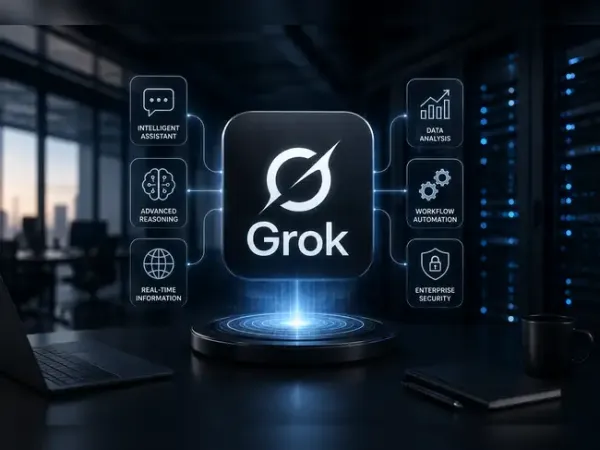
The AI industry is moving past a phase where bigger and smarter models solely defined success. The approach of companies these days is much more practical where scalability, deployment efficiency, operational costs, and real-world usability are becoming just as important as benchmark performance.
That shift in thinking is one of the key reasons Grok 4.3 is beginning to attract attention across the AI ecosystem.
Recently launched by xAI and highlighted by Abacus AI, Grok 4.3 is being positioned as a model that combines strong reasoning capabilities with significantly lower operational costs compared to several premium AI systems.
Rather than competing only on raw intelligence, the model appears designed for practical enterprise deployment and large scale AI workflows.
This matters because the economics of AI are becoming increasingly difficult to ignore. Running AI systems across customer support, coding workflows, research operations, and enterprise automation requires substantial computing infrastructure.
As organisations deploy AI agents capable of handling multi-step tasks autonomously, infrastructure costs can rise rapidly. In such an environment, a model that offers reliable performance at lower inference costs can often become more valuable than one focused purely on benchmark dominance.
Another major reason behind interest in Grok 4.3 is its ability to process large volumes of information in a single interaction.
Businesses today increasingly require AI systems capable of analysing long reports, contracts, datasets and extensive code repositories without losing context midway. Larger context windows help AI systems handle more information at once, improving workflow continuity and reducing the need for complex retrieval systems in the background.
The model also reflects a broader transition taking place within AI itself.
The industry is steadily moving beyond chatbots towards more agentic systems capable of independently executing tasks. From enterprise copilots and coding assistants to workflow automation platforms, organisations now expect AI systems to reason through complex processes, interact with tools, and generate structured outputs.
Grok 4.3 appears to align closely with these evolving demands. At the same time, the rollout has not been without criticism. Some users have raised concerns around conversational refinement, stability and reliability.
Despite these debates, the larger significance of Grok 4.3 remains difficult to ignore. It reflects a broader market shift, one where the future of AI may ultimately belong not only to the smartest systems, but also to the ones businesses can realistically afford to deploy at scale.
Nominate now for ET AI Awards 2026
That shift in thinking is one of the key reasons Grok 4.3 is beginning to attract attention across the AI ecosystem.
Recently launched by xAI and highlighted by Abacus AI, Grok 4.3 is being positioned as a model that combines strong reasoning capabilities with significantly lower operational costs compared to several premium AI systems.
Rather than competing only on raw intelligence, the model appears designed for practical enterprise deployment and large scale AI workflows.
This matters because the economics of AI are becoming increasingly difficult to ignore. Running AI systems across customer support, coding workflows, research operations, and enterprise automation requires substantial computing infrastructure.
As organisations deploy AI agents capable of handling multi-step tasks autonomously, infrastructure costs can rise rapidly. In such an environment, a model that offers reliable performance at lower inference costs can often become more valuable than one focused purely on benchmark dominance.
Another major reason behind interest in Grok 4.3 is its ability to process large volumes of information in a single interaction.
Businesses today increasingly require AI systems capable of analysing long reports, contracts, datasets and extensive code repositories without losing context midway. Larger context windows help AI systems handle more information at once, improving workflow continuity and reducing the need for complex retrieval systems in the background.
The model also reflects a broader transition taking place within AI itself.
The industry is steadily moving beyond chatbots towards more agentic systems capable of independently executing tasks. From enterprise copilots and coding assistants to workflow automation platforms, organisations now expect AI systems to reason through complex processes, interact with tools, and generate structured outputs.
Grok 4.3 appears to align closely with these evolving demands. At the same time, the rollout has not been without criticism. Some users have raised concerns around conversational refinement, stability and reliability.
Despite these debates, the larger significance of Grok 4.3 remains difficult to ignore. It reflects a broader market shift, one where the future of AI may ultimately belong not only to the smartest systems, but also to the ones businesses can realistically afford to deploy at scale.
Nominate now for ET AI Awards 2026
Disclaimer Statement: This content is authored by a 3rd party. The views expressed here are that of the respective authors/ entities and do not represent the views of Economic Times (ET). ET does not guarantee, vouch for or endorse any of its contents nor is responsible for them in any manner whatsoever. Please take all steps necessary to ascertain that any information and content provided is correct, updated, and verified. ET hereby disclaims any and all warranties, express or implied, relating to the report and any content therein.