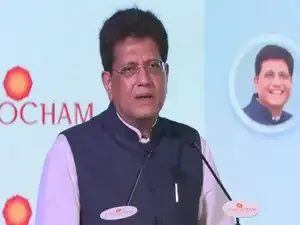
New Delhi: India should use global uncertainty to accelerate reforms, strengthen supply chains and deepen engagement with the world, according to Union Commerce and Industry Minister Piyush Goyal, who framed current geopolitical risks as a chance to build resilience and drive competitiveness.
Addressing a session at the Associated Chambers of Commerce and Industry of India (ASOCHAM) on Tuesday on ease of doing business, the Union Minister said the government was working to make India a trusted partner for investment and exports as the country advanced toward Viksit Bharat 2047.
"I have absolutely no doubt that we will convert the current situation and the risks associated with the geopolitics around the world into an opportunity for faster reform, into preparing ourselves for greater resilience, make our supply chains stronger," Goyal said. The minister added that "India and Prime Minister Modi have never let a crisis go by," stressing that tough times brought out the best in business.
Goyal highlighted that 38 countries across nine free trade agreements were now opening up, but warned that FTAs were a two-way street. "Unless businesses encash the opportunity for inviting investments and promoting exports, you can jolly well land up with a situation where more imports come in and we don't take the benefit of the open markets," he said.
The minister noted that India was a competitive manufacturer and service provider, and that productive imports like data centres and precision capital goods were enablers for growth. The focus, he said, must be on boosting exports of value-added products in automobiles, electronics, consumer goods and agro-based sectors.
On industrial infrastructure, Goyal said the government had consulted stakeholders to identify locations for 100 new industrial parks under BHAVYA, with 20 parks already under development. He supported the idea of a single body at each park as a one-stop shop for all approvals and urged the private sector to engage more actively with the National Single Window System.
Addressing the West Asia crisis, he said, "We don't need to panic. We need to be smart." Citing lessons from COVID, he pointed to the rapid rise of 1,800 plus Global Capability Centres creating two million direct and 10 million indirect jobs. "Our IT industry... is aspiring to be a trillion dollars in the next 10 years. It's very much eminently doable," he said, adding that Indian talent was best placed to convert AI platforms into applications.
Goyal said India was enabling data centre growth with low-cost data, renewable energy, a strong national grid and 100% tax-free status until 2047 for cloud services exported from India. These investments, he said, would create a virtuous cycle across real estate, talent, equipment and the wider ecosystem, powering India's economy forward.
Addressing a session at the Associated Chambers of Commerce and Industry of India (ASOCHAM) on Tuesday on ease of doing business, the Union Minister said the government was working to make India a trusted partner for investment and exports as the country advanced toward Viksit Bharat 2047.
"I have absolutely no doubt that we will convert the current situation and the risks associated with the geopolitics around the world into an opportunity for faster reform, into preparing ourselves for greater resilience, make our supply chains stronger," Goyal said. The minister added that "India and Prime Minister Modi have never let a crisis go by," stressing that tough times brought out the best in business.
Goyal highlighted that 38 countries across nine free trade agreements were now opening up, but warned that FTAs were a two-way street. "Unless businesses encash the opportunity for inviting investments and promoting exports, you can jolly well land up with a situation where more imports come in and we don't take the benefit of the open markets," he said.
The minister noted that India was a competitive manufacturer and service provider, and that productive imports like data centres and precision capital goods were enablers for growth. The focus, he said, must be on boosting exports of value-added products in automobiles, electronics, consumer goods and agro-based sectors.
On industrial infrastructure, Goyal said the government had consulted stakeholders to identify locations for 100 new industrial parks under BHAVYA, with 20 parks already under development. He supported the idea of a single body at each park as a one-stop shop for all approvals and urged the private sector to engage more actively with the National Single Window System.
Addressing the West Asia crisis, he said, "We don't need to panic. We need to be smart." Citing lessons from COVID, he pointed to the rapid rise of 1,800 plus Global Capability Centres creating two million direct and 10 million indirect jobs. "Our IT industry... is aspiring to be a trillion dollars in the next 10 years. It's very much eminently doable," he said, adding that Indian talent was best placed to convert AI platforms into applications.
Goyal said India was enabling data centre growth with low-cost data, renewable energy, a strong national grid and 100% tax-free status until 2047 for cloud services exported from India. These investments, he said, would create a virtuous cycle across real estate, talent, equipment and the wider ecosystem, powering India's economy forward.