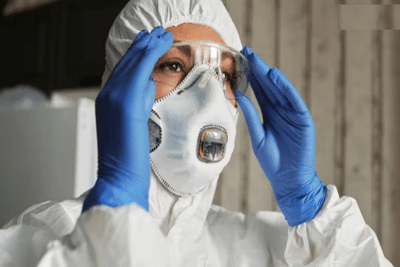
Emergency Health Response: After COVID, the world thought that now the preparations to deal with the next pandemic would be better than before, but the new report has once again increased the concern.

How prepared is the world for the next pandemic?
Is The World Ready For The Next Pandemic? After COVID-19, the world thought it would be better prepared to deal with the next pandemic, but a new report has raised concerns once again. Amid new Ebola outbreaks in parts of Central Africa, as well as the growing threat of diseases like hantavirus, monkeypox, and bird flu, a global report has warned that the world is becoming more vulnerable to future pandemics.
The risk of infection is increasing rapidly worldwide.
According to a report by the Global Preparedness Monitoring Board, an independent organization supported by the World Health Organization and the World Bank, the threat of infectious diseases is increasing more rapidly than ever before. The report stated that countries and health systems are less able to recover from epidemics than they were in the past ten years. This warning comes at a time when the World Health Organization has declared a new Ebola outbreak in the Democratic Republic of the Congo and Uganda an international public health emergency. This time, the emergence of the lesser-known Bundibugyo strain of Ebola has further increased concerns.
Why is the risk of infection spreading rapidly?
The report, "A World on the Edge: Priorities for a Pandemic-Resilient Future," released during the 79th World Health Assembly, stated that investments in pandemic preparedness are falling far short of rapidly evolving threats. According to the report, rising geopolitical tensions, environmental degradation related to climate change, increasing global mobility, and declining international development funding are undermining world health security.
What were the points discussed in the report?
The report reviewed major health emergencies such as the 2014-16 and 2019-20 Ebola outbreaks, COVID-19, and monkeypox. It found that while new health systems and plans were created after COVID, global capacity to respond to pandemics remains highly unequal. The most worrying issue was access to vaccines and medicines. According to the report, the monkeypox vaccine took nearly two years to reach poor countries, a delay even longer than the COVID vaccine. The board warned that the world is regressing in equitable access to vaccines, testing, and treatment.
The report also stated that pandemics are no longer just health crises, but are also impacting democratic institutions and public trust. Both COVID and Ebola saw political polarization, attacks on scientific institutions, and the rapid spread of misinformation. These effects persist long after the pandemic ends.
-
KKR Restrict Mumbai Indians To Their Lowest First Innings Total Of IPL 2026; Hardik & Co Stutter To 147/8 at Eden Gardens

-
KKR Suffer Injury Scare As Angkrish Raghuvanshi Walks Off; Tejasvi Singh Dahiya Substitutes As Wicket-Keeper

-
'We Deliberated Extensively On Enhancing India-Italy Ties': PM Modi As India, Italy Elevate Partnership
-
Rayan Cherki targets Arsenal: The dazzling creator who could be Manchester City’s secret weapon against Mikel Arteta’s defensive game plan in the Premier League title decider

-
Portugal's 2026 World Cup Squad: Full List of Players Heading to USA, Mexico, and Canada