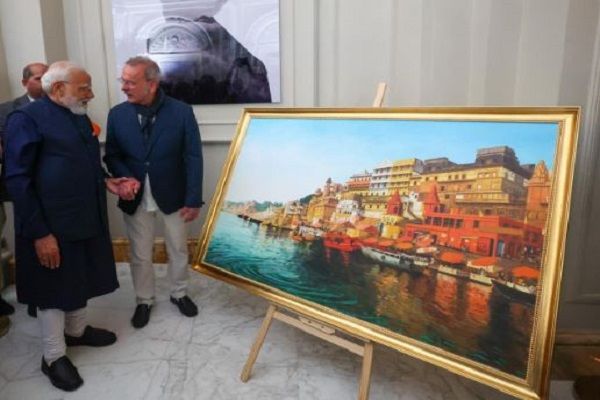
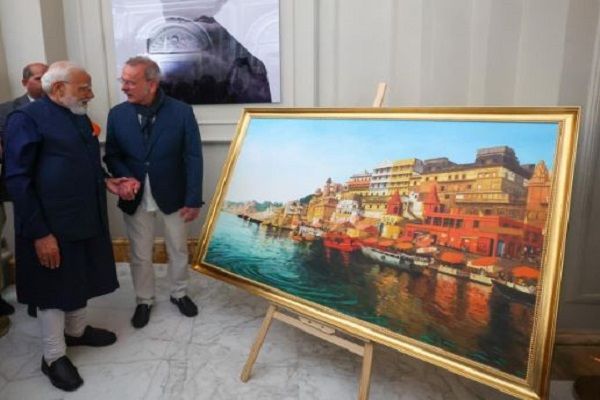
Rome, May 20. A vibrant painting of the Ganga ghats of India’s cultural capital Varanasi became a symbol of cultural friendship between India and Italy when renowned Italian artist Johnpaolo Tommasetti presented it to Prime Minister Narendra Modi in Rome.
Italian artist Johnpaolo described this painting as a ‘bridge’, connecting the Italian artist’s vision and the colorful soul of India. Tohmasetti mentioned the conversation he had with Prime Minister Modi. He said that PM Modi appreciated it and asked about the time taken to create this masterpiece.
Tohmasetti said, ‘I told him that this painting is like a bridge between the Italian artist’s vision and colorful India, and he appreciated it. He asked me how long it took to make, and I said it took about two weeks to make.’
The artist further said that PM Modi praised his work and showed keen interest in his artistic journey linked to the spiritual and cultural heritage of India. The painter said that he studied Indian art and literature from an Italian perspective for years. He said, ‘I found that India is extremely rich in culture, sculptures and paintings. I also studied ancient texts like Bhagavad Gita, Mahabharata and Ramayana and got inspired by them and gave a new dimension to my art.
The Italian artist also explained the techniques used to sculpt the painting. He said this handmade painting depicts the sacred ghats of Varanasi on the banks of Ganga using mixed techniques, such as acrylic colours. “I call it ‘Holi Varanasi.’ It is very colourful, reflecting the vibrant culture of India,” he said.
Earlier, PM Modi praised Tohmasetti’s skills on social media platform X. He said, ‘A glimpse of Kashi in Rome! Johnpaolo Tohmasetti, an Italian painter, presented work based on Varanasi. His enthusiasm for Indian culture is four decades old. In the 1980s, he started as an illustrator for books based on Vedic culture. From 2008 to 2013, he worked on 23 large paintings to Mahabharata.
Johnpaulo Tohmasetti first saw the Mahabharata at the age of 17 through Peter Brook’s theater adaptation, which piqued his interest. After spending about five years studying the Mahabharata, he worked for about 12 years on the main painting project, which continued in various stages. His art travels took him to places like Chitta di Castello and Perugia in Italy and he collaborated with the International Academy of Vedic Arts at Villa Vrindavan.
His notable paintings include Partha-Sarathi (Krishna as Arjuna’s charioteer), Draupadi’s abduction and help of Krishna and Arjuna and Subhadra’s dramatic escape at Dwarka. Other depicted moments include various battle scenes, Krishna’s return to Dwaraka, and Krishna’s insult by Shishupala. These paintings often feature elaborate landscapes, intricate architectural details (such as the idealized Indraprastha), flying creatures, and expressive characters.
-
Ebola outbreak: Major airport begins screening arrivals as experts 'very concerned'
-
Tech world mourns Indian-origin Microsoft veteran Soma
-
Killer's final four-words before being executed for 'especially cruel' murder

-
Jeff Bezos Advocates for Tax Relief for Low-Income Earners Amid Controversy

-
Severe Thunderstorms Trigger Flood Advisory in New York City and New Jersey