The Telangana Public Schools proposal promises better education and infrastructure, but its competitive model may deepen educational inequality and weaken neighbourhood schools
Published Date – 21 May 2026, 12:46 AM
By Adama Srinivas Reddy
The Telangana Education Commission’s proposal to establish Telangana Public Schools (TPS) across the State appears, at first glance, to be a progressive and ambitious intervention in public education. Spacious campuses, laboratories, digital classrooms, transport facilities, sports infrastructure, counselling services, arts education, and inclusive facilities for children with disabilities together create the image of a modern and equitable public school system. The proposal also invokes the long-standing democratic aspiration of a “Common School System.”
Yet beneath this progressive language lies a serious contradiction. The TPS model simultaneously borrows from two opposing educational philosophies: one rooted in equality and universal accessibility, and the other rooted in neoliberal ideas of competition, school choice, and market logic. Unless these contradictions are recognised, the long-term consequences may be damaging not only to government schools but also to the democratic idea of public education itself.
Choice Or Freedom
At the heart of the issue lies a philosophical confusion between “choice” and “freedom.”
For decades, neoliberal educational reforms across the world have argued that parents should have “choice” among schools and that competition would automatically improve quality. This logic transformed education from a social right into a competitive marketplace. Schools began to function like brands competing for consumers. Parents became customers, students became measurable outputs, and education increasingly became a commodity.
However, “choice” is not the same as freedom. Choice without equal access merely benefits those who already possess socialeconomic, linguistic, and cultural advantages. True educational freedom emerges only when every child, irrespective of caste, class, gender, geography, or language background, has access to equally good neighbourhood schools.
The TPS proposal partially recognises this truth. It rightly acknowledges that poor-quality government schools, lack of infrastructure, and uneven access have weakened public confidence in the system. Therefore, it proposes well-equipped public institutions that can rival private schools in quality.
Competitive Framing
But the proposal also repeatedly frames TPS as an “attractive choice” for parents over private schools and ordinary government schools. This framing is crucial because it subtly shifts the purpose of public education from universal provision to competitive positioning.
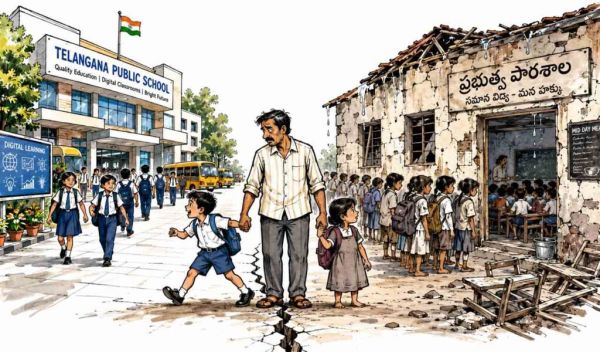
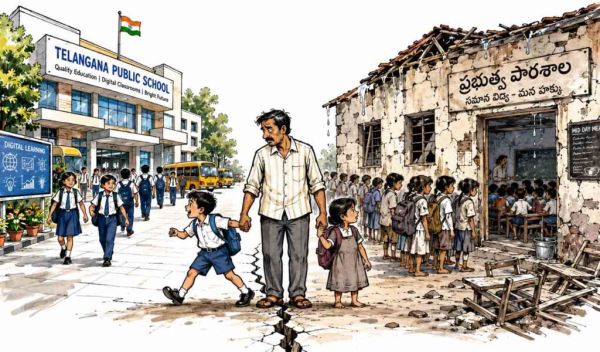
Once education is framed as competition among schools, neoliberal logic quietly enters the public system itself. The danger is not merely theoretical. The proposal effectively creates three parallel schooling options:
- Neighbourhood government schools
- Private schools
- Telangana Public Schools
The TPS campuses, naturally receiving better infrastructure, staffing, transport, and public attention, may gradually emerge as elite islands within the government sector itself. As middle-class aspirations shift towards TPS, ordinary government schools may increasingly be seen as inferior residual institutions meant only for the poorest children.
This has happened in many countries and even within Indian States where “model schools,” “schools of excellence,” or “magnet schools” were introduced. Instead of strengthening the entire public system, governments began selectively investing in a few showcase institutions while neglecting ordinary neighbourhood schools. The most serious long-term danger is that accessible local government schools may slowly disappear.
The TPS proposal argues that it is not forcibly closing schools. Yet the cluster-based model centralises educational resources into large campuses serving multiple villages through transport systems. Over time, declining enrolment in nearby small schools may be used to justify their merger or closure. Once that process begins, education becomes geographically centralised and socially stratified.
If Telangana truly seeks educational freedom rather than selective choice, it must prioritise quality, accessible neighbourhood schooling everywhere
For younger children, especially, neighbourhood schools are not merely educational spaces; they are spaces of emotional familiarity, community participation, and democratic accessibility. Replacing them with distant centralised campuses fundamentally alters the relationship between education and community life.
The irony is that a policy introduced in the name of accessibility may eventually reduce accessibility. The proposal’s transport model itself reflects neoliberal restructuring. Public responsibility for school transport is partially outsourced to local entrepreneurs through subsidised private bus ownership. Similarly, several categories of staff are proposed on contractual arrangements. Such measures indicate that even while the state appears to expand public educationelements of privatisation and market dependency continue to penetrate the system.
Another contradiction emerges in the proposal’s emphasis on English-medium qualifications for teachers. While presented as a quality measure, this risks excluding capable Telugu-medium graduates and reinforcing linguistic hierarchy. The democratic objective of educational equality becomes entangled with aspirational market-oriented English dominance.
Contradictory Claim
Most importantly, the proposal’s claim that TPS will ultimately realise a Common School System appears deeply contradictory.
A genuine Common School System requires the state to ensure uniformly high-quality neighbourhood schools for all children, regardless of social background. It minimises hierarchy among schools and discourages educational segregation. But TPS, by design, creates differentiated public institutions competing for preference and prestige.
Competition among private schools and TPS may certainly intensify. Yet such competition does not necessarily strengthen public education as a whole. Instead, it may deepen educational stratification:
- Elite private schools for the wealthy
- TPS for aspiring lower- and middle-classes
- Weakened residual government schools for marginalised populations
In such a structure, the dream of common schooling becomes increasingly difficult.
The deeper philosophical issue is this: public education cannot be built sustainably through market psychology. Once the language of competition, attractiveness, branding, and parental preference dominates educational thinking, the public system itself begins to imitate private-sector behaviour. The result is not equality but layered inequality.
Critical Question
This does not mean the TPS proposal should be rejected entirely. Its commitment to infrastructure, dignity, inclusion, libraries, sports, arts, counselling, and public investment is important and welcome. The recognition that poor children deserve educational environments equal to elite institutions is itself socially transformative.
But the state must confront a critical question: Should public education create a few high-performing islands, or should it build a universally strong ecosystem?
If Telangana genuinely seeks educational freedom rather than selective educational choice, then the priority should not merely be creating attractive alternative schools. It should guarantee high-quality, accessible neighbourhood schooling everywhere.
Otherwise, the State may unknowingly accelerate the very neoliberal transformation it seeks to resist — a future where public education survives not as a common democratic institution, but as another competitive marketplace.
(The author is a faculty member at Kakatiya Government College (Autonomous), affiliated with Kakatiya University, Hanumakonda, and serves as General Secretary of the Society for Change in Education, Telangana)
-
Mohammed Shami Acquitted By Alipore Court In ₹1 Lakh Cheque Bounce Case Filed By Estranged Wife Hasin Jahan

-
FIFA World Cup 2026: Iran Players Caught In Visa Uncertainty Amid US-Iran Tensions

-
Russian jets 'dangerously' intercept UK aircraft over Black Sea

-
India, South Korea to jointly develop laser weapons, air defence systems
-
Arsenal end 22-year Premier League title drought after Manchester City drop points against Bournemouth