
In many workplaces today, employees are skeptical about whether loyalty is still rewarded. As hiring markets become more competitive, companies are often willing to offer large salaries to attract outside talent while existing workers wait months, sometimes years, for modest raises.
That growing frustration became the focus of a widely shared X post from career counselor Simon Ingari, which presented an apparently fictional conversation between an HR executive and a CEO after a senior employee resigned.
The post described a company losing a longtime employee after he accepted an external job offer. According to the fictional HR character, the employee had repeatedly exceeded expectations but was continually asked to wait for the “next review cycle” when requesting a raise.
The CEO in the conversation argued that external hiring budgets are based on “market pricing.” But the HR executive pointed out that the employee was also part of that same market, and another company recognized his value first.
Also Read: Candidate politely asks HR why his job application was rejected; the answer left him so embarrassed he abruptly disconnected the call
The post further claimed that while the company hesitated to approve a 20% raise for the employee, it was prepared to pay an outside candidate 70% more for the same position.
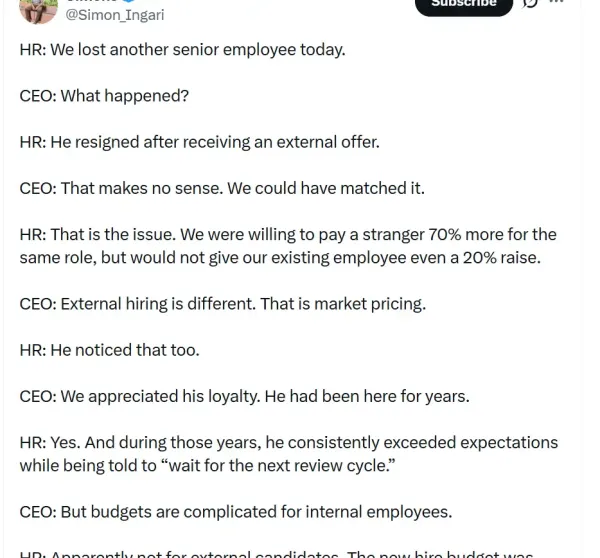
One of the most discussed moments in the post came when the HR executive explained that the employee did not leave solely because of salary.
Instead, ‘he realized loyalty was being rewarded less than leaving.’
The fictional dialogue also highlighted how companies sometimes move faster to approve budgets for external candidates than for internal employees. In the example shared online, the new hire budget was approved within days, while the employee’s raise request remained pending for months.
Less than 24 hours the post got viewed over 1 million times and the reason is many professionals said the scenario felt familiar. Across industries, workers often discuss how switching jobs can lead to bigger salary increases than staying with one employer for years.
Others connected with the emotional side of the story. The post suggested that recognition, respect, and timely appreciation matter as much as compensation.
A key line that resonated with many readers stated that companies sometimes trust “a candidate after a 45-minute interview more than an employee who already proved themselves for five years.”
The discussion also touched on a wider workplace reality: employees increasingly see career mobility as the fastest route to financial growth and professional recognition.
That growing frustration became the focus of a widely shared X post from career counselor Simon Ingari, which presented an apparently fictional conversation between an HR executive and a CEO after a senior employee resigned.
What happened
The post described a company losing a longtime employee after he accepted an external job offer. According to the fictional HR character, the employee had repeatedly exceeded expectations but was continually asked to wait for the “next review cycle” when requesting a raise.
The CEO in the conversation argued that external hiring budgets are based on “market pricing.” But the HR executive pointed out that the employee was also part of that same market, and another company recognized his value first.
Also Read: Candidate politely asks HR why his job application was rejected; the answer left him so embarrassed he abruptly disconnected the call
The post further claimed that while the company hesitated to approve a 20% raise for the employee, it was prepared to pay an outside candidate 70% more for the same position.
Loyal employee leaves after a company rejects 20% raise and the conversation between HR and CEO uncovered unexpected details about corporate workculture.
The turning point
One of the most discussed moments in the post came when the HR executive explained that the employee did not leave solely because of salary.
Instead, ‘he realized loyalty was being rewarded less than leaving.’
The fictional dialogue also highlighted how companies sometimes move faster to approve budgets for external candidates than for internal employees. In the example shared online, the new hire budget was approved within days, while the employee’s raise request remained pending for months.
Why it got viral online
Less than 24 hours the post got viewed over 1 million times and the reason is many professionals said the scenario felt familiar. Across industries, workers often discuss how switching jobs can lead to bigger salary increases than staying with one employer for years.
Others connected with the emotional side of the story. The post suggested that recognition, respect, and timely appreciation matter as much as compensation.
A key line that resonated with many readers stated that companies sometimes trust “a candidate after a 45-minute interview more than an employee who already proved themselves for five years.”
The discussion also touched on a wider workplace reality: employees increasingly see career mobility as the fastest route to financial growth and professional recognition.