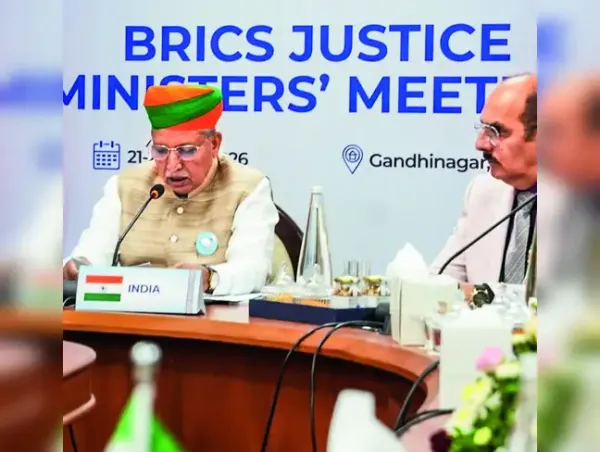
New Delhi: BRICS is working on updating its counter-terror strategy amid fresh challenges, including terror financing, money laundering, and cyber threats linked to international terrorism.
The BRICS Counter-Terrorism Working Group is currently meeting here, with discussions focused on updating the group's counter-terror strategy, ET has reliably learnt.
The 11-member grouping will brainstorm on a range of issues, including information sharing, cyber threats by extremist groups, FATF, and money laundering, among other challenges, it has been further learnt.
Also Read: India’s BRICS presidency: Beyond trade and investment narratives
The BRICS counter-terror track is currently co-led by Russia and Indonesia, both of which have extended support to India's concerns over cross-border terrorism and terror infrastructure. While Moscow has historically backed India's position on cross-border terrorism, Indonesia has also expressed reservations over Pakistan's position on the Jammu and Kashmir issue in the OIC. It may be recalled that the BRICS Foreign Ministers' meeting held in New Delhi last week adopted a robust counter-terror declaration that acknowledged India's concerns regarding cross-border threats.
The BRICS foreign ministers strongly condemned all acts of terrorism as criminal and unjustifiable, irrespective of their motivation, and regardless of where, when, or by whom they are committed - seen as a vindication of India's stand. They also condemned the terrorist attack in Jammu and Kashmir in April last year, which claimed 26 lives and injured several others.
"They reaffirmed their commitment to combating terrorism in all its forms and manifestations, including the cross-border movement of terrorists, terrorism financing, and safe havens. They reiterated that terrorism should not be associated with any religion, nationality, civilization, or ethnic group, and that all those involved in terrorist activities and their support networks must be held accountable and brought to justice in accordance with relevant national and international law. They urged zero tolerance towards terrorism and rejected double standards in countering terrorism," according to the chair's summary and outcomes issued by India at the end of the foreign ministers' meeting.
The reference to the 2025 terror attack in Jammu and Kashmir in the chair's summary, endorsed by all foreign ministers, also indicated that China did not object to India's efforts to include a mention of the Pahalgam terror attack in the document.
The BRICS foreign ministers stressed that nations bear the primary responsibility for combating terrorism, and that global efforts to counter terrorist threats must fully comply with obligations under international law, including the UN Charter and relevant international conventions and protocols, particularly international human rights law, international refugee law, and international humanitarian law, where applicable.
The foreign ministers also welcomed the activities of the BRICS Counter-Terrorism Working Group and its five subgroups, guided by the BRICS Counter-Terrorism Strategy, the BRICS Counter-Terrorism Action Plan, and the CTWG position paper. They expressed hope for deeper counter-terror cooperation and called for the early finalisation and adoption of the Comprehensive Convention on International Terrorism within the UN framework.
The BRICS Counter-Terrorism Working Group is currently meeting here, with discussions focused on updating the group's counter-terror strategy, ET has reliably learnt.
The 11-member grouping will brainstorm on a range of issues, including information sharing, cyber threats by extremist groups, FATF, and money laundering, among other challenges, it has been further learnt.
Also Read: India’s BRICS presidency: Beyond trade and investment narratives
The BRICS counter-terror track is currently co-led by Russia and Indonesia, both of which have extended support to India's concerns over cross-border terrorism and terror infrastructure. While Moscow has historically backed India's position on cross-border terrorism, Indonesia has also expressed reservations over Pakistan's position on the Jammu and Kashmir issue in the OIC. It may be recalled that the BRICS Foreign Ministers' meeting held in New Delhi last week adopted a robust counter-terror declaration that acknowledged India's concerns regarding cross-border threats.
The BRICS foreign ministers strongly condemned all acts of terrorism as criminal and unjustifiable, irrespective of their motivation, and regardless of where, when, or by whom they are committed - seen as a vindication of India's stand. They also condemned the terrorist attack in Jammu and Kashmir in April last year, which claimed 26 lives and injured several others.
"They reaffirmed their commitment to combating terrorism in all its forms and manifestations, including the cross-border movement of terrorists, terrorism financing, and safe havens. They reiterated that terrorism should not be associated with any religion, nationality, civilization, or ethnic group, and that all those involved in terrorist activities and their support networks must be held accountable and brought to justice in accordance with relevant national and international law. They urged zero tolerance towards terrorism and rejected double standards in countering terrorism," according to the chair's summary and outcomes issued by India at the end of the foreign ministers' meeting.
The reference to the 2025 terror attack in Jammu and Kashmir in the chair's summary, endorsed by all foreign ministers, also indicated that China did not object to India's efforts to include a mention of the Pahalgam terror attack in the document.
The BRICS foreign ministers stressed that nations bear the primary responsibility for combating terrorism, and that global efforts to counter terrorist threats must fully comply with obligations under international law, including the UN Charter and relevant international conventions and protocols, particularly international human rights law, international refugee law, and international humanitarian law, where applicable.
The foreign ministers also welcomed the activities of the BRICS Counter-Terrorism Working Group and its five subgroups, guided by the BRICS Counter-Terrorism Strategy, the BRICS Counter-Terrorism Action Plan, and the CTWG position paper. They expressed hope for deeper counter-terror cooperation and called for the early finalisation and adoption of the Comprehensive Convention on International Terrorism within the UN framework.