What is 'kheer' Called in English: The surprising meaning behind India's favourite dessert
ETimes | May 23, 2026 12:39 AM CST
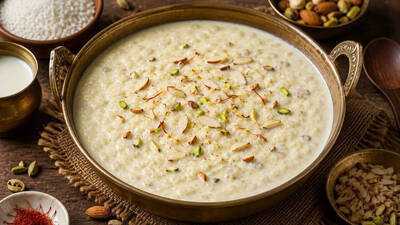
There is a moment in many Indian homes when milk is left to simmer longer than usual. The kitchen smells faintly of cardamom and toasted nuts. Someone checks the pot every few minutes, and the rice slowly softens into the milk until the mixture thickens almost by itself. That dish is kheer . Outside India, it is generally translated as rice pudding , which is technically correct but still feels slightly incomplete. The English phrase explains the ingredients, though not entirely the place the dessert occupies in daily life, ritual, and memory. Kheer appears at temple offerings, family gatherings, festival meals, and ordinary dinners where something sweet is made without much ceremony. The dish changes shape from region to region, yet the idea behind it stays recognisable.
“Kheer” meaning in English: The answer is more interesting than you think
The comparison makes sense because several cultures have their own versions of milk-based rice desserts. Still, Indian kheer usually carries a different flavour profile from European-style rice puddings. Cardamom, saffron, rose water and ghee often appear in the recipe, along with almonds, pistachios or cashews added near the end. The texture can also vary. Some households prefer it loose and pourable, others reduce the milk until the spoon stands almost upright.
Regional varieties of kheer across India
The word “kheer” is widely used in North India, though the dish exists under several names elsewhere. In South India, it is often called payasam . Bengal has payesh. Phirni , another close relative, uses ground rice instead of whole grains and is usually served chilled. Even the grain changes depending on the household or region. Vermicelli, sabudana and broken wheat are sometimes used in place of rice. Certain festive versions include coconut milk, especially in coastal areas, while others become richer through condensed milk or slow reduction over wood fires. Because of these variations, translating kheer into a single English term can flatten the differences between recipes that are culturally distinct from one another. Rice pudding explains the category, not necessarily the identity.
Kheer and its place in Indian traditions and rituals
Kheer has been tied to religious customs in India for centuries. Historical references to milk-and-rice preparations appear in old Sanskrit texts and temple traditions. In many temples, sweet milk dishes are still distributed as prasad after worship. Some families prepare kheer on birthdays, anniversaries or during fast-breaking rituals rather than as an everyday dessert.
There is also a practical side to its ceremonial use. The ingredients are simple, widely available and inexpensive enough to prepare in large quantities. Milk, rice and sugar could be stretched to feed many people, which helped the dish travel across communities and regions over time.
Accounts connected to temple traditions in Kerala and older Indian scriptures are frequently cited in discussions about the dessert’s origins.
How to make traditional kheer at home with milk, rice and cardamom
Key ingredients used:
Recipe to make the traditional kheer at home:
“Kheer” meaning in English: The answer is more interesting than you think
The comparison makes sense because several cultures have their own versions of milk-based rice desserts. Still, Indian kheer usually carries a different flavour profile from European-style rice puddings. Cardamom, saffron, rose water and ghee often appear in the recipe, along with almonds, pistachios or cashews added near the end. The texture can also vary. Some households prefer it loose and pourable, others reduce the milk until the spoon stands almost upright.
Regional varieties of kheer across India
The word “kheer” is widely used in North India, though the dish exists under several names elsewhere. In South India, it is often called payasam . Bengal has payesh. Phirni , another close relative, uses ground rice instead of whole grains and is usually served chilled. Even the grain changes depending on the household or region. Vermicelli, sabudana and broken wheat are sometimes used in place of rice. Certain festive versions include coconut milk, especially in coastal areas, while others become richer through condensed milk or slow reduction over wood fires. Because of these variations, translating kheer into a single English term can flatten the differences between recipes that are culturally distinct from one another. Rice pudding explains the category, not necessarily the identity.
Kheer and its place in Indian traditions and rituals
Kheer has been tied to religious customs in India for centuries. Historical references to milk-and-rice preparations appear in old Sanskrit texts and temple traditions. In many temples, sweet milk dishes are still distributed as prasad after worship. Some families prepare kheer on birthdays, anniversaries or during fast-breaking rituals rather than as an everyday dessert.
There is also a practical side to its ceremonial use. The ingredients are simple, widely available and inexpensive enough to prepare in large quantities. Milk, rice and sugar could be stretched to feed many people, which helped the dish travel across communities and regions over time.
Accounts connected to temple traditions in Kerala and older Indian scriptures are frequently cited in discussions about the dessert’s origins.
How to make traditional kheer at home with milk, rice and cardamom
Key ingredients used:
- 1 litre of full-fat milk
- ¼ cup basmati rice
- 4–5 tablespoons sugar or grated jaggery
- 3–4 green cardamom pods
- A small pinch of saffron strands
- 8–10 chopped almonds
- 8–10 chopped pistachios or cashews
- 1 teaspoon ghee (optional)
- A few raisins (optional)
Recipe to make the traditional kheer at home:
- The rice is first rinsed properly and soaked for around 15 to 20 minutes. Some people lightly crush the grains before cooking, while others leave them whole for more texture.
- Milk is poured into a heavy-bottomed pan and brought to a gentle boil over medium heat. Once it starts simmering, the soaked rice is added slowly while stirring continuously so the grains do not stick to the bottom.
- The mixture cooks on low heat for around 35 to 45 minutes. During this time, the rice softens, and the milk gradually thickens through slow reduction. Frequent stirring helps prevent a layer from forming on the surface.
- Sugar is added only after the rice becomes fully tender. Crushed cardamom, saffron and chopped nuts are stirred in near the end. Some households also add a spoon of ghee for a richer flavour.
- The finished kheer can be served warm straight from the pot or chilled in the refrigerator for a few hours before serving. As it cools, the texture thickens further, which is why many people add a small splash of milk before eating leftover kheer the next day.
READ NEXT
-
Tulsi Gabbard To Resign As Director Of National Intelligence: Here’s Why

-
UP Admin Goes Digital: 5.41 Lakh Employees Trained Under Mission Karmayogi

-
Angkrish Raghuvanshi RULED Out After Injury; KKR Suffer Big Blow In IPL 2026 Playoffs Race

-
NEET-UG 2026 Paper Leak: CBI Arrests Pune-Based Expert Manisha Havaldar, Accused of Leaking Physics Questions

-
Fake DigiLocker Website Using CISCE Name Detected Online; MeitY Issues Fake Website Alert