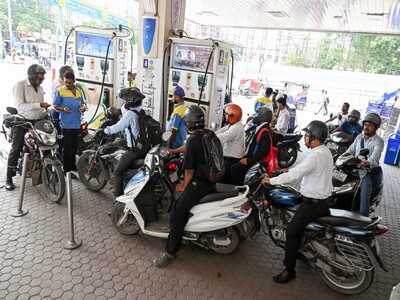
New Delhi, [India] May 23 (ANI): Despite uniform central excise structures across the country, consumer fuel prices continue to vary sharply from one state to another.
The primary driver of this disparity is the differences in Value Added Tax (VAT) and additional local cesses imposed by state governments, with non-BJP and INDIA-bloc ruled states imposing substantially higher levies on retail consumers.
While the central excise duty charged by the Union government remains standard nationwide, the final retail price paid at the pump depends heavily on state-level taxation policies. States governed by the BJP generally witness lower petrol and diesel prices due to moderate VAT rates and fewer additional levies.
In contrast, several non-BJP and INDIA-bloc ruled states have implemented higher VAT structures, road cesses, and social security levies, resulting in significantly higher costs for ordinary citizens.
Following recent price revisions by oil marketing companies (OMCs), opposition and regional bloc strongholds like Andhra Pradesh, Telangana, and Kerala remain among the costliest places in India to purchase fuel.
In Andhra Pradesh and Telangana, Petrol retails at around ₹116 per litre, driven by steep state taxes. Andhra Pradesh, for instance, levies a 31% VAT alongside an additional ₹4 per litre fee and a road development cess, pushing the effective tax burden close to 35%.
In Keralam, prices have soared above ₹113 per litre in several cities, heavily impacted by the state government's decision to maintain a high base VAT and an additional social security cess.
Conversely, some of the lowest petrol prices are recorded in BJP-ruled states like Gujarat, Uttar Pradesh, and Haryana. In these territories, petrol prices consistently hover between ₹95-98 per litre due to moderate state tax brackets and an absence of heavy local cesses. Delhi, Goa, and Assam also maintain comparatively lower consumer prices.
The sharp variation in pump prices across states is driven almost entirely by the distinct VAT policies adopted by respective state governments rather than by the Centre's uniform excise policy.
The stark regional differences have taken centre stage following cumulative fuel price revisions enacted by OMCs. Driven by rising global crude oil prices linked to escalating geopolitical tensions in West Asia, domestic petrol prices increased by ₹4.74 per litre and diesel by ₹4.82 per litre.
To buffer the domestic economy from these international supply-side shocks, the Union government intervened with systemic excise cuts, dropping its central collection margins. However, because state-level VAT is computed as an ad valorem percentage on top of base operational costs, the final retail price paid by ordinary citizens remains heavily dictated by local cabinets.
The Union government has repeatedly stepped in to lower its share of taxation to provide consumer relief. The most sweeping intervention occurred when the Centre slashed domestic excise duties, reducing petrol duty down to just ₹3 per litre and bringing domestic diesel excise duty down to absolute zero.
The most recent major cut came on March 27, 2026, when excise duty on both petrol and diesel was reduced by Rs 10 per litre amid the global energy crisis.
However, major non-BJP and opposition-led states chose not to reduce their corresponding state VAT percentages following the Centre's historic excise cuts. Because state VAT is calculated as a percentage of the base price, the failure to ease local tax margins has meant that consumers in INDIA-bloc and other opposition-led territories continue to pay heavily inflated pump prices, depending entirely on their state of residence. (ANI)
-
Sonu Nigam’s ‘The Revolution’ world tour to kick off in Abu Dhabi

-
Religious conversion is like throwing salt on Sanatan tree: IRS officer

-
Centre offers Article 371-style safeguards, legislative body for Ladakh
-
Five Record-Breaking Moments And Stats From IPL That Still Remain Iconic

-
WWE Star Arrested For Allegedly Beating Up Neighbor Over Elevator Kissing Comment