New Delhi: State-run oil companies raised petrol and diesel prices by about 90 paise per litre on Saturday, while Indraprastha Gas Ltd hiked CNG prices in Delhi and satellite cities by ₹1 per kg.
Over the past nine days, petrol and diesel prices have risen by around ₹5 per litre, while those of CNG are up ₹3 per kg. Higher fuel costs are already feeding into the broader economy, pushing up transport fares as well as milk and food prices.
Oil companies are increasing pump prices to offset a sharp rise in costs after the Iran conflict sent crude oil prices soaring.
Also Read: CNG prices hiked for third time in 10 days, gets costlier by Rs 1 per kg
Retail fuel prices had remained unchanged for about two-and-a-half months after the conflict began, a period that coincided with assembly elections in several states. The first increase came on May 15, when companies raised petrol and diesel prices by ₹3 per litre each. Oil marketing companies (OMCs) had sought an increase of more than ₹10 per litre, but the government did not approve it. Companies instead opted for a series of smaller revisions.
Saturday's increase of 82-95 paise per litre across metro cities marks the third such revision. Actual increases vary across states because of differences in local levies.
The last time companies adopted a similar strategy of incremental revisions was between March 21 and April 6, 2022, when petrol and diesel prices rose by ₹10 per litre within 16 days.
Also Read: IndianOil says no nationwide fuel shortage; supply issues at some outlets 'highly localised'
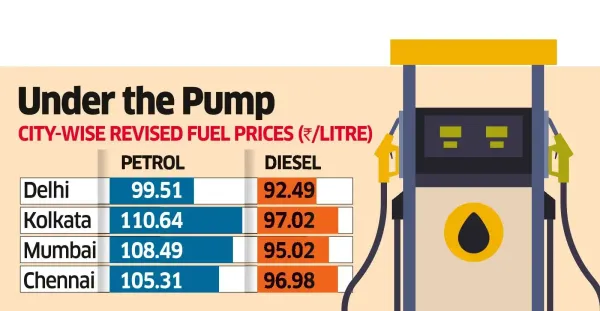
Petrol now costs ₹99.5 per litre in Delhi and ₹108.5 per litre in Mumbai. Diesel prices stand at ₹92.5 per litre in Delhi and ₹95 per litre in Mumbai.
Indian Oil on Saturday said that its petrol and diesel sales rose 14% and 18%, respectively, during May 1-22 over the same period last year.
The state-owned OMC attributed the unusually strong growth to customers shifting away from some private fuel stations, migration of institutional and commercial demand to PSU outlets and a seasonal increase in diesel consumption during the harvesting season. Latest hike comes as Iran conflict pushes up costs for retailers and feeds into inflation.
Over the past nine days, petrol and diesel prices have risen by around ₹5 per litre, while those of CNG are up ₹3 per kg. Higher fuel costs are already feeding into the broader economy, pushing up transport fares as well as milk and food prices.
Oil companies are increasing pump prices to offset a sharp rise in costs after the Iran conflict sent crude oil prices soaring.
Also Read: CNG prices hiked for third time in 10 days, gets costlier by Rs 1 per kg
Retail fuel prices had remained unchanged for about two-and-a-half months after the conflict began, a period that coincided with assembly elections in several states. The first increase came on May 15, when companies raised petrol and diesel prices by ₹3 per litre each. Oil marketing companies (OMCs) had sought an increase of more than ₹10 per litre, but the government did not approve it. Companies instead opted for a series of smaller revisions.
Saturday's increase of 82-95 paise per litre across metro cities marks the third such revision. Actual increases vary across states because of differences in local levies.
The last time companies adopted a similar strategy of incremental revisions was between March 21 and April 6, 2022, when petrol and diesel prices rose by ₹10 per litre within 16 days.
Also Read: IndianOil says no nationwide fuel shortage; supply issues at some outlets 'highly localised'
Petrol now costs ₹99.5 per litre in Delhi and ₹108.5 per litre in Mumbai. Diesel prices stand at ₹92.5 per litre in Delhi and ₹95 per litre in Mumbai.
Pvt Retailers Diverting Demand
Fuel stations operated by private retailers such as Nayara Energy and Shell have kept petrol and diesel prices significantly higher to discourage sales, diverting demand towards state-run outlets.Indian Oil on Saturday said that its petrol and diesel sales rose 14% and 18%, respectively, during May 1-22 over the same period last year.
The state-owned OMC attributed the unusually strong growth to customers shifting away from some private fuel stations, migration of institutional and commercial demand to PSU outlets and a seasonal increase in diesel consumption during the harvesting season. Latest hike comes as Iran conflict pushes up costs for retailers and feeds into inflation.