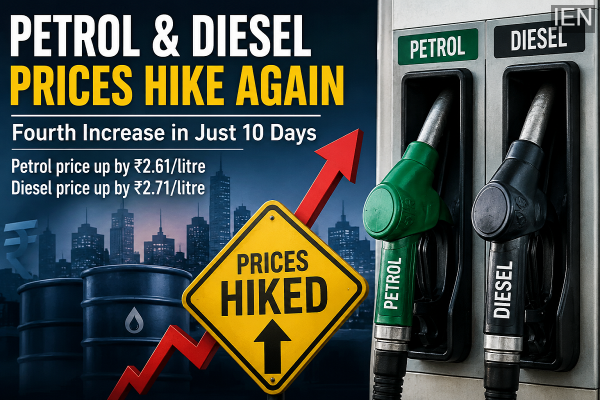
Petrol and diesel prices have increased once again across the country, adding more pressure on household budgets and transportation costs. In the latest revision announced on May 25, fuel rates have been raised for the fourth time within just 10 days, pushing retail prices to their highest levels since 2022.
The continuous surge in fuel prices is being linked to rising crude oil prices in the international market, ongoing geopolitical tensions in West Asia, shrinking refining margins, and the weakening value of the Indian rupee against the US dollar. Public sector oil marketing companies have revised fuel prices upward as global energy costs continue to climb.
Petrol and Diesel Become Costlier Again
According to the latest update, petrol prices have been increased by ₹2.61 per litre, while diesel prices have gone up by ₹2.71 per litre. Following this hike, fuel prices in the national capital Delhi have crossed major psychological levels.
Petrol in Delhi is now retailing at ₹102.12 per litre, while diesel has climbed to ₹95.20 per litre. This marks one of the sharpest short-term increases seen in recent months.
In just 10 days, fuel prices have increased by nearly ₹7.50 per litre across several parts of the country. Earlier, on May 23, petrol prices were raised by 87 paise per litre and diesel by 91 paise per litre.
Latest Petrol Prices in Metro Cities
Here are the updated petrol prices in four major metropolitan cities:
| City | Petrol Price (Per Litre) | Increase |
|---|---|---|
| Delhi | ₹102.12 | +₹2.61 |
| Kolkata | ₹113.51 | +₹2.87 |
| Mumbai | ₹111.21 | +₹2.72 |
| Chennai | ₹107.77 | +₹2.46 |
Latest Diesel Prices in Metro Cities
| City | Diesel Price (Per Litre) | Increase |
|---|---|---|
| Delhi | ₹95.20 | +₹2.71 |
| Kolkata | ₹99.82 | +₹2.80 |
| Mumbai | ₹97.83 | +₹2.81 |
| Chennai | ₹99.55 | +₹2.57 |
Why Are Fuel Prices Rising Repeatedly?
The biggest reason behind the recent increase in petrol and diesel prices is the sharp rise in global crude oil prices amid escalating tensions in West Asia. The ongoing conflict involving Iran, Israel, and the United States has disrupted global energy supply routes and created uncertainty in oil markets.
One of the most crucial global shipping routes for crude oil, the Strait of Hormuz, has reportedly faced major disruptions due to the conflict. This has pushed crude oil prices sharply higher in international markets, increasing the import burden on oil-dependent countries like India.
Reports suggest that global crude oil prices have surged by more than 50 percent since tensions intensified earlier this year.
Apart from geopolitical issues, other factors such as the weakening rupee, reduced refining margins, and increasing transportation costs are also contributing to the rise in fuel rates.
Previous Fuel Price Hikes Added Pressure
This is not the first fuel hike in recent weeks. Earlier on May 15, petrol and diesel prices were increased by nearly ₹3 per litre. Another hike followed on May 19, when rates went up by around 90 paise per litre.
Private fuel retailers had also revised rates earlier this year. In March, Nayara Energy reportedly raised petrol prices by ₹5 per litre and diesel prices by ₹3 per litre.
Despite increasing international oil costs, oil companies had initially avoided passing the entire burden onto consumers. The government had earlier stated that it wanted to shield citizens from inflationary pressure. However, opposition parties alleged that fuel price revisions were delayed until the completion of assembly elections in several states.
Highest Fuel Rates Since 2022
The latest increase has pushed petrol and diesel prices to their highest levels since May 2022. Interestingly, ahead of the 2024 Lok Sabha elections, fuel prices had been reduced by ₹2 per litre in an attempt to provide relief to consumers.
Before the current series of hikes, the last major increase in fuel prices had taken place in April 2022.
Government Calls for Controlled Spending
With rising energy costs putting pressure on India’s economy and foreign exchange reserves, the government has urged citizens to use fuel more carefully. Prime Minister Narendra Modi has reportedly appealed to people to reduce unnecessary fuel consumption, postpone non-essential foreign travel, and avoid excessive spending on imported commodities such as gold.
Several state governments have also started implementing cost-control measures by limiting official travel, reducing meetings, and operating departments with fewer resources.
Experts believe that if global crude oil prices remain elevated, consumers may continue to face pressure in the coming weeks, especially in transportation, logistics, and daily household expenses.
-
Politics News- India-America relations will be strengthened, this deal will be sealed
-
Eid al-Adha: Goats for Qurbani fall ill amid intense heatwave in UP

-
Terror Tech: American GoPro in Pahalgam, ChatGPT in Delhi blast! How did terrorists get high-tech power? | nia-probe-reveals-terrorists-used-us-cameras-in-pahalgam-and-ai-for-delhi-blast

-
KKR vs DC Highlights: Kuldeep’s Magic ENDS KKR’s Playoff Dream! IPL 2026 Playoff Race

-
‘Only in India’: Foreigner Praises Dehradun Police After Lost Bag Returned During Rishikesh Trip