

Listen to this article in summarized format
Loading...
××
Subscribe to

Unlock AI Briefing and Premium Content
New Year Offer 24 Hours Left
Subscribe NowAlready a member? Sign In
What's Included
- Exclusive Stories
- Daily ePaper Access
- Smart Market Tools
- Curated Investment Ideas
- Ad-lite Experience
Subscription

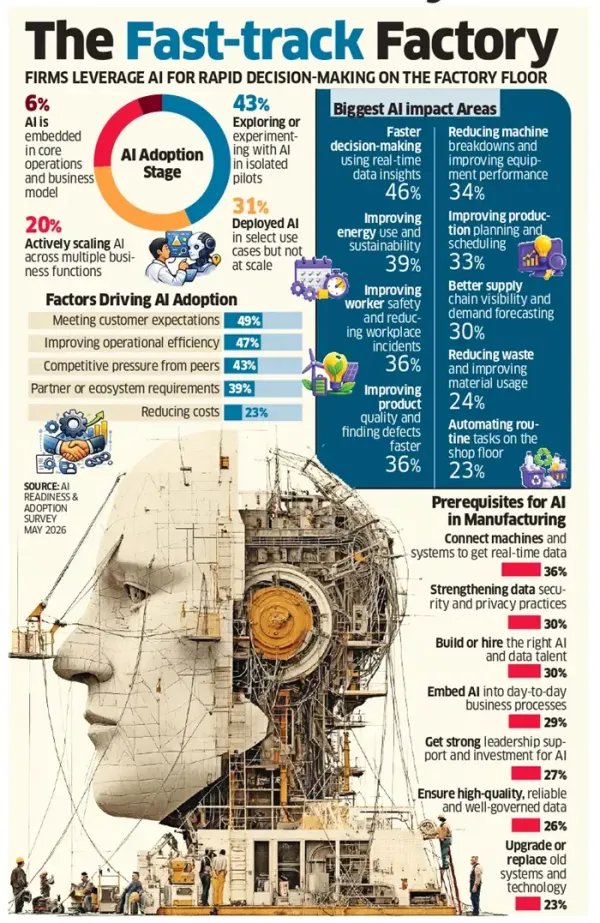
Manufacturers are co-opting AI as an engine for growth and faster decision-making rather than a tool for slashing costs, according to the AI Readiness & Adoption Survey conducted by Cisco in collaboration with The Economic Times.
The survey, for which 70 CXOs from manufacturing firms were interviewed, found that meeting customer expectations (49%) and boosting operational efficiency (47%) were the primary forces driving AI adoption. However, cost reduction, often touted as a top reason for AI adoption in enterprises, ranked last at just 23%. Instead of slashing the workforce, manufacturers are chasing real-time data insights (46%) and improving product quality/defect detections (36%) to speed up factory-floor decision-making and overall efficiency.
“Rather than isolated automation investments, manufacturers are building intelligent systems where data flows seamlessly between machines, operators, and enterprise applications, enabling real-time decisions, improving worker safety, and driving more sustainable operations at scale,” Himani Agrawal, Chief Operating Officer, Microsoft India and South Asia, told ET. She said manufacturers were moving decisively from experimentation to scaled deployment of AI, with the fastest adoption seen across automotive, industrials, and energy-intensive sectors.
“Global industrial leaders like ABB are using AI to unify operational data and enable predictive insights at scale, while Indian enterprises such as the Mahindra Group are applying AI across both customer engagement and core operations,” Agrawal added. “What is also emerging strongly is agentic AI, where systems can reason and act across workflows, enabling manufacturers to move from insights to execution at scale.”
German luxury carmaker Mercedes-Benz is using AI and future technologies in every aspect from product development and production to internal processes.
 “AI is being directly deployed into production, making it intuitive, accessible and usable for everyone,” Santosh Iyer, Managing Director and CEO, Mercedes-Benz India, said. “AI-supported virtual assistants analyse complex data in real time and instead of laborious, manual root-cause analysis, the engineers now rely on AI agents from a virtual data-science team. These AI agents quickly and reliably analyse available data, identify patterns, and offer comprehensive analysis and solutions resulting in higher efficiency in production.”
For Danish multinational Danfoss, AI has been most effective in prototyping, simulations, software testing and coding, where AI accelerates new product development cycles. Other impact areas include waste reduction of both material and time, as well as enhanced worker productivity and safety.
“Industry 4.0/AI enabled production lines are delivering 15-20% higher productivity,” Ravichandran Purushothaman, President, Danfoss India, said. “In the supply chain environment, an operator on a machine without digitalisation was a bit blindfolded. Today, they have got a lot of meaningful data that can help them take action.”
Industrial-to-services conglomerate RPG Group too said that AI and generative AI have delivered a measurable impact across the group, with around 28% energy savings in manufacturing to 25% faster supply chains and accelerated product engineering and innovation.
“Generative AI and AI is driving end-to-end value across the RPG Group, with the strongest impact in manufacturing efficiency, supply chain agility, engineering and R&D,” said Amol Deshpande, the company’s Chief Digital Officer & Head of Innovation. He added that with over 1,000 IoT sensors and AI-led analytics, RPG Group has shifted to proactive maintenance in many cases, reducing downtime and improving asset reliability at scale.
This article is part of the AI Vantage series, developed in partnership with Cisco.
The survey, for which 70 CXOs from manufacturing firms were interviewed, found that meeting customer expectations (49%) and boosting operational efficiency (47%) were the primary forces driving AI adoption. However, cost reduction, often touted as a top reason for AI adoption in enterprises, ranked last at just 23%. Instead of slashing the workforce, manufacturers are chasing real-time data insights (46%) and improving product quality/defect detections (36%) to speed up factory-floor decision-making and overall efficiency.
“Rather than isolated automation investments, manufacturers are building intelligent systems where data flows seamlessly between machines, operators, and enterprise applications, enabling real-time decisions, improving worker safety, and driving more sustainable operations at scale,” Himani Agrawal, Chief Operating Officer, Microsoft India and South Asia, told ET. She said manufacturers were moving decisively from experimentation to scaled deployment of AI, with the fastest adoption seen across automotive, industrials, and energy-intensive sectors.
“Global industrial leaders like ABB are using AI to unify operational data and enable predictive insights at scale, while Indian enterprises such as the Mahindra Group are applying AI across both customer engagement and core operations,” Agrawal added. “What is also emerging strongly is agentic AI, where systems can reason and act across workflows, enabling manufacturers to move from insights to execution at scale.”
German luxury carmaker Mercedes-Benz is using AI and future technologies in every aspect from product development and production to internal processes.
For Danish multinational Danfoss, AI has been most effective in prototyping, simulations, software testing and coding, where AI accelerates new product development cycles. Other impact areas include waste reduction of both material and time, as well as enhanced worker productivity and safety.
“Industry 4.0/AI enabled production lines are delivering 15-20% higher productivity,” Ravichandran Purushothaman, President, Danfoss India, said. “In the supply chain environment, an operator on a machine without digitalisation was a bit blindfolded. Today, they have got a lot of meaningful data that can help them take action.”
Industrial-to-services conglomerate RPG Group too said that AI and generative AI have delivered a measurable impact across the group, with around 28% energy savings in manufacturing to 25% faster supply chains and accelerated product engineering and innovation.
“Generative AI and AI is driving end-to-end value across the RPG Group, with the strongest impact in manufacturing efficiency, supply chain agility, engineering and R&D,” said Amol Deshpande, the company’s Chief Digital Officer & Head of Innovation. He added that with over 1,000 IoT sensors and AI-led analytics, RPG Group has shifted to proactive maintenance in many cases, reducing downtime and improving asset reliability at scale.
This article is part of the AI Vantage series, developed in partnership with Cisco.
( Originally published on May 25, 2026 )