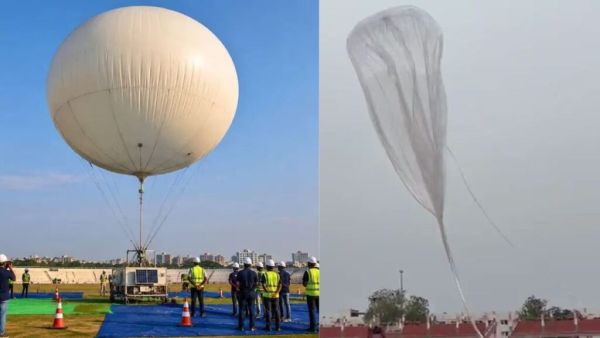
India marked a major milestone in aerospace and near-space technology on Tuesday as Union Civil Aviation Minister Kinjarapu Ram Mohan Naidu participated in the launch of the country’s first indigenous Super Pressure Balloon (SPB) mission by Red Balloon Aerospace in Vijayawada.
The mission, named Mission SANAwas launched from Indira Gandhi Stadium using the company’s high-altitude VISTA platform, placing India among a select group of nations — including the United States, France, Japan and China — with indigenous stratospheric super-pressure balloon capability.
What is a Super Pressure Balloon?
A Super Pressure Balloon is a highly engineered high-altitude balloon designed to operate in the stratosphere, typically between 20 and 40 kilometres above Earth’s surface. Unlike conventional weather balloons that expand and burst as they rise, SPBs maintain a sealed, pressurised shape that allows them to remain stable at a fixed altitude for extended durations.
Experts describe the technology as a bridge between aircraft and satellites. Commercial aircraft generally fly below 12 kilometres, while satellites orbit hundreds of kilometres above Earth. The “near-space” layer in between has remained largely underutilised for decades.
The VISTA platform launched by Red Balloon Aerospace reportedly ascended to nearly 25 kilometres above Earth carrying multiple scientific and commercial payloads from national and international partners.
Why the technology matters
The launch is being viewed as a breakthrough because SPBs can stay airborne for weeks or even months while carrying communication systems, imaging sensors, scientific instruments and surveillance equipment at a fraction of satellite costs.
According to the company, the balloon can support applications including:
- Telecommunications coverage in remote and rural regions
- Disaster monitoring and emergency response
- Earth observation and environmental surveillance
- Navigation validation systems
- Scientific experiments and atmospheric research
- Border and maritime surveillance
- Industrial infrastructure monitoring
At stratospheric altitude, the platform can function like a “tower in the sky,” enabling Non-Terrestrial Network (NTN) connectivity in areas lacking reliable communication infrastructure.
Cost-effective alternative to satellites
One of the biggest advantages of SPBs is cost efficiency. Building and launching satellites can take years and require investments worth millions of dollars. In contrast, super-pressure balloons can be deployed quickly, recovered after missions, upgraded and relaunched.
Red Balloon Aerospace CEO C.V.S. Kiran said the company aims to build a persistent near-space infrastructure layer for India.
“Between the ground and space, there’s an entire domain that has been underutilised,” Kiran said while explaining the project vision.
The mission also carried payloads testing onboard computing systems, propulsion technologies, biological experiment systems and Earth observation sensors. The company stated that all payload missions were completed successfully.
India’s growing private Space-Tech push
The development highlights India’s rapidly expanding private aerospace ecosystem following reforms that opened the space sector to startups and private investment. Companies such as Skyroot Aerospace and AgniKul Cosmos have already made headlines in rocket technology, while Red Balloon Aerospace is now focusing on high-altitude near-space infrastructure.
Founded in 2025, Red Balloon Aerospace reportedly achieved operational commercial flight capability within just eight months, making it one of the fastest near-space platform developments globally.
Strategic importance for India
Analysts believe indigenous SPB technology could eventually support defense operations, weather monitoring, precision agriculture, rural internet connectivity and national disaster response systems. Since the balloons operate closer to Earth than satellites, they can provide higher-resolution imaging and more persistent coverage over a specific region.
The successful launch is being seen as an important step toward India’s ambition to build an independent near-space capability and reduce dependence on expensive foreign technologies.
-
Harry Kane’s Record-Breaking 2025/26 Season: The Numbers Behind His Historic Run

-
Eli Junior Kroupi’s Rise at Bournemouth Sparks Interest from Europe’s Elite

-
FourFourTwo’s Comprehensive Premier League 2025–26 Season Guide

-
‘Baigan dikhra’: Elvish Yadav turns Hyderabadi in London, watch

-
Bobby Deol on working with Alia Bhatt and Ranbir Kapoor