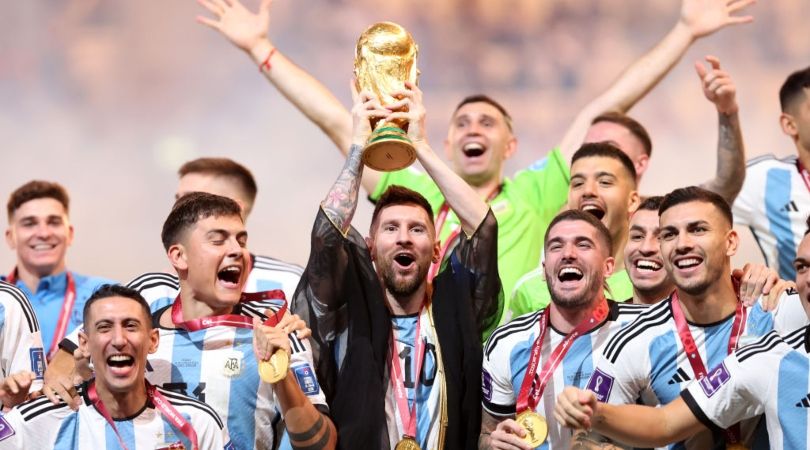
FourFourTwo were at the Lusail Stadium to witness a legend complete his destiny, as Argentina triumphed over France in a truly unforgettable World Cup final.
“Please! Please!” the bus driver pleaded, visibly worried as a group of ecstatic Argentina supporters clambered onto the roof of a moving bus on a Qatari motorway, banging in rhythm to their chants.
FourFourTwo were aboard a public bus heading from the Al Janoub apartment village across Doha to the Lusail Stadium for the grand finale. The buses, free for fans throughout the tournament, were overflowing with Argentina supporters that afternoon, with not a single France fan in sight.
The Albiceleste’s faithful followers had been one of the tournament’s biggest highlights. Outnumbered only by the Mexicans during the group stage, they had dominated the stands thereafter. It was estimated that nearly 40,000 of them had made the trip to Qatar.
Over the week leading up to the final, their makeshift home at Al Janoub had transformed into a vibrant slice of Buenos Aires—complete with giant Maradona banners, all-night barbecues, and impromptu football matches. Even at 6am, chants of “Messi! Messi!” echoed through the complex. For them, there was no wrong time to celebrate their hero.
As they boarded the bus on what could be the most significant day of their lives—many too young to remember Argentina’s last World Cup triumph in 1986—it was clear this journey would be a lively one. “Please, we cannot move until you sit down!” pleaded the staff, but the fans, singing and jumping, were far too excited to listen.
“Come on Argentina, you know that I love you, today you have to win and be first, these crazy fans, leave everything for the cup, the one with Messi and Maradona!” they sang at full volume.
The bus literally bounced along the road. When the staff finally gave up trying to restore order, one supporter grabbed the driver’s microphone to lead the chants. Others popped through the sunroof to wave flags, somehow managing to hold on as the bus swerved through corners. Onlookers watched in amusement as the convoy passed the Al Janoub, Al Thumama, and Khalifa International stadiums on its way to Lusail.
Traffic was unusually heavy on Doha’s highways, as cars flew Argentina flags from their windows. Many locals were heading towards Lusail too—tickets or not—simply to soak in the atmosphere.
Walking down Lusail Boulevard, Qatar’s version of Wembley Way, crowds filled the streets beneath a sky where a formation of aircraft streaked by. Restaurants overflowed, the mood festive but peaceful, unlike the scenes at the Euro 2020 final. Argentina supporters mingled with Qataris, migrant workers waving Indian and Palestinian flags, and the occasional France fan.
It felt like the centre of the world. Few occasions rival the magnitude of a World Cup final—after all, more than a billion people watched the previous one.
Security was noticeably tighter than at earlier Lusail matches, with police cordons ensuring only ticket holders neared the arena and an armoured vehicle stationed nearby just in case.
Kiosks handed out Argentina and France flags, though unsurprisingly, the blue-and-white ones ran out first. Since the start of the tournament, local fans had adopted Argentina as their own, Messi shirts visible everywhere.
This was the writer’s first-ever World Cup final, a dream realised after years of anticipation, and the fifth visit to the magnificent 88,000-capacity Lusail Stadium—whose vastness feels even greater inside. One piece of advice for future visitors: take the lift if you’re heading to the top tier; the climb rivals anything at St James’ Park.
Four of those visits had been to watch Argentina, who had practically made Lusail their home. It seemed a deliberate setup—allowing Asia’s Messi-mad fans to see their idol up close, while giving Argentina familiar surroundings should they reach the final.
That outcome had looked distant 26 days earlier when Saudi Arabia stunned them in their opening match. Messi had given Lionel Scaloni’s men an early lead from the spot, only for the Saudis to stage one of the great World Cup comebacks. Argentina fans, so confident after arriving on a 36-match unbeaten run, left heartbroken. Yet, just as they did after their shock loss to Cameroon in 1990, Argentina recovered—and made it all the way.
After the semi-final win over Croatia, Messi admitted that the Saudi defeat had sharpened their focus—it left no room for error. From then on, they thrived under pressure.
There was chaos along the way: the fiery clash with the Netherlands saw Messi’s clever assist for Nahuel Molina, a Dutch comeback, Leandro Paredes blasting the ball into the opposing bench, and a penalty shootout that nearly erupted into a brawl. Then came Messi’s mesmerising assist against Croatia, when he twisted Josko Gvardiol inside out before setting up Julian Alvarez.
Being in Qatar often felt like stepping into football history. And history was exactly what awaited when Messi’s Argentina met Mbappe’s France.
The nations had met three times before at the World Cup. In 1930, controversy reigned when the referee blew for full-time six minutes early with France through on goal. And in 2018, Mbappe, then 19, scored twice to eliminate Messi’s Argentina en route to glory.
This time, both stars arrived at the peak of their powers. Mbappe, dazzling against Australia in France’s opener and already at nine World Cup goals after his brace against Poland, looked poised to challenge Miroslav Klose’s all-time record. Under Didier Deschamps—himself a world champion as player and manager—France were chasing history. Only Italy (1934, 1938) and Brazil (1958, 1962) had ever retained the title. Mbappe, still only 23, could have joined legends like Pele and Garrincha.
Messi, meanwhile, entered his record 26th World Cup appearance, surpassing Lothar Matthaus. A win would elevate him to the pantheon of Maradona and Pele, and possibly end the debate over who is the greatest of all time.
At 35, in his last World Cup match, it was all or nothing—immortality or an unfillable void. The stakes: the trophy, the golden boot, and an eighth Ballon d’Or. For Qatar-owned PSG, whose two superstars were facing off, it was a dream scenario.
Fans filled the stands well before kickoff. French supporters were more visible than earlier rounds but still vastly outnumbered. Every glimpse of Messi on the big screen drew roars; every French appearance drew whistles. Around three-quarters of the stadium backed Argentina.
Before kickoff, a tribute video honoured football legends who had passed since 2018, culminating with a rousing ovation for Diego Maradona.
Scaloni restored Angel Di Maria to the starting XI, while France, recovering from illness, fielded Raphael Varane, Dayot Upamecano, and Adrien Rabiot. Before the whistle, Olivier Giroud rallied the French fans, but the Argentine chorus drowned them out.
Argentina began strongly. Alexis Mac Allister tested Hugo Lloris from range, while Messi drew cheers every time he touched the ball. Exploiting Mbappe’s lack of defensive cover, Argentina attacked relentlessly down the right.
The breakthrough came on the left, though, when Di Maria outwitted Ousmane Dembele, who then fouled him inside the box. Messi stepped up for his fifth penalty of the tournament. Calm as ever, he waited for Lloris to dive before rolling the ball the other way—his 12th World Cup goal, level with Pele, and his sixth of the tournament.
The stadium exploded. Di Maria embraced Messi, who pointed skyward in celebration. Moments later, the pair combined again in a breathtaking counter-attack—Messi to Alvarez to Mac Allister to Di Maria, who finished clinically to make it 2-0. Lusail shook with joy.
France were in disarray. Deschamps reacted boldly, substituting Dembele and Giroud before halftime for Randal Kolo Muani and Marcus Thuram, pushing Mbappe into the centre-forward role.
Argentina looked in control after the break, Messi nearly adding another. The fans chanted his name, sensing destiny. But football had other plans.
With 10 minutes left, Kolo Muani was tripped by Nicolas Otamendi. Mbappe converted from the spot, then seconds later volleyed home a superb second after a one-two with Thuram. In an instant, France were level, and the world stood stunned.
Extra time followed. The tension was unbearable. Messi scored again, bundling home a rebound after Lautaro Martinez’s shot was saved—his 13th World Cup goal, surpassing Pele. It seemed written.
But then came another twist. A handball by Gonzalo Montiel gifted Mbappe yet another penalty. He completed his hat-trick—the first in a World Cup final since Geoff Hurst in 1966—and matched Pele’s tally of 12 goals, reclaiming the golden boot.
Both sides had chances in the dying seconds—Mbappe almost weaving through for a fourth, Lautaro heading wide. The match had become the most extraordinary final ever witnessed.
In the shootout, both Messi and Mbappe scored. Emiliano Martinez saved Kingsley Coman’s effort, and Aurelien Tchouameni missed. When Montiel converted the winning penalty, the stadium erupted. Messi collapsed in tears of joy as Argentina’s long wait ended.
Nearby, one shirtless fan lay down in pure bliss. It was the perfect embodiment of Messi’s World Cup story—heartbreak, brilliance, resilience, and ultimate triumph.
This was his coronation. His tournament. Lusail should probably be renamed the Lionel Messi Stadium after what he achieved there.
Two years since Maradona’s passing, Argentina had now won Copa America 2021 and the World Cup 2022. “Diego is watching us from heaven,” Messi had said earlier in the tournament. “He’s pushing us.” Indeed, he was. Messi finally matched his idol, and the world witnessed football perfection.
At Lusail Stadium, we saw history written before our eyes. Lionel Messi’s legacy as the greatest of all time was finally complete.
-
Champions League Final Referee Revealed: Arsenal to See Familiar Official for PSG Clash in Budapest

-
Tottenham Hotspur set to finalise first summer signing as Roberto De Zerbi identifies key target
-
Transfer buzz: Liverpool chase Diomande amid Konate contract collapse; Dias considering Man City departure
-
Indonesia U-19 National Team Announces 23-Man Squad for 2026 ASEAN U-19 Championship, Featuring Mathew Baker and Several Overseas Players
-
“Even if the pay packet sounds wild!” Robert Lewandowski linked with a Premier League giant
