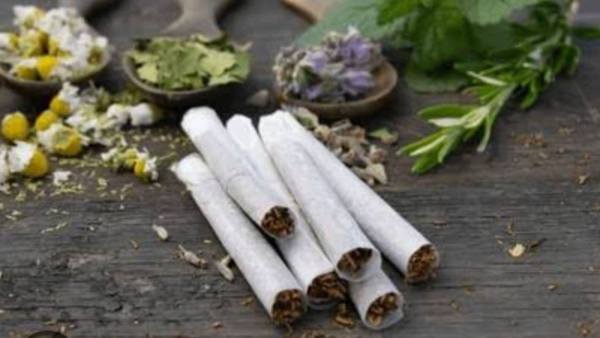
Are you smoking ‘herbal’ cigarettes? Do you think they are safe and a viable alternative to conventional cigarettes?
Then, read this carefully. Herbal cigarettes can be as damaging as tobacco cigarettes, says a study jointly done by the Indian Institute of Technology Gandhinagar in Gujarat and the University of Illinois Urbana-Champaign (UIUC), US.
Herbal cigarettes are widely sold in India and abroad as natural, tobacco-free and even therapeutic alternatives to conventional cigarettes. They produce emissions that can be comparable to or even more damaging than tobacco smoke, the study reported. These cigarettes are also outside of the country’s main tobacco control law.

The study compared emissions from two of India’s best-selling tobacco brands and four popular herbal varieties containing combinations of basil, clove, cinnamon, mint, green tea, water lily, and chamomile. Notably, two of the herbal brands utilised tendu (ebony) leaves as wrappers, identical to those used in bidis, the country’s most widely consumed smoking product.
On the occasion of World No Tobacco Day, observed by the World Health Organization and other stakeholders on May 31, it is imperative to create awareness that herbal cigarettes are not safer than tobacco.
The findings were published in the Journal of Hazardous Materials (https://doi.org/10.1016/j.jhazmat.2026.142424). The paper was co-authored by Alok Kumar Thakur and Sameer Patel from IIT Gandhinagar and P.S. Ganesh Subramanian and Vishal Verma from the University of Illinois, Urbana-Champaign, US.
The research paper presents a comparison of the physical, chemical, and oxidative properties of mainstream (first-hand) smoke from commercially available herbal and tobacco cigarettes in the Indian market.
According to Sameer Patel, “Our findings challenge the widely held belief that tobacco-free means risk-free. Emissions from herbal cigarettes are comparable to or exceed those from tobacco cigarettes on nearly every metric we measured. Leaf-wrapped herbal variants turned out to be the most hazardous of all the samples tested.”
To isolate the emissions, each cigarette was combusted inside a sealed, automated two-chamber rig designed to replicate human inhalation rate. The cigarette emission was funnelled into real-time instruments, and filter samples were collected for physical and chemical characterisation of particles. As a proxy for the potential toxicity of emissions, the oxidative potential of the collected samples was quantified.
A key finding was that sub-500-nanometer particles were emitted at approximately 20 per cent higher concentrations in herbal smoke than in tobacco smoke. These fine particles are increasingly linked to cardiovascular and respiratory disease.
The team also measured a property called ‘Oxidative Potential’ (OP), which quantifies the smoke’s capacity to generate reactive oxygen species, aggressive molecules that drive inflammation, lung tissue remodelling, and the vascular changes underlying heart disease. Particulate matter from herbal cigarettes recorded significantly higher OP than that from tobacco cigarettes.
Tendu-leaf-wrapped variants, in particular, showed OP roughly 49 per cent higher than paper-wrapped versions. Chemical analysis revealed that one herbal cigarette, filled with basil, had the highest lead concentration, despite being marketed as ‘Chemical-free with 100% natural filler for a healthy lifestyle.”
Prof Vishal Verma of Urbana-Champaign said, “That finding is important because many consumers associate nicotine-free products with reduced harm.”
Regulatory Gap
The study also exposes the regulatory gap problem surrounding herbal cigarettes. India’s Cigarettes and Other Tobacco Products Act, 2003 (COTPA) regulates tobacco products through warning labels, advertising restrictions, and public-smoking rules, but products marketed as tobacco-free often fall outside these frameworks. Comparable regulatory gaps exist in several other countries.
According to lead author, Dr Alok Kumar Thakur, several of the herbal cigarettes they tested were marketed with claims of relieving cough, improving sleep or easing anxiety. “However, there is limited scientific evidence evaluating the emissions and toxicological impacts of these products,” he added.
The researchers emphasise that the study does not make direct epidemiological claims about disease outcomes. Instead, it focuses on measurable properties of the emitted smoke particles and their potential biological reactivity.
“Combustion, fine particles, soot, trace metals, and the wrapper around them all matter more than what is written on the box,” said Dr P S Ganesh Subramanian, currently a postdoctoral researcher at Washington University in St. Louis, US.
With the herbal cigarette category potentially attracting younger consumers and first-time smokers using wellness-oriented language, there is an urgent need to develop frameworks to regulate the marketing of tobacco alternatives. This study adds to a growing body of scientific evidence that could help inform evidence-based regulation and public-health discussions around alternative smoking products.
-
Atalanta officially appoint former Juventus and Napoli director Cristiano Giuntoli as new Sporting Director

-
Premier League clubs weigh joint legal move over Chelsea 'secret payments' verdict: report

-
Victor Osimhen: Why the Galatasaray forward is Manchester United’s ultimate transfer dream

-
Peace over stress: Bengaluru woman quits IT job to become auto rickshaw driver

-
Free Quranic Arabic course for women to begin in Hyderabad, registration opens