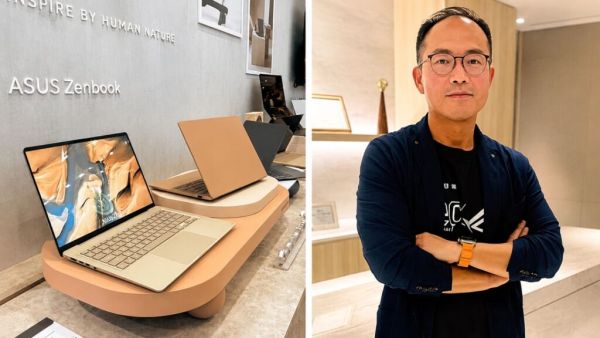
“Premiumisation isn’t simply about making a product better and charging more for it,” says Shawn Yen, senior vice president of the Consumer Business Unit at ASUS. “It starts with understanding what customers actually need, defining the minimum viable product that meets those needs, and then enhancing every aspect of that experience within those parameters.”
This philosophy reflects ASUS’ broader approach to product development, where premium experiences are shaped not by adding more features but by identifying what matters most to users and refining it. At a time when the PC industry is converging on the same silicon, operating systems, and increasingly similar feature sets, companies seem to be looking for ways to stand apart with something harder to copy.
On the sidelines of Computex 2026 in Taipei, Taiwan, Yen sat down with indianexpress.com to discuss the company’s strategy across its consumer lineup, the realities of building for markets like India, and where he believes AI is taking personal computing.
Towards post-purchase experience
India occupies a special place in ASUS’ thinking about premium experiences. Yen describes the country as both critically important and deeply instructive, having shaped the company’s understanding of what customers value beyond the point of purchase. For the PC maker, that has increasingly meant focusing on service and long-term ownership rather than just hardware specifications.
ASUS recently introduced drop points in India, allowing customers to have small repairs handled without visiting a service centre. Parts are shipped to the customer first; the faulty component is collected afterwards.
“Service is how we actually deliver premium touch to an end customer,” Yen says. “We can sell a customer a product, and there’s only one transaction. But after that transaction, over the years when customers use those products, that’s where those experiences come in.”
Story continues below this ad
While his definition of premium may sound less glamorous than cutting-edge specifications or premium materials, Yen argues that it reflects a more honest accounting of what customers actually experience over a product’s lifetime.
On a varied portfolio
The Taiwanese tech giant sells laptops under several distinct brands, such as ROG for gamers; Zenbook for what Yen describes as being meant for the ‘tech and urban fashion crowd’; Vivobook for practical users; and ProArt for creators. Usually, it is assumed that these lines stand for a hierarchy based on quality, with ROG at the top and Vivobook as the entry-level option. Yen was quick to dismiss this framing during the conversation.
“We never ask a Vivobook customer to pay a Zenbook price,” he said. “If you are pragmatic about what you need and the Vivobook is good enough, then the premiumisation we apply to the Vivobook is for that user.” As an example, he pointed to OLED displays. ASUS uses the technology across price points but calibrates it differently depending on the line. A screen that performs well in a dim office may wash out under daylight glare, a distinction, according to Yen, that matters more than whether a spec sheet says OLED or not.
“OLED is not created equal. You can simply put an OLED panel in front of a customer, and it’s easy to understand what OLED means. But when you take it home or use it outdoors, when glare and reflections on the screen disturb you from what you’re working on, that creates frustrating moments.”
The material question
At the Asus Design Centre, one of the most ubiquitous expressions of the company’s identity has been its motto – ‘design that you can feel’. When asked how this translates into product decisions, Yen spoke about the company’s proprietary material called Ceraluminium, a treated aluminium with a matte, stone-like finish that the company uses on its Zenbook line. The Asus executive explained that the aim was to create a surface that resists scratches, repels smudges, and doesn’t develop the worn look that standard aluminium can over time.
Yen acknowledged the slipperiness of describing it as anything more than a material choice but argued the experience it creates is the point. “Design you can feel is when you pick it up, and you know it’s different,” he said. “The only reason we choose aluminium is that it gives you the touch of Mother Earth – that stony, natural finish. You don’t feel like you’re touching a technology product; you’re touching a gift from nature.”
The practical challenge, he noted, is less about discovering new materials than manufacturing them at scale. Producing a finish that holds up across millions of units, not just prototypes, requires a different level of factory and supply chain investment. According to him, it’s a constraint that tempers how quickly material innovation can move.
Local AI: Privacy first, then cost
When it comes to the shift to AI, Yen offers a nuanced perspective. He frames the shift toward on-device AI processing around two concrete benefits: privacy and cost. “The local AI experience delivers two critical benefits,” he said. “First is context privacy – your context should not be in the cloud, because that’s your work. Second is that it’s not metered. You don’t pay for tokens if your compute power is good enough for what you need.”
ASUS’s ProArt PX13, he noted, carries 128 gigabytes of memory, which is enough to run a 70-billion-parameter language model locally across text, voice, and image inputs. However, he was cautious enough to not oversell what smaller models running on mainstream hardware actually do. “Those models may not change the way you work or give you dramatically higher capabilities, but they become an ever-present companion when you need it. They’ll do those small things for you very well.”
The more interesting idea Yen floats is orchestration: a local model that doesn’t try to do everything itself, but instead decides what to handle on-device and what to route to the cloud. “The local model becomes the manager,” he said. “If it needs a truck driver to handle something big, it sends it to the cloud – the truck driver can bring a tonne of context and tokens, process it, and bring back the output.”
When asked about the growing shift toward local AI workloads and how ASUS is shaping its hardware strategy around it, Yen moved beyond the local-versus-cloud debate, describing the two as complementary layers that work together. It is an approach that appears to be guiding ASUS’ AI ambitions.
-
Never mention these sensitive things to your partner, otherwise your loving relationship may break.

-
First MasterChef India Winner Pankaj Bhadouria Diagnosed With Breast Cancer, Shares In A Post

-
Vitamin D deficiency can cause these serious problems in the body

-
Why is National Cancer Free Day celebrated? Major medical measures to overcome serious diseases like cancer

-
Tech Tips: Does the thick cover of the smartphone affect the battery? One mistake and big loss can happen… Know the facts