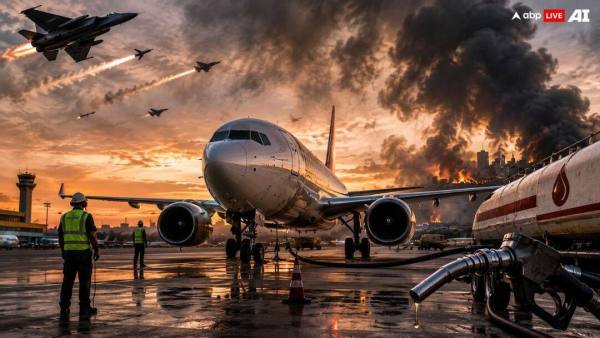
In a major intervention aimed at protecting India's aviation sector from the fallout of the West Asia crisis, the Union Cabinet on Wednesday approved a Rs 10,000 crore Aviation Turbine Fuel (ATF) Price Stabilisation Fund to help airlines manage soaring fuel costs and maintain air connectivity.
The decision comes at a time when global fuel markets remain volatile, with ATF prices having surged nearly 2.5 times over the past few months.
The government believes the move will provide greater certainty to airlines, reduce pressure on passenger fares and safeguard connectivity across domestic and international routes.
The Cabinet, chaired by Prime Minister Narendra Modi, approved one-time budgetary support of up to Rs 10,000 crore for Oil Marketing Companies (OMCs), which will be used to stabilise ATF prices for scheduled Indian airlines.
Why The Government Has Stepped In
The aviation industry has been among the sectors hardest hit by the ongoing conflict in West Asia.
According to official data, international ATF prices jumped from Rs 60.50 per litre in March 2026 to around Rs 142 per litre in May 2026. Since fuel accounts for nearly 40 per cent of airline operating costs, and can rise to as much as 60 per cent during periods of extreme volatility, the spike has significantly increased pressure on airline finances.
The situation has become even more challenging following the closure of Pakistani airspace for Indian carriers, forcing airlines to take longer routes to Europe, North America and Central Asia. Longer flying times have translated into higher fuel consumption and increased operating expenses.
As costs have risen, airlines have faced growing pressure on profitability, while some international routes have witnessed weaker demand and service reductions.
How The Rs 10,000 Crore Fund Will Work
Under the approved mechanism, the government will provide an interest-free advance of up to Rs 10,000 crore to OMCs through the Ministry of Petroleum and Natural Gas.
The fund will compensate OMCs whenever international ATF prices rise above a benchmark level determined under the scheme.
Rather than directly subsidising airlines, the government will support fuel suppliers, allowing them to provide airlines with greater pricing stability during periods of extreme market volatility.
Importantly, the support is not designed as a permanent subsidy.
Built-In Recovery Mechanism
The government has incorporated a recovery and settlement framework into the scheme.
When international ATF prices decline and market conditions normalise, the differential amount will be recovered from OMCs and returned to the Consolidated Fund of India.
The process will continue until the entire Rs 10,000 crore support amount is fully recovered and reconciled.
This structure allows the government to provide temporary relief without permanently burdening public finances.
Fixed Fuel Prices To Help Airlines Plan Better
One of the key features of the programme is the introduction of a fixed-price arrangement for participating airlines.
By reducing exposure to sudden spikes in fuel prices, the mechanism is expected to improve financial visibility and operational planning for carriers.
The scheme will be available to all willing scheduled Indian airlines and will cover both domestic and international operations.
For an industry where fuel costs represent one of the largest expense categories, greater pricing predictability could offer significant relief at a time of heightened uncertainty.
A New Role For Oil Marketing Companies
The arrangement will be implemented through a formal agreement involving participating airlines, OMCs, the Ministry of Civil Aviation and the Ministry of Petroleum and Natural Gas.
As part of the programme, airlines opting into the scheme will source ATF exclusively from OMCs for a period of up to three years, subject to annual review or until the advance amount is fully recovered.
The government believes this framework will simplify implementation while ensuring accountability across all stakeholders.
Monitoring, Audits And Oversight
To oversee the initiative, a dedicated monitoring committee will be established comprising representatives from the Ministry of Civil Aviation, Ministry of Petroleum and Natural Gas and the Department of Expenditure.
The panel will be responsible for implementation, claim verification, reconciliation and settlement.
All claims and recoveries under the scheme will also be subject to audit, adding an additional layer of oversight.
The stabilisation support will remain in force for 36 months, with annual reviews built into the framework. The arrangement could be extended beyond that period if the corpus has not been fully settled.
What It Means For Passengers
While the scheme is primarily aimed at supporting airlines and OMCs, passengers are also expected to benefit.
The government expects the initiative to reduce the extent to which fuel price shocks are passed on through airfares, helping to moderate ticket price volatility.
More stable airline finances could also support continued connectivity to remote, regional, Tier-II and Tier-III cities, including routes developed under the UDAN programme.
Wider Economic Impact
Officials believe the benefits of the scheme will extend beyond airlines.
Stable aviation operations help sustain employment across airports, maintenance and repair services, ground handling agencies, logistics firms, travel companies and hospitality businesses.
The government also expects positive spillover effects on tourism, exports, regional development and investment.
By helping airlines navigate an unprecedented fuel price shock, policymakers hope the intervention will strengthen India's connectivity with global markets while supporting broader economic activity.
-
Watch: Virat Kohli's Golden Advice For Vaibhav Sooryavanshi, Says 'Ek Bihari...'

-
U18 Asia Cup 2026: Nousheen Naz & Geethasri Nammi Power Indian Women’s Hockey Team To 25-0 Win Over Singapore, Top Pool A

-
Anthropic Brings Its Most Powerful Mythos AI Model to India; Expands Project Glasswing To 14 Other Countries

-
St. Stephen’s First Woman Principal Susan Elias Visits Delhi Brotherhood Society, Briefed On College Legacy & History

-
Kerala SSLC SAY Hall Ticket 2026 To Be Out Tomorrow At sslcexam.kerala.gov.in; Exams Begin June 10