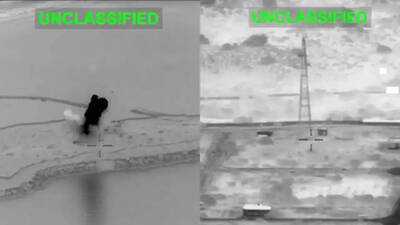
The United States military has unveiled footage depicting strikes on Iranian coastal surveillance radar installations located in Goruk and Qeshm Island. This release marks a significant moment in the escalating tensions between the US and Tehran, particularly in the strategic Strait of Hormuz.
In a statement released late Friday, the US Central Command (CENTCOM) confirmed that these strikes were executed following the interception of several Iranian threats aimed at regional allies and maritime operations. The military also provided a summary of the battlefield situation, noting that six Iranian ballistic missiles were intercepted, while one failed to reach its target. Initial evaluations indicated that no American personnel were injured during these operations.
The footage showcased precise strikes targeting radar facilities that the US claims were facilitating Iranian military operations in this vital waterway. CENTCOM identified these radar sites as being strategically positioned in Goruk and on Qeshm Island, both of which overlook the Strait of Hormuz.
Escalating Tensions Between Iran and the US Iran-US Exchange Intensifies
CENTCOM reported that the recent hostilities began after US forces intercepted four Iranian drones intended for one-way attacks towards the Strait of Hormuz. These drones were deemed an "immediate threat" to maritime traffic, prompting defensive measures from American forces. Following the interception of the drones, US aircraft targeted the Iranian radar facilities to thwart further assaults and ensure the safety of regional shipping routes. The Strait of Hormuz is a crucial channel for global energy supplies and international trade, making military actions in this area a significant concern worldwide.
Shortly after, Iran launched seven ballistic missiles aimed at Kuwait and Bahrain, according to US military reports. CENTCOM stated that six of these missiles were intercepted by American and allied air defense systems, while the seventh missile failed before reaching its intended target.
CENTCOM Responds to Iranian Claims CENTCOM Rejects Iranian Claims
The US military firmly rejected Iranian assertions that their retaliatory strikes successfully targeted the headquarters of the US Fifth Fleet in Bahrain. CENTCOM categorically denied these claims, affirming that no US personnel were harmed and that American military facilities remained undamaged during the recent exchanges.
The Islamic Revolutionary Guard Corps (IRGC) of Iran had previously claimed responsibility for targeting "enemy bases in the region" in retaliation for what they described as US aggression against Iranian territory, including Qeshm Island. Tehran has framed its actions as responses to recent US military operations.
Rising Tensions in the Gulf Region Gulf Region On Edge
This latest confrontation occurs amidst increasing instability in the Gulf, where recent missile and drone attacks have raised concerns about a potential broader regional conflict. Air raid alerts were reported in parts of Kuwait during the recent exchanges, and Bahrain's air defense systems were activated as missiles approached the regional airspace.
Despite ongoing diplomatic efforts to ease tensions, the recent military exchanges highlight the precarious nature of the situation. With drones, missiles, and critical infrastructure becoming frequent targets, analysts caution that the risk of miscalculations in the Gulf is on the rise. Currently, Washington and Tehran find themselves in a cycle of retaliation, with the Strait of Hormuz once again at the center of one of the world's most scrutinized security crises.
-
Erling Haaland and Norway Head to the 2026 World Cup Carrying 300 Kg of Fish – Here’s Why

-
World Cup Fever Grips Jayapura as Spain Jerseys Become the Top Choice

-
Trump and Musk: A Renewed Friendship Amidst Political Tensions

-
Union Ministry of Coal Takes Action Against Illegal Mining in Assam

-
Union Ministry of Coal Enhances Powers to Combat Illegal Mining in Assam