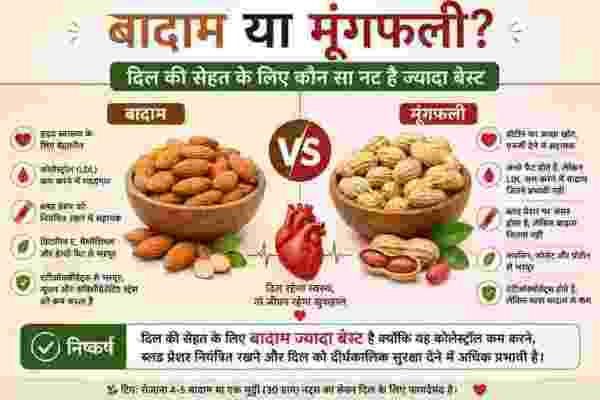
Amid changing lifestyle and increasing mental stress, heart- diseases have become the biggest enemy of health across the world. The good thing is that by making some small and correct changes in our daily diet, we can avoid this big danger to a great extent. The easiest and most economical way to give your heart a long and healthy life is to eat a handful of nuts every day.
When it comes to healthy nuts, almonds and peanuts are two names which are easily found in the kitchen of every Indian home. Both the nuts contain within themselves a wealth of healthy fats and antioxidants. But when it comes to heart protection specifically, which of the two is more beneficial to make a part of your routine? Come, let us understand the entire nutrition game of both from the experts’ perspective.
Effect of almonds on heart health: Why is it everyone’s favorite?
According to nutrition expert Drew Hemler, almonds are considered a powerhouse of vitamin E, fiber, magnesium and monounsaturated fats. All these nutrients together strengthen our cardiovascular system.
-
Improvement in cholesterol level: About 28 grams (1 ounce) of almonds contain 14 grams of fat, which is actually heart-protecting ‘good and healthy fat’. When you remove harmful saturated fats from your diet and replace them with unsaturated fats, cholesterol remains balanced.
-
Reduces bad cholesterol (LDL): The fiber and special plant compounds present in almonds help bind and remove bad cholesterol accumulated in the body and boost the levels of good cholesterol (HDL).
-
Better blood circulation: Almonds are the best source of Vitamin E. Its antioxidant properties protect our arteries from oxidative stress, which prevents plaque (waste) from accumulating in the veins and maintains proper blood flow throughout the body. At the same time, the magnesium present in it keeps both blood pressure and blood sugar under control.
Miracle of peanuts: Benefits of ‘poor man’s almond’ are royal
Although peanuts may be underestimated in common parlance by being called ‘poor man’s almond’, but in terms of health, its benefits are no less than any expensive dry fruit. According to experts, the nutrition profile of peanuts is slightly different from that of almonds but very effective. It contains more protein, niacin and folate than almonds.
-
Lower risk of heart disease and stroke: The thin red skin (peel) on the peanut grains contains tremendous bioactive compounds and antioxidants. Medical research shows that eating peanuts at least twice a week reduces the risk of heart diseases to a great extent.
-
Control on Triglycerides: Vitamin B i.e. ‘niacin’ present in peanuts improves the cellular function of the body. It shows direct effect in reducing the level of bad cholesterol and triglycerides in the blood.
-
Stress Relief: According to a recent study, reduced levels of anxiety and mental stress have been observed in people who eat limited amounts of peanuts daily. Since stress directly weakens the heart, peanuts indirectly shield your heart.
Almonds vs. Peanuts: Nutrition Difference at a Glance
Expert’s final verdict: who is the real winner?
According to experts, it would not be right to choose any one winner in this race. Both the nuts are excellent for heart protection at their own level.
Nutritionist’s advice
Health expert Roxana Ehsani says that both the nuts have their own unique benefits, so the wisest decision would be to include both of them in your diet one by one (by mixing). At the same time, Drew Hemler believes that the best nut is the one that you can make a part of your daily diet without forgetting it – whether it is within your budget or your taste.
If you want to keep your heart young, safe and healthy for a long time, then instead of creating a competition between almonds and peanuts, make these two powerhouses a part of your regular diet. Just keep in mind to consume both in limited and balanced quantities.
-
Barcelona Wonderkid Nearly Causes Ballon d'Or Winner to Miss the 2026 World Cup

-
David Beckham to Receive Hollywood Walk of Fame Star Ahead of World Cup Opener

-
FIR against 7 for pasting ‘I love Muhammad’ posters inside mosque

-
Kylian Mbappe and Rayan Cherki Discontent with FFF's Image Rights Decision

-
Spain's World Cup Preparations Hit by Injury Concerns