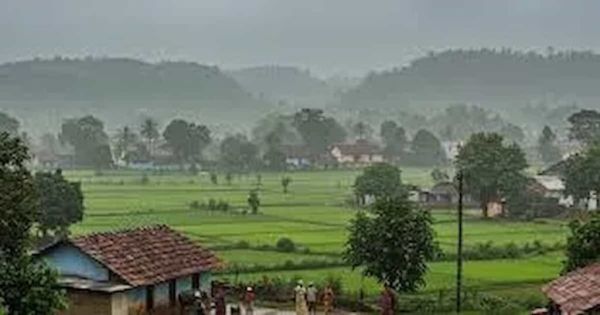
Whenever there is talk of monsoon in India, one word often comes into the headlines – ‘El Nino’. This movement in the Pacific Ocean has a direct impact on the Indian monsoon, the whole world knows this today. But do you know that the one who explained to the world this deep and unique relationship between El Nino and monsoon was none other than India itself? About 100 years ago, a historic scientific discovery was made on Indian soil, which not only changed the thinking of meteorologists around the world, but also brought about an epoch-making revolution in the entire science of predicting monsoon.
Sir Gilbert Walker and that historical research of Shimla Meteorological Department
This story begins in the year 1904, when British mathematician and scientist Sir Gilbert Walker was appointed Director General of the Indian Meteorological Department (IMD). At that time, India was struggling with frequent severe droughts and famines, due to which crores of lives were at stake. Sitting in the meteorological office of Shimla, Walker began to closely study decades-old weather data. He believed that the Indian monsoon is not just to local winds, but there is a global weather cycle working behind it. After years of hard work, he found that whenever there is a change in the atmospheric pressure of the Pacific Ocean, it has a direct impact on the Indian Ocean and the monsoon of India. He named this large seasonal fluctuation ‘Southern Oscillation’.
When the fate of the Indian monsoon was linked to the movement of the Pacific Ocean
Many decades after this unprecedented discovery by Sir Gilbert Walker, scientists understood that Walker’s ‘Southern Oscillation’ and the ocean warming phenomenon ‘El Nino’ are actually two sides of the same coin, which today is collectively called ‘ENSO’ (El Nino Southern Oscillation). The findings from that historic office of the Indian Meteorological Department proved for the first time how the warm waters of the Pacific Ocean, located thousands of miles away, decide the fate of millions of farmers in India. Before this discovery, meteorologists around the world used to estimate rainfall only on the basis of local clouds and air pressure, but this Indian discovery forced them to see the entire Earth’s weather as an interconnected system.
That 100 year old Indian formula is still relevant today
In today’s modern and digital era, even though we have supercomputers and advanced satellites, the same 100 year old Indian discovery is still used as the basis for accurate prediction of monsoon. El Nino affects not only India but the agriculture, economy and food security of the entire world. This great scientific heritage of India strengthened the foundation of meteorology at the global level. This is the reason why today whenever the world’s leading scientists discuss the dangers of El Nino and global warming, they do not forget to salute this glorious and historical contribution of India.
-
Barcelona Wonderkid Nearly Causes Ballon d'Or Winner to Miss the 2026 World Cup

-
Cristiano Ronaldo’s Coach Says Bernardo Silva Is the Perfect Fit for Barcelona

-
Determined to Redeem His Poor Form in Qatar, Lionel Messi’s Teammate Vows to Shine at the 2026 World Cup

-
David Beckham to Receive Hollywood Walk of Fame Star Ahead of World Cup Opener

-
FIR against 7 for pasting ‘I love Muhammad’ posters inside mosque