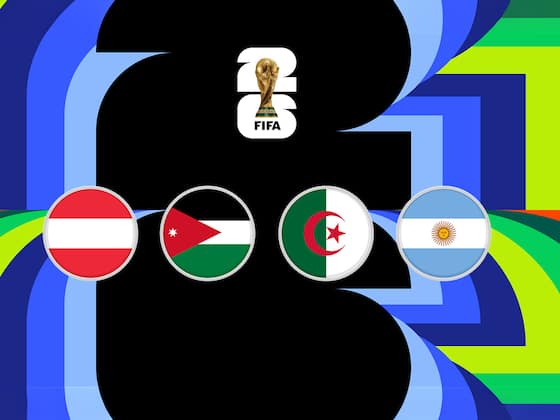
The World Cup is almost upon us! With only hours remaining before kickoff, Playmaker has unveiled detailed previews of all 48 participating nations through 12 dedicated articles — each focusing on one group. Here’s your complete guide to Group J, including probable starting line-ups and the standout names to watch.
Group J carries a special significance, featuring the reigning champions Argentina. Apart from Lionel Scaloni’s squad, no other team has come close to matching their level in recent years, underlining the gap in quality within the group.
La Albiceleste are chasing history, hoping to join the elite group of teams that have won consecutive World Cups — Italy (1934–1938) and Brazil (1958–1962). These are distant but inspiring milestones for a side led by Lionel Messi, who is set to play the final matches of his illustrious international career.
Alongside Argentina, Group J features Austria, returning to the tournament after 28 years, Jordan, who have qualified for the first time, and Algeria, eager to surpass their 14th-place finish from the 2014 World Cup in Brazil. While Argentina are clear favourites, the other three sides are expected to battle fiercely for the remaining qualification spot.
Number of appearances: 18
Best finish: Winners in 2022
This World Cup will hold special meaning for Argentina, who will wear the champions’ badge for the third time in their history, following triumphs in 1978 and 1986. Despite facing criticism during the March and April international breaks, there is strong motivation within the squad to defend their crown.
Scaloni’s team boasts immense quality and depth, filled with world-class talent capable of taking Argentina deep into the tournament. The only lingering question is how much impact the bench players can make when called upon.
Argentina are widely tipped to top Group J comfortably. Anything less than first place would trigger scrutiny for a team seeking both confidence and continuity.
Head coach Lionel Scaloni, one of the architects of Argentina’s 2022 triumph, has been leading the national side since 2018. A former player with stints in Argentina, Spain, England, and Italy, Scaloni also spent time at Sevilla as an assistant coach. He now prepares for his fifth major tournament in charge of the Albiceleste.
Discussing Lionel Messi never gets old. At 38, the Argentinian icon enters the twilight of his career, and the 2026 World Cup will likely mark one of his final appearances on the grand stage. Currently playing for Inter Miami CF in the United States, Messi continues to display his trademark ability to change games with minimal effort — truly one of football’s all-time greats.
At just 21, Nico Paz has been one of the breakout stars of the season. The Como 1907 midfielder impressed during the 2025/26 campaign and will aim to carry that form into the World Cup. Despite only eight senior appearances so far, Paz offers Scaloni a technically gifted option, whether starting or coming off the bench.
Other key players: Rodrigo de Paul (Inter Miami CF), Enzo Fernández (Chelsea), Julián Álvarez (Atlético de Madrid), and Emiliano Martínez (Aston Villa)
Number of appearances: 7
Best finish: Third place in 1954
Far removed from their golden era, Austria enter this World Cup with realistic ambitions following solid performances at Euro 2020 and Euro 2024 — to progress beyond the group stage. Under Ralf Rangnick, the team has shown consistent growth, and their qualification campaign reaffirmed that stability.
Austria’s qualifiers showcased both attacking flair and defensive discipline, scoring 22 goals while conceding only four. This balance makes them a disciplined and competitive side capable of troubling any opponent.
Aiming to reach the round of 32, Austria will look to improve upon their 1998 group-stage exit under Herbert Prohaska. Nearly three decades later, they return to football’s biggest event with renewed confidence.
Rangnick, who took charge in 2022 after a turbulent spell at Manchester United, has vast experience across Europe, including stints as an executive in Brazil and the USA. Notably, he managed Cristiano Ronaldo during the Portuguese star’s return to England.
Choosing Austria’s talisman isn’t easy given the long-standing contributions of David Alaba and Marko Arnautović. However, Real Madrid’s Alaba, with over 110 international caps, stands out as a natural leader, even as he continues to battle injury setbacks.
Among Austria’s rising names is a 22-year-old Borussia Dortmund midfielder who previously represented England’s youth sides. Though still new to international football, he is expected to play a significant role under Rangnick.
Other key players: Marcel Sabitzer (Borussia Dortmund), Konrad Laimer (Bayern Munich), Marko Arnautović (Crvena Zvezda), and Michael Gregoritsch (FC Augsburg)
Number of appearances: 4
Best finish: 14th place in 2014
After a 12-year absence, Algeria return to the global stage with high hopes. Under Vladimir Petković, they aim to build on their strong showing at the 2025 Africa Cup of Nations, where they reached the quarter-finals.
While Argentina and Austria appear stronger on paper, Algeria have enough quality to mount a serious challenge for qualification, even if the task is a steep one.
Algeria’s squad is spread across multiple world leagues, adding depth and diversity. Their clash against Argentina on 17 June at 02:00 (UK time) could prove decisive in determining their fate.
Petković, a seasoned football mind, brings a wealth of experience from clubs across Switzerland, Turkey, Italy, and France, as well as a prior tenure leading Switzerland’s national team. At 62, this is his second international managerial role.
Riyad Mahrez, though now 35, remains a creative force and one of Algeria’s brightest hopes. With nearly 120 caps, the former Manchester City winger continues to mesmerize fans — this time from his base in Saudi Arabia.
Up front, Amine Gouiri adds further firepower. The 26-year-old Marseille striker is known for his clinical finishing and technical sharpness, making him a key attacking threat.
Other key players: Mohamed Amoura (Wolfsburg), Houssem Aouar (Al-Ittihad Jeddah), Rayan Aït-Nouri (Manchester City), and Ibrahim Maza (Bayer Leverkusen)
Number of appearances: 0
Best finish: -
Jordan complete Group J’s line-up, qualifying for their first-ever World Cup. It’s a historic occasion for the country of over 11 million people, marking a new chapter in their football journey.
Under Jamal Sellami, Jordan finished second in Group B of the AFC qualifiers, just behind South Korea. Their campaign, featuring only three defeats, earned them a place in the 2026 tournament across the USA, Canada, and Mexico.
Most of Jordan’s players are drawn from domestic and Asian leagues, and they enter as clear underdogs, but with the spirit of a side eager to make their mark.
Sellami took charge in 2024 after a long coaching career in Morocco. As a former player with CO Casablanca, Raja Casablanca, Maghreb Fès, and Beşiktaş, he brings deep experience. His managerial journey has included stints with DHJ El Jadida, Hassania Agadir, FUS Rabat, and Morocco’s youth sides.
Moussa Al-Tamari, one of the few Jordanians playing in Europe, enjoyed an excellent season with Rennes. The 28-year-old winger, approaching 90 international appearances, is expected to be a key figure for his nation.
Ali Al Olwan, Jordan’s top scorer in qualifying with nine goals in 13 matches, returns from injury and will look to replicate his clinical form on the world stage.
Other key players: Noor Al-Rawabdeh (Selangor), Yazeed Abulaila (Al Hussein), Odeh Al Fakhouri (Pyramids FC), and Yazan Al-Arab (FC Seoul)
-
UGC NET June 2026 Admit Card Soon At ugcnet.nta.nic.in; Check Release Update And Download Steps
-
Nepal U-Turn? No Ban On Indian Mangoes, Kathmandu Clarifies Imports Allowed After Quality Checks
-
Revised schedule puts Aussie women in the spotlight
-
Molineux urges Australia to play with freedom in bid to reclaim title
-
"Pressure is privilege: England's Sciver-Brunt"