
Snap Inc., which owns the Snapchat social media platform, is finally bringing its Spectacles hardware to consumers with the introduction of its SPECS AR glasses. This may not sound groundbreaking, as we already have several options from companies like Xreal and INMO that build dedicated augmented reality glasses that serve as on-the-face display for phones and other devices, and standalone AI glasses like the Meta Ray-Ban Display.
Snap seeks to differentiate its offering by combining the functions of those AR glasses and AI glasses into one device, which its calls “a wearable computer.” The SPECS boasts two Snapdragon processors — one dedicated to computer vision and the other reserved for running the device itself. It also doesn’t need another input device, with the smart glasses solely using hand tracking for “more natural interactions.” It also features a liquid crystal on silicon display, which delivers a 51-degree field-of-view and 16 million colors, making it comparable to a 24-inch work monitor or a 115-inch home cinema screen about 10 feet away from your face. This allows the SPECS to serve both as work monitor, an entertainment screen, and a lifestyle display that lets use your apps without getting your phone out.
“For decades, computers have asked us to look down, sit still, or step out of the moment. SPECS bring computing into the world around us where we live, work, learn, create, and connect,” says Snap Inc. CEO and co-founder Evan Spiegel. He also adds, “The smartphone put our lives in our pockets. SPECS put computing into the world where life actually happens.”
What could the SPECS actually do?
But aside from being a screen attached right in front of our eyes, what is the SPECS hardware actually capable of? It’s biggest draw is its AI capabilities. The company says that this pair of smart glasses aims to become useful in your day-to-day life, putting apps like navigation, spatial measurements, and contextual AI assistants right into your line-of-sight.
More importantly, Snap Inc. says that it now has agentic development in Lens Studio, the company’s free AR development platform that practically lets any developer build AR apps. This AI feature makes it far easier to use and encourage more developers to make Lenses. It also introduced other tools like the Migration Agent and Native Development Kit so it’s easier to port existing code and libraries as a starting point for programmers.
This is actually quite crucial, as the existence of an open software market is what allowed several hardware platforms to become successful. We saw this with Windows and macOS, and even in iOS and Android with their semi-open markets.
But will this be enough to convince users to purchase the SPECS? The hardware is quite expensive, costing $2,195 — nearly double the iPhone 17 Pro Max — and you’ll still likely need a smartphone as your primary device. By comparison, the original 8 GB iPhone launched at $599 in 2007, about $962.08 in today’s dollars if we account for inflation.
The SPECS AR glasses seem useful on the surface
Despite being expensive, the SPECS AR feels like a handy gadget for those who are willing to shell out the $200 deposit that Snap is asking for right now (and the balance upon delivery, naturally). For one, it would’ve been pretty handy for me if I had one on when I visited Taiwan for Computex 2026.
I found myself getting lost a couple of times while navigating the streets of Taipei as my smartwatch had trouble orienting Google Maps when I checked for directions. I also didn’t want to take out my phone to survey the surroundings with its AR feature as it was raining at the time, and I had to carry my bag and my umbrella. If I was wearing the SPECS AR glasses, I probably would have been able to follow turn-by-turn navigation without taking my phone out even once.
Another advantage that I could foresee this “wearable computer” delivering is the ability to take quick notes on the go. That way, I don’t have to step away from the natural flow of a conversation to take notes. This helps ensure that I stay locked into the topic and have a deeper understanding of the subject we’re talking about. I could then go back to the recording or notes on the SPECS AR glasses later to reference any information I may have missed as I write my coverage of the expo later in the day.
These two applications immediately came to my mind when it comes to usefulness of the SPECS. But given that it has a free and open development suite with the Lens Studio, it could potentially receive so much more useful apps that I haven’t thought of yet.
Do we really need to put our apps on our face?
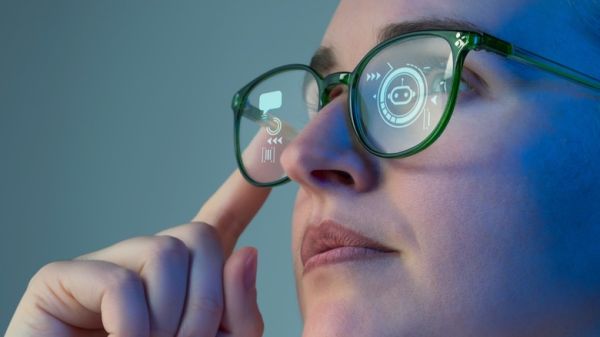
Despite its usefulness, one question always comes back to my mind: are we really ready to have a display on our faces all the time? Augmented Reality is certainly useful — as I pointed out, I could’ve used it when I was exploring a new city and taking notes during meetings. I also imagine that it would’ve helped me with communication through an AI translator app since I can’t understand Mandarin.
However, it also sparks danger as it could cause us to lose focus. One of the things that I try to do when I’m commuting is to keep off my phone, even when I’m seated, so that I stay safe and aware of my surroundings. I also try to force myself to practice my navigation skills without relying on an electronic device, at least while walking on the street.
But if we all have a SPECS-like device on our faces all the time, we can no longer hide the distracting device in our pockets or bags. A notification could pop up at any time and demand for our attention, and it could even happen at the most inopportune of moments. This form of distraction is bad, as it could cause us to lose focus on the task at hand, like going down the stairs, crossing the road, or even driving, and cause an accident.
Another thing I’m concerned about is its AI features. While this technology has grown by leaps and bounds in recent years, it’s far from perfect and still has its limitations. But if we make it readily available to users, then they risk becoming too dependent on the flawed technology and even ending with outsourcing most of their critical thinking to the cloud.