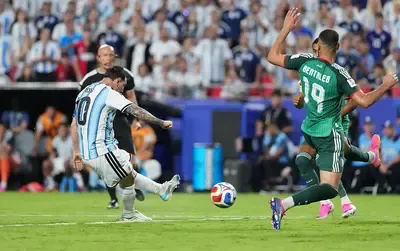
Right at the centre of the media tribune, an elderly cameraman of the official broadcasters was engrossed in his job. Argentina were locked in a Round of 16 battle with Australia at the 2022 Qatar World Cup. Despite the gulf in class, Australia held their own against the South American giants, winning back possession before launching counter-attacks at breathtaking speed.
Play and predict your Fifa World Cup 2026 champion hereIn the middle of that engrossing battle at Ahmed bin Ali Stadium, what caught my eye was the cameraman who never moved his equipment to follow the ball.
His focus was one man and one man alone — Lionel Messi. For the entire 90 minutes and the injury time, he kept following Messi.
In that tournament, Messi barely ran. He mostly walked. But unlike the cameraperson, Messi followed the action, scanning the play as he plotted his next moves in his mind like a chess player before exploding into action to either set up a teammate or score himself.
At 35, Messi’s masterclass in conserving energy to be able to play the pivotal role in the memorable World Cup triumph for an Argentina team built to suit his new game still boggles the mind of many a pundit.
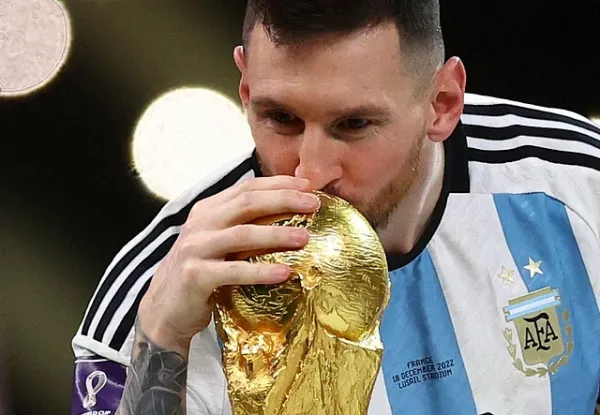
Argentina's Lionel Messi kisses the trophy as he celebrates after winning the 2022 World Cup in Qatar.
In Qatar, Messi was no longer the force of nature he once was.
But even with his reduced pace, Messi became the fulcrum of the champions, allowing the Argentinian midfielders to build the tempo before he popped up with one inspired move to be either a creator or a finisher.
In the history of football, perhaps there has never been another example of a player who had completely changed his style to cope with the physical demands while playing a decisive role in a tournament as tough as the World Cup.
Messi’s Qatar performance had echoes of Michael Jackson’s Stranger in Moscow, the most underrated classic of the late American superstar.
Based on a dark period in his life, Stranger in Moscow lacked Jackson’s trademark tempo. But the haunting melody of the slow-paced song beautifully captured the mental battle the King of Pop was fighting under constant media scrutiny.
Messi’s battle, on the other hand, was with his diminishing physical ability as an athlete — a challenge he overcame with economy of movement and mesmeric vision to unlock a rival defence.
Now almost four years later, fans and pundits could only wait in anticipation of what Messi could do as he returned to defend the World Cup with Argentina.
A week shy of his 39th birthday, how would he cope with the physical demands in the US, where the scorching summer heat has forced Fifa to introduce drinks breaks in each half?
Messi also kept everyone guessing whether he would pull on the Argentina shirt again in a World Cup, never confirming his plans until the last moment.
But when Lionel Scaloni announced the team a couple of weeks ago with Messi as the captain, the football world began asking questions again — this time about his fitness, especially after he was substituted in an Inter Miami game due to hamstring fatigue.
He was wrapped in cotton wool by Scaloni, who only brought him on for the final 20 minutes of Argentina’s last warm-up game against Iceland.
Messi looked lively in those 20 minutes, even scoring a goal from the penalty spot.
But several former players still raised doubts about his ability to survive intense matches in a World Cup at 38.
Messi responded by scoring a hat trick — his first in a World Cup — on Tuesday night against Algeria in Argentina’s opener.
He is now also the oldest player to score a treble in a World Cup game.
The three goals took his tally to 16, equalling Miroslav Klose’s all-time World Cup goalscoring record.
His overall goal contribution in World Cups now stands at 24, three ahead of Pele’s record of 21.
The Messi-inspired Argentina was also relieved to open their campaign with a comfortable win in a tournament where Spain and Brazil struggled to find rhythm in their first matches.
Ranked 28th in the world, Algeria are a pretty decent team. Not quite as strong as their African counterparts Morocco and Senegal, but the Algerians can play neat football when in possession.
Argentina’s 3-0 scoreline against Algeria has raised expectations among fans that the defending champions are not going to give up their title without a fight.
Fans coming out of the stadium pumped their fists, chanting 'Vamos Argentina, Vamos Messi' after the game.
But the most incredible aspect of Messi's performance against Algeria was that he barely walked on the pitch to conserve energy.
Messi scores his third goal
Messi aggressively pursued the ball when out of possession, even running the risk of getting a red card for a clumsy challenge on Aissa Mandi.
He also tracked back to defend when Algeria were threatening to test Argentina's backline in the final third.
While no data is available on how much he ran until he was substituted in the 79th minute, the tactical shift was unmistakable.
Based on Tuesday night’s evidence, Messi could be more persistent while chasing possession in this tournament.
If he continues in this fashion, rival coaches, who might have been making their 'stop Messi' strategy based on what they saw in Qatar, could face a new conundrum.
For a man who has scored 10 World Cup goals since turning 35, Messi could yet show us a completely new version of his football in North America.
The talismanic Argentine's goals on Tuesday night came against Algerian goalie Luca Zidane, the son of French legend Zinedine Zidane.
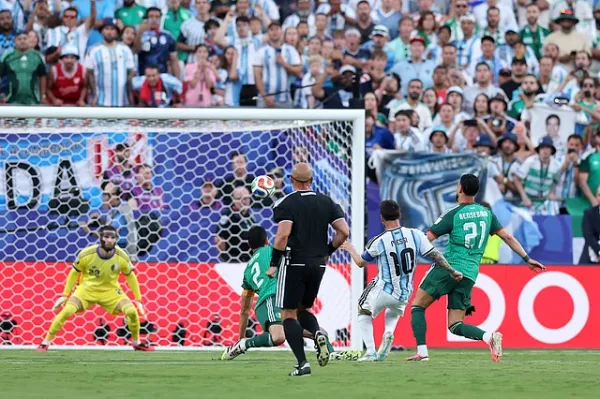
Messi scores his first goal past Luca Zidane (left) of Algeria
Luca made his World Cup debut for the country of his heritage with his famous father watching from the VIP Box at Kansas City Stadium.
Remarkably, Messi played his first World Cup in 2006, which was Zidane’s last appearance at the global showpiece.
A lot has changed since then, as Zidane went on to become a decorated football coach, leading Real Madrid to historic triumphs.
But what hasn’t changed in all these years is Messi’s ability to reinvent himself, keeping everyone on their toes.
The cameramen assigned to follow Messi at the 2026 World Cup are likely to face a far more complicated challenge than the relative calm they experienced in Qatar.
Father killed, brother missing: Iraq's Hussein scores World Cup dream despite tragedies You don't have to be an Argentina fan to admire what Messi has done, says Scaloni From Mexico to Qatar: Why Messi is a bigger icon than Pele and Maradona-
Who Will Officiate England vs Croatia at the World Cup?
-
BBC Commentators, Analysts and Hosts for Portugal vs DR Congo Match
-
Explained: Why Harry Kane’s Penalty Against Croatia Was Ordered to Be Retaken
-
Artist crafts massive 30-foot England emblem on Suffolk beach before World Cup opener
-
Former Netherlands midfielder Rafael van der Vaart apologises for offensive comment about Japan players after World Cup opener