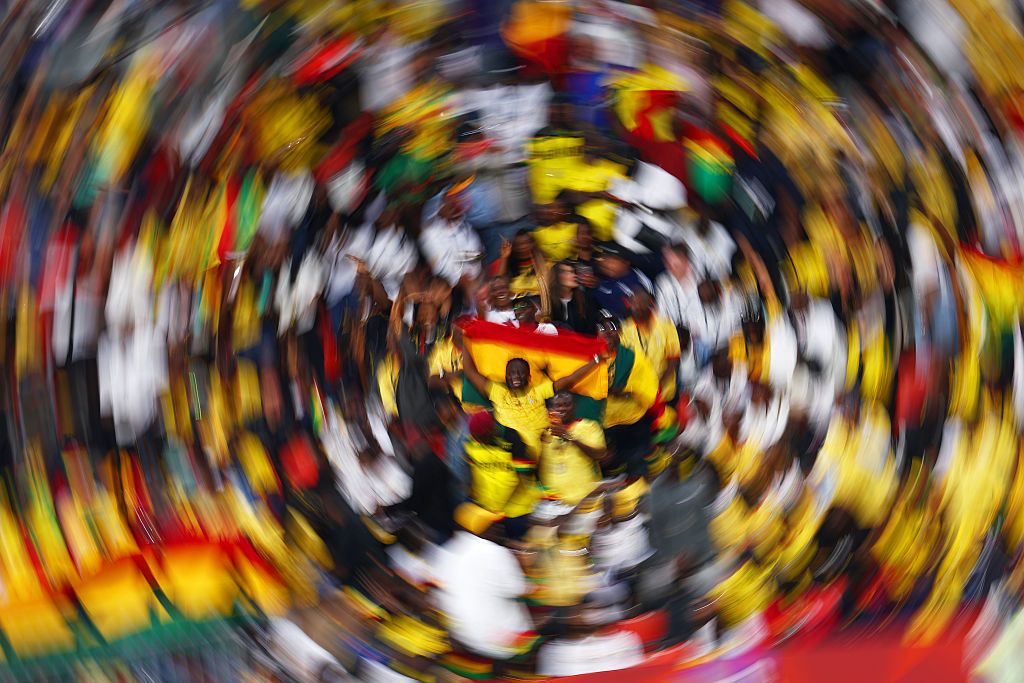
FourFourTwo was at Sankofa Square in Toronto, where Ghana’s opening FIFA World Cup game turned the city into a sea of joy and rhythm.
The celebration began as hundreds gathered around a slow-moving black truck in Sankofa Square. The air was filled with the beat of half a dozen drums and the ringing of metal bells, pulsing to the rhythm of Ghanaian Jama music. The crowd, half clad in bright yellow Ghana jerseys and the rest in traditional kente cloth, swayed and chanted in unison. A loud cheer erupted when a man stepped out of the car—it was Otumfuo Nana Osei Tutu II, the king of Ghana’s Ashanti tribe. Sheltered from the blazing heat, the Asantehene followed the music and a lively parade towards a stage crowned with a golden throne.
As the king took his seat, the chants reached their climax before fading away. Moments later, the wail of a Toronto Police Service siren cut through the air, the city’s familiar noise reclaiming the atmosphere. This was Canada—but for one day, it felt like Ghana.
The Black Stars’ first World Cup game united Ghanaians from around the world who joined Toronto’s large Ghanaian community to cheer for their team. Their dedication was rewarded with a thrilling last-minute win that sent the crowds into euphoria.
FourFourTwo spent the day alongside the Ghanaian supporters to capture the spirit of Ghana’s first-ever World Cup match in Toronto. The festivities began nearly ten hours before kickoff at Sankofa Square, where hundreds gathered to greet the king, dance, sing, and celebrate the Black Stars’ arrival. The square, renamed in 2023 from Yonge-Dundas Square to Sankofa Square, honours a West African Twi concept meaning “to go back and get it.” The idea symbolises learning from the past to create a better future.
“The Ghanaian population [in Toronto] is huge,” said Gabriel Odartei, former secretary of the Ghanaian Canadian Association of Ontario. “We are really, really proud people. Whenever you spot a Ghanaian, you immediately want to speak our language, greet them—it’s just pride in seeing one another.”
Toronto is home to more than 20,000 Ghanaians, representing various tribes, languages, and traditions, yet football binds them all together. “We’re here, we are Ghanaians, we are one, we wear one jersey,” said Ghanaian-Canadian Kwebena Boateng. “That’s the beauty of it—there are no boundaries, especially here in Toronto. What unites us is football and music.”
Even before kickoff, the rhythms of Jama music brought Ghanaians together. As the match neared, another vibrant session erupted in a park near Toronto Stadium. Odartei described Jama as an “energy booster,” and the drumming, whistling, and clapping certainly energised the crowd as they prepared to march to the ground. A solo trumpeter soon stole the spotlight, adding to the electric atmosphere.
The fans transformed a park bench into a makeshift concert stage. Everyone joined in—from lifelong Jama enthusiasts to first-timers, even journalists and photographers nodding to the beat. The procession of yellow jerseys and waving flags danced along the streets toward the stadium, bringing traffic to a standstill as spontaneous dance breaks erupted on the road.
While hundreds filled the stands at Toronto Stadium, others gathered in the north of the city for a viewing party. The barn-style venue was packed with yellow shirts and eager faces illuminated by the glow of a projected screen. Rain began to fall as the game kicked off, forcing fans to huddle even closer together.
Those watching from afar mirrored the emotions of those inside the stadium. Every save and attack drew identical reactions—cheers, gasps, and applause echoed as if they were side by side. The energy rose and fell with the flow of the game, and not a moment passed in silence.
Sharp intakes of breath filled the air each time goalkeeper Lawrence Ati-Zigi made a crucial save to keep Ghana level in the first half. Nervous shouts of “who’s there?” rang out when a loose ball rolled across the penalty box unclaimed. Panama started the stronger of the two sides, drawing anxious cries as they pressed forward.
The second half saw renewed energy among the fans, who leapt to their feet as Jonas Adjetey’s early header threatened to break the deadlock. Although Ghana improved their play, neither team managed to score in regular time. Still, the supporters’ passion never waned.
Then came pure pandemonium. Five minutes into extra time, the stadium—and the viewing parties across Toronto—erupted as Brandon Thomas-Asante weaved past his defender, setting up Caleb Yirenkyi to tap home the decisive goal. The crowd exploded in unison, hundreds jumping with joy as chants of triumph filled the air. The Black Stars’ players celebrated on the pitch as the fans’ voices roared behind them.
The noise continued until the final whistle. Drums, whistles, and Jama beats reverberated as fans awaited the referee’s signal. When it came, the celebration turned communal—people hugged, children danced, and strangers shared smiles as their compatriots at Toronto Stadium basked in victory.
“This is better than Christmas,” exclaimed event organiser Ebenezer Otang after the final whistle.
Echoing the sentiment, Emmanuel Quaye, director of external affairs for the Ghanaian Canadian Association of Ontario, said, “The Black Stars represent Ghana as a national team, and for them to perform on this grand stage is a proud moment for all of us. With the chanting, the singing, the flag-waving—it’s all one voice, one nation, one spirit. The Black Stars shine brightest when they feel the nation and the diaspora behind them with these Jama songs.”
Whether the players on the pitch could feel the energy from across the city or not, they certainly delivered for their supporters. Boateng, who emigrated to Canada in 1997, reflected on Toronto’s multicultural spirit: “Everywhere you go, there’s diversity, everyone’s welcome, and there’s opportunity for people of colour. Look at Sankofa Square—right in the heart of the city, and it carries a Ghanaian name.”
From the symbolic heart of Sankofa Square to Toronto Stadium, the Black Stars’ matchday brought Ghana’s vibrant culture to life across the city. “What you saw here today—that’s exactly what the Ghanaian community is all about,” Otang said as jubilant fans poured out of the venue. “It’s culture, jerseys, art, football, and celebration all rolled into one. That’s the true essence of our Black Stars from Ghana.”
-
Telangana CID arrests executive VP in Falcon fraud case

-
Rishabh Pant Poised for Dramatic Return to Delhi Capitals Ahead of IPL 2027

-
Actis Offloads Pine Labs Shares Worth ₹152 Cr

-
Juneteenth 2023: What to Expect on the Federal Holiday
-
Instagram Introduces Per-Slide Captions for Carousel Posts, Giving Creators More Storytelling Freedom