Edited by: R. Casey
"A great victory" and a "pivotal point for Lebanon" — that was how Naim Kassem, the leader of Lebanese group Hezbollah, described on Wednesday the memorandum of understanding that stopped fighting between Iran and the US this week.
Kassem also thanked the Iranians for "linking the Lebanese arena" to the deal and "forcing Israel to stop its aggression."
Hezbollah was founded in 1982 with support from Iran, and one of its primary aims then was to end Israeli occupation of southern Lebanon. It has both a military and political wing and the support of much of Lebanon's Shiite Muslim community. Today it plays a major part in Lebanese society and politics, has often been described as a "state within a state," and remains opposed to Israel.
Since Kassem's comments, fighting has continued in southern Lebanon, with Hezbollah targeting Israeli soldiers and Israel continuing to destroy southern villages and use bombs and drones. Sixty days of talks between the US and Iran, during which details would be hammered out, were due to start in Switzerland on Friday but were postponed in the morning because of Iran's opposition to the fighting in Lebanon.
Yet, despite it's troubled start, analysts say that the deal on the table favors Hezbollah's allies in Tehran.
How 'Great' A Victory For Hezbollah?
"This memorandum of understanding virtually gives Iran everything it wanted and Trump everything he had [before attacking Iran, together with Israel, in February]," says James M. Dorsey, an expert on the region at Singapore's Rajaratnam School of International Studies. "And certainly, at least initially, it looks like a victory for Hezbollah."
But whether it really is, remains to be seen, Dorsey told DW.
The first paragraph of the memorandum states that the US, Iran and allies will declare an "immediate and permanent" termination of military operations on "all fronts," including Lebanon.
The deal, signed by the US, Iran and mediator Pakistan on Wednesday, also says that both will ensure "the territorial integrity and sovereignty" of Lebanon.
Israel currently occupies around 600 square kilometers in southern Lebanon and calls this a necessary "security buffer zone" needed to protect citizens in northern Israel from Hezbollah rockets. Critics of Israel say it is an invasion and occupation.
"The Iranians, for all practical purposes, said this means two things," Dorsey explained. "No more military action and an Israeli withdrawal from Lebanon. So the litmus test of the Iranian position is going to be whether or not Israel is forced to abide by those conditions, and whether Trump says to Israel, 'You have no choice.'"
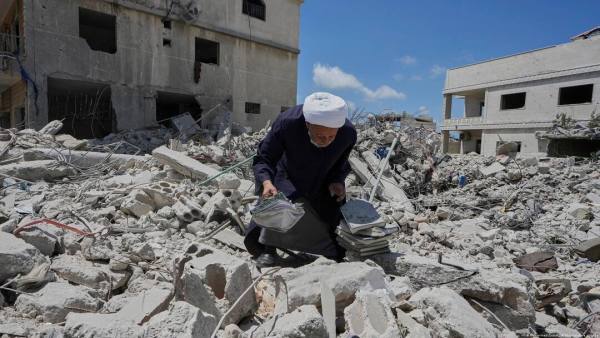
If Israel were to withdraw, this would be a gain for Hezbollah. Many of Lebanon's Shiite Muslim communities live in the south and more than one million have been displaced by Israeli troops, who have also demolished whole villages there.
More Money For Hezbollah
The US-Iran memorandum also mentions billions in reconstruction funding for Iran as well as unfreezing Iranian funds and allowing Iran to continue to sell oil.
Diplomats in the region told the Reuters news agency that, once its funds were unfrozen, Iran had said it would send more money to Hezbollah.
"If Iran's oil revenue resumes with no restriction on where it goes, the external pressure that was supposed to make Hezbollah's funding harder to sustain eases," Lebanese commentator Karim Chebaklo, who's also a board member with the Beirut's port authority, wrote in an editorial this week.
The Lebanese government has been trying to rein Hezbollah in and to disarm it, in order to stop Israeli bombardments. The military wing of the group is widely seen as having pushed Lebanon into the current conflict after it fired rockets at Israel in early March, following the Israeli assassination of Iranian leader Ali Khamenei.
But as Chebako points out, one of ways the Lebanese government could pressure Hezbollah was due to "a financially squeezed Iran." If Iran becomes more solvent and sends more cash to Hezbollah, "it pushes the disarmament question further out," Chebako argued.
No Guarantees
However, none of those potential "wins" for Hezbollah are guaranteed by the US-Iran agreement. Neither of the two belligerents fighting in Lebanon — Israel and Hezbollah — nor the Lebanese government, were signatories to the US-Iran deal.
For the Lebanese government, the deal makes it look as though Hezbollah's sponsor, Iran, is dictating Lebanese foreign policy.
Earlier this year the Lebanese government entered into direct talks with Israel about an agreement to disarm Hezbollah, which should have facilitated peace and an Israeli withdrawal. It was the first direct talks between the two countries for over 30 years. Hezbollah itself was strongly opposed to such engagement with Israel.
For the Israeli government, this week's deal takes away what it sees as a chance to continue to degrade Hezbollah.
Immediately after details of the memorandum became clear, several Israeli politicians said their troops would not be leaving Lebanon, despite coming under increasing pressure from the US, Israel's biggest ally and military supplier. Israeli officials also told journalists their country was engaged in tense negotiations with the US, to be allowed to stay in Lebanon.
Ceasefire Or Not?
"Iran insists that Lebanon is part is of the deal and we've seen twice in the past two weeks or so, that when Iran stood up for Lebanon, Trump responded by acting against Israel," the Rajaratnam School's Dorsey points out. "And the fact of the matter is, Israel was not consulted and was not at the table. All this makes [Israeli prime Minister Bejmanin] Netanyahu the loser in all of this — depending on how it plays out politically, of course. And the jury is still out on that"
Later Friday, Reuters reported that Hezbollah and Israel had agreed to a ceasefire, to start that same afternoon. However, shortly after the announcement, more Israeli aerial strikes on southern Lebanon were reported and a military spokesperson said Israeli forces retained "full operational freedom" in Lebanon.
Despite heavy losses of fighters, equipment and even political support, Hezbollah "could still emerge strengthened from this war," Anthony Samrani, editor-in-chief of the Beirut-based newspaper, L'Orient-Le Jour, explained in a question-and-answer session this week. "Imagine a scenario in which the US forces Israel to withdraw from the south as part of a final agreement with Iran … Hezbollah would then claim it has 'liberated' the south and would manage its reconstruction as it sees fit, according to its interests."
But the most likely scenario, he concluded, "is a double burden for Lebanon: an Israeli occupation and a defiant Hezbollah. The south would remain a territory of war and suffering … and if Beirut and Tel Aviv eventually reach an agreement, the main issue will become the power struggle between the [Lebanese] state and the [Hezbollah] militia."
Disclaimer: This report first appeared on Deutsche Welle, and has been republished on ABP Live as part of a special arrangement. Apart from the headline, no changes have been made in the report by ABP Live.
-
Clothes Care Tips: Dampness and bad smell coming from clothes during rain? Adopt these easy home remedies

-
Korean Skincare Tips: For Flawless Skin in Summer

-
Ziaur Rahman Burke’s big statement on arms demonstration and DJ ban regarding Muharram 2026, said – ‘Muslims are already aware of such orders…’
-
Lottery held for employees! You will get 5 months more job and salary, this new formula came during the 8th Pay Commission
-
Samsung’s AI will check the health of your pet, the risk of disease will be known as soon as the photo is taken.