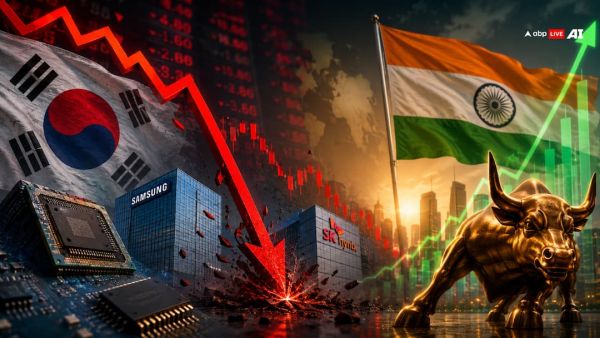
South Korea’s benchmark KOSPI index suffered a dramatic collapse on Tuesday, plunging 10 per cent by the close after a sharp wave of selling swept through the market and triggered a market-wide circuit breaker.
The Korea Exchange halted trading for 20 minutes after the benchmark index breached the 8 per cent decline threshold. However, selling pressure intensified once trading resumed, dragging the KOSPI down 10 per cent to settle at 8,203.84.
The steep decline marked a sudden reversal for a market that had enjoyed months of strong gains, with heavy selling in technology and semiconductor stocks leading the downturn. Samsung Electronics dropped more than 10 per cent, while SK Hynix fell over 12 per cent.
Profit Booking After A Massive Rally
VK Vijayakumar, chief investment strategist at Geojit Financial Services, said the correction was driven by several factors, including profit booking after a prolonged rally, expensive valuations in AI-related shares and high levels of leverage in the market, Business Standard reported.
According to Vijayakumar, the KOSPI had delivered extraordinary returns over the past year. The benchmark generated returns of nearly 200 per cent during the past 12 months and had risen about 110 per cent so far this year.
"When you have such unprecedented, steep rallies in the market, and when the rallies are driven by two stocks in South Korea, Samsung and SK Hynix, corrections are also steep," he said.
AI Trade And Valuation Concerns
Vijayakumar said elevated valuations in semiconductor and artificial intelligence-related companies had made the market vulnerable to a sharp correction.
He noted that the AI-driven rally in South Korea and Taiwan had become increasingly concentrated, exposing investors to significant risks.
"The problem with this AI trade, which is confined to South Korea and Taiwan, is that the concentration risk is excessive. In South Korea, these two stocks, Samsung and SK Hynix, account for 52 per cent of KOSPI," he said.
Foreign Selling Adds To Pressure
Foreign investor selling further intensified the decline. According to a Bloomberg report, overseas investors sold nearly 5 trillion won worth of KOSPI shares on Tuesday.
Vijayakumar said sharp market rallies are often followed by equally strong corrections as institutional and foreign investors begin to reduce exposure.
"When you see steep rises like this, there will be steep corrections also, because the buyers may be selling, institutions may be selling. Foreign institutions have been selling for some time, and they have stipulations also," he said.
Retail Borrowing Raises Concerns
Vijayakumar said foreign funds operate under limits on the amount they can invest in a single stock and suggested those limits had already been reached in some cases.
He added that South Korean regulators had increased participation opportunities for retail investors. Data showed retail traders added a record 7.9 trillion won worth of positions during Tuesday's session.
"Retail investors in South Korea have been borrowing excessively to invest in stocks. Investors are taking personal loans from banks, borrowing against the insurance, and others," he said.
Weak Global Cues Hurt Sentiment
The sell-off in South Korea also coincided with weak sentiment across global technology stocks.
Investors remained cautious ahead of Micron Technology's earnings announcement, which is being closely watched for signals on AI-related chip demand. Overnight, the Nasdaq Composite fell 1.32 per cent, adding to concerns across Asian markets.
The weakness in US technology shares further weighed on investor sentiment and contributed to the broader market decline.
Can India Benefit From The Shift?
Vijayakumar said the correction in South Korea could prove beneficial for India if the trend continues.
He noted that while earnings declined during FY25, earnings growth in the Nifty 500 improved by 15.6 per cent in FY26, which remains consistent with long-term averages.
Vijayakumar said India offers comparatively stable returns, unlike markets that experience sharp rallies driven by a handful of stocks.
"In contrast, markets such as South Korea and Taiwan may generate returns in a particular year, but such performance is unlikely to be sustained indefinitely. This could ultimately benefit India. Foreign institutional investors (FIIs), who have been reallocating funds from India to markets such as South Korea and Taiwan, may reconsider their positioning and return to India, where returns are likely to be more stable and relatively safer," he said.
-
The Greatest Goal Scorers in FIFA World Cup History

-
Telegram: No office, no large team... Find out the inside story of how Telegram operates with just 30 employees..

-
'Go to Calcutta HC': SC on plea against Bengal denying ration to persons excluded in SIR

-
Delhi Police Head Constable Exam 2025: Final Answer Key and Scores Released

-
SEBA Assam HSLC 10th Compartment Exam Results Released