From campus to community: Student-led book clubs rewrite Delhi's reading culture
ETimes | June 23, 2026 7:39 PM CST
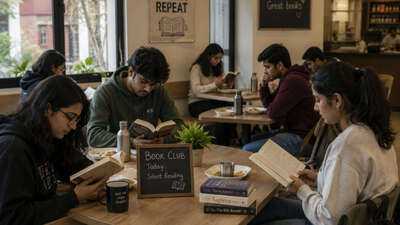
Campus book clubs are mushrooming throughout the city and also growing into communities with larger goals. With literary societies and book clubs scaling in Delhi University , students running these groups reflect on their impact on the capital's reading culture.
‘Clubs are more open and free now’
The concept of book clubs isn’t new, the format is. Evolving from exclusive, reader-only communities to free-flowing discussion groups welcoming beginners, Delhi’s campus book clubs have made reading accessible. “Earlier it used to be exclusive. People didn't know what was happening in literary societies. I used to envy the St. Stephen’s Shakespeare Society as a student. The situation is completely different because book clubs are now mushrooming everywhere, which is just amazing to see,” shares Sneha Misran, a Hindu college alumna who co-founded the community Kitaab Club in 2014.
Finding community in fellow readers
Some book clubs in colleges have existed long before today’s students learnt how to read! Kamala Nehru College’s book club Unabridged was started in the early 2000s. Third-year psychology student Ankita Jain, president of the club, shares how it has grown. “The biggest plus point about university campuses is, it brings people from across the country together. Book clubs bring people with diverse backgrounds—and equally diverse reading habits—into one space, opening up conversations across viewpoints and even languages.”
Third spaces for students
A Gargi college alumna, Molina Singh, started Delhi Reads noticing the lack of third spaces. She says that she still runs it like a student-led community which is open for discussions. “My college experience was integral to starting Delhi Reads – without it, I don’t think the community would exist. I spent half my college years in the pandemic, and when campuses reopened, my batch was coming straight out of that isolation. Socialisation was at an all-time low, and everything felt different. That one year I spent on campus made it clear how much these social spaces were missing, and how necessary they were.”
 No academic deadlines here!
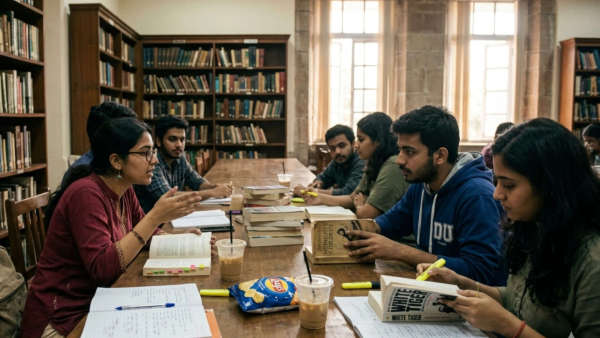
With coursework already demanding extensive reading, leisure reading can feel like a chore. Book clubs counter this by turning reading into a low-pressure social space. “Knowing that most courses already require extensive academic reading, we don't have set reading meetups. Our meetings are about stealing one hour of relaxation and chill, with fellow readers to gush about latest reads, recommendations, and fun literary games,” Ankita adds.
Bhargawi, a third-year student, president of the Kirori Mal College Book Club shares the sentiment, “The book club was started as a space for like-minded readers in our college as an alternative to the literary society, which was an extension of the English department. We wanted a space which wasn't governed by mainstream literature taught in classrooms.”
Faculty leads the way for students
Faculty aims to push reading as well, like Dr Lalkrishna, an associate professor at Motilal Nehru College (Evening) one of the faculty in-charge at DU Reads. “Students are eager to read and discuss, but opportunities are limited—that’s what inspired faculty to start this initiative a year ago. It’s a monthly gathering held in the last week of every month, where students come together to discuss a book. The idea is to encourage reading habits and give students a space to express themselves," he says.
Blending formats for the community
Starting a book club in college gives readers a slate to experiment with formats. Ankita shares that they often host movie screenings of book adaptations or movies that are similar to the book, while Kitaab Club does vinyl listening sessions from albums that relate to the book. “For one vinyl listening event, we chose a book called 'The Bluest Eye' by Toni Morrison. And then we picked up a vinyl record by Roberta Flack, who is a black jazz artist. The book club got together and celebrated the culture around the book as well. We've been playing around with formats to enhance the experience for readers,” Sneha shares.
‘Clubs are more open and free now’
The concept of book clubs isn’t new, the format is. Evolving from exclusive, reader-only communities to free-flowing discussion groups welcoming beginners, Delhi’s campus book clubs have made reading accessible. “Earlier it used to be exclusive. People didn't know what was happening in literary societies. I used to envy the St. Stephen’s Shakespeare Society as a student. The situation is completely different because book clubs are now mushrooming everywhere, which is just amazing to see,” shares Sneha Misran, a Hindu college alumna who co-founded the community Kitaab Club in 2014.
Finding community in fellow readers
Some book clubs in colleges have existed long before today’s students learnt how to read! Kamala Nehru College’s book club Unabridged was started in the early 2000s. Third-year psychology student Ankita Jain, president of the club, shares how it has grown. “The biggest plus point about university campuses is, it brings people from across the country together. Book clubs bring people with diverse backgrounds—and equally diverse reading habits—into one space, opening up conversations across viewpoints and even languages.”
Third spaces for students
A Gargi college alumna, Molina Singh, started Delhi Reads noticing the lack of third spaces. She says that she still runs it like a student-led community which is open for discussions. “My college experience was integral to starting Delhi Reads – without it, I don’t think the community would exist. I spent half my college years in the pandemic, and when campuses reopened, my batch was coming straight out of that isolation. Socialisation was at an all-time low, and everything felt different. That one year I spent on campus made it clear how much these social spaces were missing, and how necessary they were.”
No academic deadlines here!
With coursework already demanding extensive reading, leisure reading can feel like a chore. Book clubs counter this by turning reading into a low-pressure social space. “Knowing that most courses already require extensive academic reading, we don't have set reading meetups. Our meetings are about stealing one hour of relaxation and chill, with fellow readers to gush about latest reads, recommendations, and fun literary games,” Ankita adds.
Bhargawi, a third-year student, president of the Kirori Mal College Book Club shares the sentiment, “The book club was started as a space for like-minded readers in our college as an alternative to the literary society, which was an extension of the English department. We wanted a space which wasn't governed by mainstream literature taught in classrooms.”
Faculty leads the way for students
Faculty aims to push reading as well, like Dr Lalkrishna, an associate professor at Motilal Nehru College (Evening) one of the faculty in-charge at DU Reads. “Students are eager to read and discuss, but opportunities are limited—that’s what inspired faculty to start this initiative a year ago. It’s a monthly gathering held in the last week of every month, where students come together to discuss a book. The idea is to encourage reading habits and give students a space to express themselves," he says.
Blending formats for the community
Starting a book club in college gives readers a slate to experiment with formats. Ankita shares that they often host movie screenings of book adaptations or movies that are similar to the book, while Kitaab Club does vinyl listening sessions from albums that relate to the book. “For one vinyl listening event, we chose a book called 'The Bluest Eye' by Toni Morrison. And then we picked up a vinyl record by Roberta Flack, who is a black jazz artist. The book club got together and celebrated the culture around the book as well. We've been playing around with formats to enhance the experience for readers,” Sneha shares.
READ NEXT
-
How countries live with earthquakes and build resilience
-
Arunachal flash floods: Hunt on for 4 missing as Assam sounds high alert
-
Devastating Earthquake Hits Venezuela, Thousands Affected

-
UK Faces Challenge with Over 50,000 Missing Migrants Amid Immigration Reform

-
We have solved the information problem. Now we must solve the judgement problem