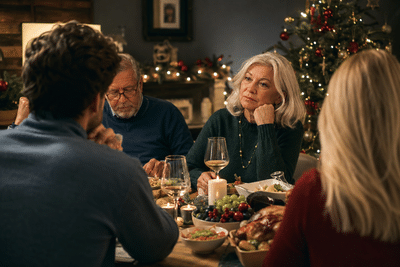
Holiday arrangements are often a source of tension in families. When adult children get married, move away or travel during the holidays, long-standing family gatherings can fade. And when a parent with years of experience hosting and organising such gatherings realises that their grown child will not be at Thanksgiving or Christmas, a sudden burst of emotions can follow. From the side of adult offspring, this can be perceived as some kind of unreasonable guilt trip or an overreaction.
Adult children tend to be defensive, believing that their parents are being stubborn and do not understand the difficulties of adulthood. The question is, what makes one skipped dinner or an alteration in the schedule such an emotionally charged ordeal?
However, a study published in the completely reframes this seasonal conflict. By analysing 50 years of psychological data on family dynamics, the researchers identified a clear distinction between daily family routines and deeply symbolic family rituals.
The research suggests these celebrations can help maintain family unity and stability. If an adult child changes the routine, a parent may perceive it as a threat to family stability. Their distress may be an automatic psychological reaction to a family transition, not an attempt to manipulate anyone.
The powerful inertia of family identity
This means a parent’s disappointment with holiday changes is not necessarily about controlling your plans. It is connected with the huge emotional investment in the creation of a common family history. For many parents, creating a safe and stable environment for children is a central concern, and holiday traditions can be an important part of that.
A study titled reinforces exactly why these gatherings carry such an overwhelming psychological weight. Across multiple distinct trials, researchers discovered that family holiday rituals directly and systematically amplify feelings of closeness, emotional involvement, and a collective family identity. Because these rituals act as the literal vehicle for family unity, a parent naturally projects an expectation of permanence onto them.
During the holidays, the family table can become a place where a parent’s role as protector and caregiver feels especially present. When an adult child spends the holiday elsewhere, that sense of identity can feel disrupted, especially without the comfort of long-established traditions.
 From defensive boundaries to mutual empathy
Families often go through a major psychological renegotiation as they shift from a dependent nuclear family to a group of independent adult households. This is a normal stage in development, and understanding the science can change how the discussion feels. That understanding can reduce defensiveness. The adult child can understand that the parent’s pain may come from family bonds and long-standing routines rather than a desire to control.
The next time vacation plans spark an emotional discussion, try to move past the initial irritation. Remember that your parent may not be criticising your adulthood, but grieving the loss of a tradition they expected to continue. It can help to acknowledge the loss without giving up your own plans or your partner’s family commitments. All that may be required is simply recognising the significance of the tradition, expressing heartfelt appreciation for all the hard work they put into making those family memories, and finding a way to form new traditions as the family changes.
-
Pawan Kalyan To Begin Shooting For OG 2 Soon; Sujeeth Teases Opening Scene Where Snow Turns Into Blood

-
Fiction: Mehr, a graphic novelist, stumbles upon Queen Jind Kaur and is immediately taken in by her

-
This Budget Electric Scooter Costs Under Rs.50,000 and Runs All Day on a Single Charge

-
How Weather Affects Mood: Why does your mood change with the weather? Discover the science behind it..
-
Amarnath Yatra 2026: Government fixes bus and auto fares for the pilgrimage; check the ticket rates for various routes..