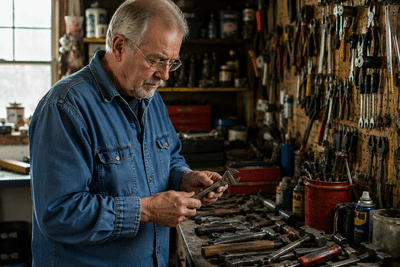
Walk into almost any father's garage, basement, or backyard shed, and you will likely encounter a deeply confusing sight: a collection of worn-out, completely broken tools. There are hammers with split wooden handles, rusted wrenches that no longer turn smoothly, and power drills that gave up their internal motors years ago. To an adult child trying to help their parent declutter, these items look like textbook junk. It is easy to view the refusal to toss them as stubbornness.
Grown children often wonder why their fathers keep items that no longer work. It is easy to assume that keeping a box of non-functional tools is a sign of a parent simply being set in their ways or refusing to accept a cleaner, more organised living space.
However, a study on consumer psychology published in the completely reframes this behaviour. The research by Dr Russell Belk explores the concept of the extended self, suggesting that human identity can extend into the objects we master, alter, and invest labour in. When a father uses a tool for decades, it can come to symbolise his problem-solving and effort. Discarding even an objectively broken tool feels like erasing the permanent, material proof of his capabilities and his history of industrious usefulness to others.
The language of acts of service
To understand why an old socket wrench or a dull hand saw holds such an immense emotional grip, you have to look at how different generations were socialised to express care. For many fathers, love is rarely expressed through verbal vulnerability or emotional declarations. Instead, their primary love language is instrumental support—showing up physically to solve tangible, real-world problems.
Dad shows love by fixing a squeaky door, tuning up the lawnmower, or replacing broken pipes. These tools are part of how he shows care and provides support. The collection of his used tools is his physical lifelong documentation of all the silent services. The worn handle of his old hammer is tangible proof of the times he stepped up to help his family.
Identity protection in times of transition
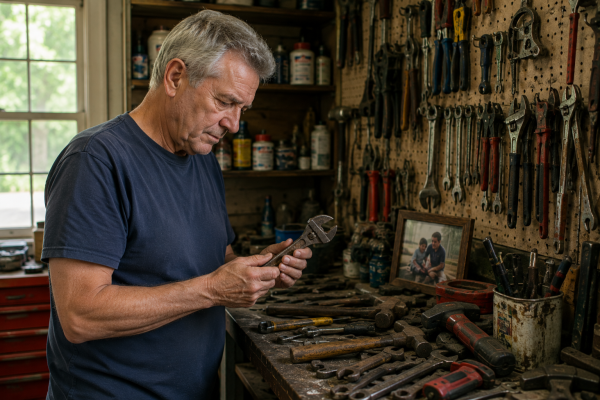
The psychological need to preserve such things is especially pronounced at the time of men's transition to retirement age and later stages of their lives. This developmental issue is well researched in a study titled .
In addition, the study was done to find out why older people are extremely protective of those objects which look like they have no practical use to other people. According to the study, these items can provide emotional support and help preserve identity continuity. As men age and retire, they may have fewer chances to present themselves as competent providers. Keeping those tools can help preserve a self-image as someone who is always ready to repair and provide.
Putting ourselves in the shoes of the owner of such a mess
If we see a seemingly useless item as an archive of memories, the situation changes.
When you are in your father's workshop, pause before complaining about the rusty, broken equipment. He may be trying to protect his legacy as someone who was dependable and important to his family. This does not imply that you should tolerate dangerous conditions just to validate his history. All it takes is asking about a particular tool and acknowledging the decades of labour behind it.
-
What Germany’s Group Stage at the World Cup Really Tells Us

-
United States capable of hosting 64-team World Cup and may bid for 2038 event, says 2026 Task Force head

-
Bengaluru Apartment Shoe Theft: 27 Pairs of Branded Shoes Worth Rs 1.3 Lakh Stolen
-
Why Is OMER Stock Falling Today?

-
Indian Industries Must Adopt Tech to Improve Low Productivity: CII