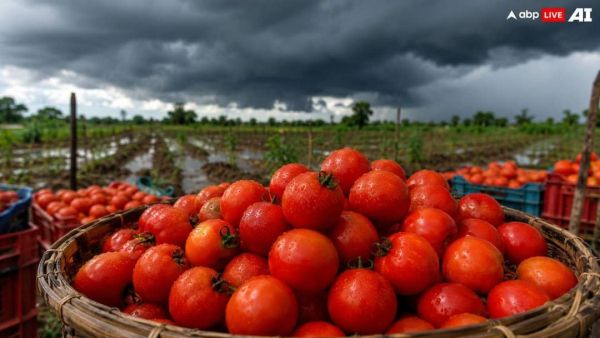
India's tomato prices are climbing once again, bringing back memories of the sharp spikes that have periodically strained household budgets over the past few years. While tomatoes have always been among the country's most volatile food items, this time the price rally is being driven by a combination of extreme weather, patchy monsoon rains and disruptions in supplies from key producing states.
According to data from the Department of Consumer Affairs' Price Monitoring Cell, the average retail price of tomatoes rose to Rs 43.7 per kg on Wednesday, up 24 per cent from a year earlier, reported Financial Express. Prices have also increased 26 per cent over the past month as supplies failed to keep pace with demand.
The surge comes at a time when the southwest monsoon has made a weak start. According to the India Meteorological Department (IMD), rainfall is currently running 43 per cent below normal, prompting concerns over crop conditions during the crucial kharif sowing season. Agriculture Minister Shivraj Singh Chouhan has also warned that 315 districts are expected to receive below-normal rainfall, raising questions over the outlook for several rain-fed crops, reported Outlook India.
Although the immediate impact is being felt in tomatoes, experts say the current trend offers an early indication of how weather disruptions can quickly feed into food inflation.
Tomato Prices Feel the Heat
Traders say supplies from major tomato-growing regions, including Maharashtra, Karnataka and Uttar Pradesh, have been affected by a combination of heatwaves and deficient rainfall.
Ashok Kaushik of Delhi's Azadpur Mandi, one of India's largest wholesale fruit and vegetable markets, told FE that supplies from Uttar Pradesh and Haryana have nearly stopped, while growers in Karnataka and Maharashtra are finding better prices in southern markets.
The disruption has pushed wholesale prices sharply higher. According to the Department of Consumer Affairs, the modal wholesale tomato price increased to around Rs 3,000 per quintal, nearly 50 per cent higher than a year ago.
At Azadpur, wholesale prices have climbed to about Rs 2,700 per quintal, representing a 66 per cent year-on-year increase, according to the traders.
The situation is even more pronounced at Andhra Pradesh's Madanapalle Agricultural Market, regarded as one of Asia's largest tomato trading hubs. Traders there say wholesale prices have crossed Rs 34,000 per quintal this week compared with around Rs 2,000 per quintal a month ago, as buyers from multiple states compete for limited arrivals.
Why Weather Is Playing Such a Big Role
Tomatoes are among the first vegetables to respond to weather disruptions because of their relatively short production cycle and highly regional supply chain.
According to an official note from the Agriculture Ministry, tomato production is spread across nearly 18 states, including Madhya Pradesh, Gujarat, Maharashtra, Chhattisgarh, Odisha, West Bengal, Telangana, Karnataka, Tamil Nadu and Punjab.
This geographical spread generally helps stabilise supplies throughout the year. However, the ministry notes that production disruptions in even a few key states can quickly affect the national supply chain.
The Department of Consumer Affairs has also identified June-August and October-November as lean production periods for tomatoes, when seasonal shortages often lead to price increases.
This year's weather has amplified that seasonal vulnerability.
The IMD has already forecast a below-normal monsoon for 2026, the first such forecast in 11 years, according to Reuters. The weather office has also indicated that weak rainfall is likely to continue in the near term, increasing uncertainty for farmers during the early stages of kharif cultivation.
Monsoon Deficit Raises Broader Concerns
While tomatoes are currently dominating headlines, policymakers are watching the broader agricultural picture closely.
Following a review of monsoon preparedness, Agriculture Minister Shivraj Singh Chouhan said the government has identified 315 districts across states including Maharashtra, Madhya Pradesh, Gujarat, Rajasthan, Karnataka, Uttar Pradesh, Bihar, Telangana, Andhra Pradesh and Odisha that are likely to receive below-normal rainfall.
Among them, 111 districts have been categorised as the most vulnerable because less than one-fourth of their agricultural land is irrigated, making crops heavily dependent on rainfall.
The timing is significant because June and July mark the peak sowing period for kharif crops such as rice, maize, soybean, cotton and sugarcane. While overall kharif sowing has marginally exceeded last year's pace, soybean remains the notable exception, according to Agriculture Ministry data.
Despite these concerns, the government has maintained that there is no reason for panic at this stage, stressing that contingency plans have already been activated across vulnerable districts.
Government Bets on Contingency Measures
The Centre has moved quickly to prepare for a weaker monsoon, focusing on minimising the impact on both farm output and food supplies.
Speaking after reviewing monsoon preparedness, Chouhan said the government has drawn up state-specific contingency plans for districts expected to receive below-normal rainfall. The plans encourage farmers in rain-fed regions to shift towards short-duration and less water-intensive crops, including pulses, oilseeds and coarse cereals.
"There is a gap in rainfall. We need to suggest to farmers to go for alternative crops. We will not let farm fields remain empty," Chouhan said.
The minister also stressed that seed and fertiliser availability remains adequate and that the government is working to ensure agricultural production does not decline despite the weather challenges.
To strengthen preparedness, the Agriculture Ministry has asked its network of 731 Krishi Vigyan Kendras (KVKs) to step up farmer outreach through SMS alerts, WhatsApp groups, call centres and local advisories. States have also been directed to improve water conservation by cleaning ponds, farm reservoirs, streams and check dams under the Viksit Bharat–Guarantee for Rozgar and Ajeevika Mission Gramin (VB-GRAM G) programme.
In addition, an El Niño Monitoring Cell and a Crop Weather Watch Group have been established to monitor rainfall patterns and provide real-time advisories.
Food Inflation Could Face Fresh Pressure
The sharp increase in tomato prices comes at a time when food inflation remains under close watch.
According to the Ministry of Statistics, tomato inflation stood at 48.43 per cent in May, contributing to food inflation of 4.78 per cent during the month. Economists note that vegetables often respond quickly to weather-related supply disruptions, making them one of the earliest indicators of changing food price trends.
Whether the current increase develops into a broader inflationary cycle will depend largely on how the monsoon progresses over the coming weeks.
For now, the government has pointed to comfortable stocks of staple grains such as rice and wheat, which could help cushion any immediate supply shocks. It has also expanded access to crop insurance, farm credit and income-support schemes in districts considered vulnerable to deficient rainfall.
Not Every Kitchen Staple Is Turning Costlier
Tomatoes may be grabbing attention, but the price trend across vegetables remains mixed.
Department of Consumer Affairs data show that the average retail price of potatoes has declined 14 per cent from a year earlier to Rs 21.99 per kg. Onion prices have increased only marginally to Rs 28.05 per kg.
Traders attribute this relative stability to healthy rabi production and adequate stocks, which are expected to meet demand until fresh early kharif arrivals begin reaching markets later in the year.
This contrast underlines an important feature of India's food economy: while weather shocks can send prices of perishable vegetables soaring within weeks, crops with stronger inventories and longer storage life tend to remain more stable.
What Consumers Can Expect Next
Traders believe tomato prices are likely to remain elevated over the next few weeks until supplies from Maharashtra, Karnataka and Uttar Pradesh improve following better rainfall.
The pace of the monsoon will therefore remain the key factor determining whether the current price spike remains confined to tomatoes or begins affecting a wider range of food items.
-
Mexico player ratings vs Czechia: Gilberto Mora shines as El Tri achieve flawless group-stage record and Guillermo Ochoa bids emotional Azteca farewell

-
Venezuela's 7.2 quake was foreshock to more powerful 7.5 earthquake: USGS

-
US 'stands ready' to help Venezuela: Trump

-
Brazil Triumphs Over Scotland in World Cup 2026, Lula Celebrates Team's Performance

-
A vapor chamber helps keep your phone cool—why is it essential for mobile phones?