In a democratic system, elections are premised on the idea that voters elect representatives who remain honest and accountable to the public, upholding the very mandate upon which they were chosen. However, in contemporary India, the strategic defection of political parties, their mergers and the tendency to forge alliances based purely on convenience amount to nothing less than a betrayal of the democratic electoral system and the voters’ trust.
The recent problems in West Bengal have shown us this. The problems that started after the West Bengal Assembly election results completely destroyed the trust in politics. However, this is not the first time that something like this has happened. Twenty out of the 28 members of the Trinamool Congress (TMC) in the Lok Sabha have suddenly decided to join a party that not many people know about – the Nationalist Citizens Party of India. Also 64 members of the Bengal Assembly have formed a separate group and have decided to shift their political allegiance.
This is not a case of people in a party disagreeing with each other or a fight between two leaders: Mamata Banerjee and her nephew Abhishek Banerjee or the wives of the old group leaders. It is part of a planned system where the critics of the developments argue that the episode reflects a broader trend toward centralisation of political power and the weakening of regional political form at ions, suppression of local political voices and eventually marginalising them.

The 10th Schedule, also known as the anti-defection law, was made to stop politicians from switching parties. According to this law, if a member of the Lok Sabha or the Assembly leaves their party and joins another party, they will lose their membership. However, there is a loophole in this law: the merger law.
The loophole in the law
If two-thirds of a party’s members in the legislature leave the party and join another party at the same time, they will not face any legal action.
In West Bengal, the Bharatiya Janata Party (BJP) and its strategists, such as Nishikant Dubey and Bhupender Yadav, used this law to create a loophole in the TMC. They needed two-thirds of the TMC’s 28 members in the Lok Sabha, which amounts to 19 members. They managed to get all 20 members to join them – one more than they needed to avoid legal action.
As a result, they are protected from being disqualified under the 10th Schedule.
The question is: why did these 20 members not join the BJP directly? If they had joined the ruling party after the elections, they would have been heavily criticised by the public and it would have been hard for them to show their faces. Also, the legal battle would have become complicated.
So, they came up with a strategy using a buffer party, which was registered in Tripura
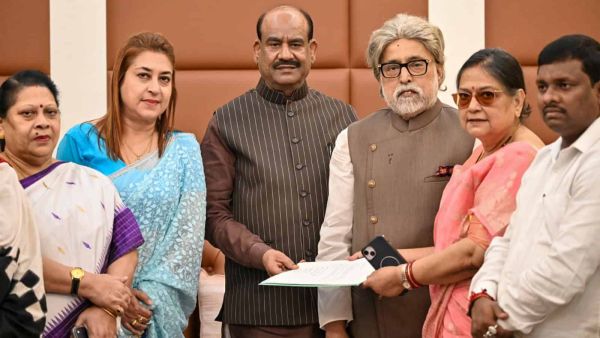
and Howrah. They found a small and almost unknown party, the National Citizens Party of India. This party has no presence in politics. Its candidates get fewer votes than the none of the above (NOTA) option. The rebel members approached Lok Sabha Speaker Om Birla and announced that their group was merging with the National Citizens Party.
The next moment, the new group announced that they were supporting the BJP-led National Democratic Alliance (NDA) at the Centre. This is like a washing machine in politics, where you go in tainted and come out clean with a label, and by evening, you become a big ally of the country’s largest coalition.
In this way, with 20 members, the National Citizens Party suddenly became the largest party in the Lok Sabha and the second-largest force in the NDA after the BJP. Critics view such political realignments as a distortion of the electoral mandate granted by voters.
A person who voted for a candidate with Mamata Banerjee’s picture and the TMC symbol then finds out that the candidate is sitting in Parliament and supporting a political formation that the voter never endorsed.
Why are state-based parties being targeted?
The ruling party’s primary political narrative is “One Nation, One Party” and a form of hyper-centralised governance. Critics argue that such developments contribute to an increasing concentration of political authority at the national level. State-based parties across India continue to act as important checks on centralised political authority.
These parties are like the TMC in West Bengal, the Shiv Sena and Nationalist Congress Party (NCP) in Maharashtra, the Dravida Munnetra Kazhagam (DMK) in Tamil Nadu and the Rashtriya Janata Dal (RJD) in Bihar. They are a problem for the ruling party’s plans.
Weakening regional pride, politics in West Bengal
Mamata Banerjee always says the BJP are outsiders. As long as a strong regional leader remains influential, the BJP cannot boss them around. The weakening of a regional party may increase the influence of the central government in state affairs.
Then decisions about West Bengal are made by the Union government in New Delhi, not in Kolkata. Only regional parties can stand up to the government in their state. They can ask for things like wages for 100 days of work, a share of taxes and help for floods and cyclones.
Leaders of national parties are too scared to speak out against their bosses at the central government. If a party like the TMC is weakened in West Bengal, the central government can do what it wants without anyone stopping it.
Support needed in Parliament
The ruling party wants to pass laws and changes to the Constitution. They need a lot of support in Parliament to do so. Recently, the Opposition stopped some of their plans. The BJP just got a lot of support from 20 TMC MPs. This will help them pass laws without anyone stopping them. They want to control Parliament even if they lose state elections.
How are leaders manipulated? How do leaders who have adhered to a single ideology for years, who never tire of praising their party’s supreme leader day and night, suddenly become rebels overnight? Do their consciences suddenly awaken? No.
Such political realignments are often shaped by a combination of institutional pressures, political incentives and strategic calculations.
Opposition parties across India have repeatedly alleged that agencies such as the Enforcement Directorate (ED) and the Central Bureau of Investigation (CBI) are used selectively against political opponents. The Union government has consistently rejected these allegations. Critics, nevertheless, argue that these agencies increasingly influence political negotiations.
The leaders who have rebelled in Bengal have often been implicated in some scam, be it Saradha, Narada, Rose Valley or cattle smuggling and teacher recruitment scams. Critics describe the process as a combination of legal pressure, political incentives and strategic negotiations.
Two options are presented to the leaders. Either you prepare to go to jail and ruin your entire career, or, according to our script, break the party and join us and get a “clean chit.” This fear makes even the most prominent regional leaders surrender to the factions.
Political ambition and elite realignment
A crisis was brewing within the TMC, a generational war. On one side were Mamata Banerjee’s old guard, like Sudip Bandyopadhyay, and on the other side was Abhishek Banerjee’s new, corporate-style youth team. The older leaders felt their careers were over in the new organisation and were being cornered. BJP strategists targeted this fear and ambition. They lured these older leaders by promising them a ministerial position at the centre, a future governorship or a guaranteed secure seat for them and their families in the upcoming elections if they split with a two-thirds majority.
When a leader feels that they are not being heard within the party, they are continuously instigated from outside. They are subjected to continuous meetings (such as the series of meetings held at Bhupender Yadav’s house in New Delhi). They are assured that “you are not alone; you have 20 other people with you, the entire legal team is with you and nothing will happen to you.” When a leader feels that the entire state and central machinery is behind them, they begin to defy their own party’s high command.
Consequences for voters
The most tragic aspect of this entire game of leader-hopping and party-splitting is that the common public (the voter) has become completely invisible. Voters stand in long lines in the morning, braving the heat and risking riots to cast their votes. They trust the ideology of a single leader or party. But once the elections are over, the value of their vote becomes like a commodity.
Political scientist William Riker argued that federal systems survive when regional political actors retain meaningful autonomy. Similarly, Indian scholars such as Rajni Kothari view regional parties as essential intermediaries between local aspirations and national governance. Our Constitution calls India a “union of states,” where each state has the right to its own distinct political and cultural identity.
But if regional parties are systematically dismantled and their base destroyed in every state, as happened with the Shiv Sena (Eknath Shinde) and the NCP (Ajit Pawar) in Maharashtra, and, if similar developments continue elsewhere, federalism may increasingly come under strain.
Critics warn that excessive centralisation could weaken the autonomy that states enjoy within India’s federal framework. One where Kolkata, Mumbai or Chennai will have to beg the Centre for every small decision and every scheme.
(The author of this article, Azam Khan, is working as an independent researcher focusing on violence against Muslims, Dalits and other minorities in India after Independence)
-
BBC Commentary Team Announced for South Africa vs South Korea Clash

-
Fabien Barthez tipped for surprise coaching comeback with French national team

-
France to Rotate Squad with Five Changes Ahead of Norway Clash

-
Ian Wright slams lack of ambition in Scottish football, urging a 'bolder, braver vision' for the national game

-
Mexico player ratings vs Czechia: Gilberto Mora shines as El Tri achieve flawless group-stage record and Guillermo Ochoa bids emotional Azteca farewell