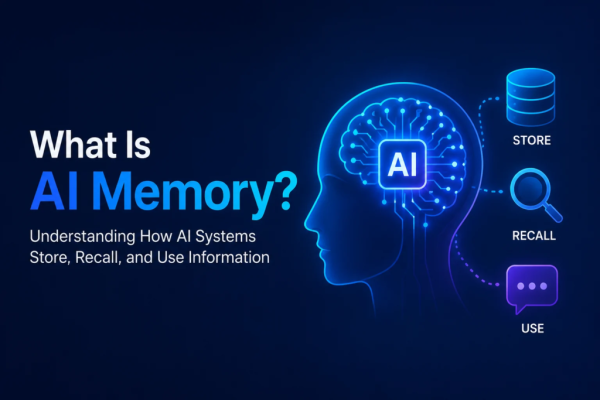
AI has come a long way since rule-based systems. The current AI technologies can engage in conversation, have memory of their users’ preferences, provide personalised recommendations, and adjust accordingly. All this is possible due to a key factor – memory of AI
However, what is AI Memory? And why is it so vital in the context of modern AI applications? With more and more businesses turning to AI-powered solutions in such diverse areas as customer support, content generation, healthcare, finance, and business process management, knowledge about AI memory will allow achieving the maximum efficiency at affordable costs and with due respect to user privacy.
In this article, we’ll examine the AI memory concept, its features, benefits, challenges, and ways of implementation.
What Is AI Memory?
AI memory can be defined as the ability of the AI system to retain, recall, and apply information over time. Just like people remember different experiences, facts and preferences, AI systems also employ memory techniques to retain context, make smarter decisions and create more personalised experiences for the user.
Instead of treating each interaction as something that happens for the first time, AI memory helps the AI system to build on information it has gained before. It helps AI tools to generate relevant responses and adapt behaviour depending on previous data.
AI memory of the current day usually includes two major parts – short-term memory and long-term memory.
What Is AI Memory in Short-Term and Long-Term Contexts?
Understanding what is AI Memory requires examining its two primary forms.
Short-Term Memory
Short-term memory is sometimes referred to as working memory or context memory and refers to information relevant to the task at hand.
For instance, in an interaction with a chatbot, short-term memory helps store recently received messages, questions, and commands so that the AI does not have to keep repeating itself.
Key characteristics of short-term memory include:
- Information is stored temporarily
- Supports active communication and processes
- Understanding based on context
- Storage capacity is usually small
Long-Term Memory
Information is stored long-term. It can involve user preferences, interaction history, business information, learned models, and domain expertise.
For example, a recommendation system will store user preferences and then use that information in recommending products even after several months.
Key characteristics of long-term memory include:
- Storage of information
- Facilitates personalization
- Permits learning from historical information
- May store information over several sessions
By combining both memory types, AI systems can deliver responses that are contextual, relevant, and personalised.
How Artificial Intelligence Memory Improves System Performance
When discussing what AI memory is, it is important to understand the practical benefits it provides.
Enhanced Contextual Understanding
One of the best advantages of artificial intelligence memories is that of context awareness. With artificial intelligence, one will be able to refer to past interactions in order to understand what the user means.
For instance, if the artificial intelligence system remembers previous user queries, then it will offer an answer without asking the user to repeat themselves.
The advantage of this improved context awareness will result in:
- Natural interactions
- Less repetition
- Task completion faster
Personalized User Experiences
Another important aspect of what AI Memory is is its role in personalisation.
AI can save the user’s preferences, interests, and behaviour to provide a customised experience to the user. Memory is used in various ways by streaming services, e-commerce sites, and digital assistants to customise recommendations.
Advantages of customisation include the following:
- More engaged users
- Enhanced customer satisfaction
- High conversion rates
- Customer loyalty
Adaptive Learning
AI memory helps computers learn from past experiences and data trends.
Unlike each new experience being like starting from scratch every single time, AI can use its memory to make better predictions and suggestions based on past data and trends.
Adaptive learning helps organizations:
- Improve operational efficiency
- Enhance decision-making
- Identify emerging trends
- Reduce repetitive training requirements
What Is Artificial Intelligence Memory’s Role in Modern Large Language Models?
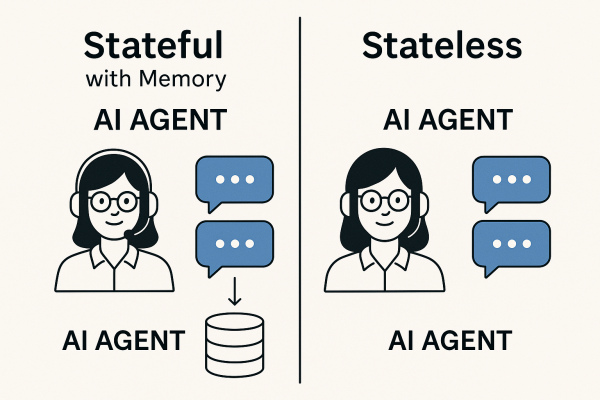
Large Language Models (LLMs) such as modern conversational AI systems depend heavily on memory-like mechanisms.
When users ask, “What is AI Memory?”, the answer often involves understanding how these models process context.
LLMs use context windows that hold information from ongoing conversations. Some advanced systems also incorporate persistent memory layers that store user preferences and long-term information.
These capabilities allow AI assistants to:
- Maintain conversation flow
- Remember previous topics
- Provide personalized responses
- Improve task completion accuracy
Without memory, every interaction would feel disconnected and repetitive.
Challenges and Limitations of Artificial Intelligence Memory
Although AI memory offers significant advantages, it also introduces several challenges.
Capacity and Scalability Issues
As organisations collect more data, memory requirements grow substantially.
Storing large volumes of structured and unstructured information requires the following:
- Additional storage infrastructure
- Increased computational resources
- Faster retrieval mechanisms
- Higher operational costs
Scaling memory systems effectively remains a major technical challenge.
Data Quality Problems
Understanding what AI memory is also means recognising that memory is only as valuable as the data it contains.
Poor-quality data can result in:
- Inaccurate recommendations
- Incorrect responses
- Biased outcomes
- Reduced trust in AI systems
Organisations must implement strong data validation and quality-control processes to ensure reliable memory storage.
Outdated Information
Information changes over time. User preferences evolve, regulations are updated, and new facts emerge.
If artificial intelligence memory retains outdated information, the system may generate inaccurate or misleading responses.
To address this issue, organisations should implement:
- Memory refresh mechanisms
- Automatic expiration policies
- Continuous data updates
- Version control systems
Privacy and Ethical Concerns
One of the biggest concerns surrounding what AI memory is involves privacy.
Since memory systems often store personal information, organisations must carefully manage the following:
- User consent
- Data security
- Regulatory compliance
- Information transparency
Failure to address privacy concerns can damage trust and create legal risks.
The Cost of AI Memory: Tokens and Computing Resources
Modern AI systems often operate using token-based architectures. Every piece of text processed by a model consumes tokens, which directly impacts costs.
Token Consumption
The more information an AI model remembers, the more tokens it may need to process.
Long conversations and extensive memory histories can increase:
- Processing costs
- Inference expenses
- Response latency
- Infrastructure requirements
Cost Optimization Strategies
Organisations seeking to maximize value must balance memory benefits against operational expenses.
Effective optimization strategies include:
- Storing only critical information
- Summarizing conversation histories
- Removing redundant data
- Prioritizing high-value memory retention
These approaches help reduce token usage while preserving performance.
Conclusion
What, then, is AI memory? It is simply the capability of the artificial intelligence to store, recall, and process information. This capability of artificial intelligence memory makes it possible for there to be contextual learning, personalisation, and adaptive learning.
However, there are some aspects that have to be considered when developing artificial intelligence memory. There needs to be proper management of costs involved in storing, tokens consumed, quality of the data, privacy, and ethics in general. Companies that are characterized by selective storage, scalability, good governance, and a customer-focused approach will be able to benefit from Artificial Intelligence memory.
The development of AI memory will make it possible to expand the utilization of AI from being a tool for doing specific things to being an assistant or partner in businesses.
-
IND W Vs BAN W Toss Update: Bangladesh Win Toss, Opt To Bat First In Crucial ICC Women's T20 WC26 Clash

-
Manchester Weather Today: Will Rain Affect IND W Vs BAN W ICC Women's T20 World Cup Match? Forecast And What Happens If It's A Draw

-
RSOS 10th, 12th Results 2026 Declared At rsosadmission.rajasthan.gov.in; What's Next For Candidates

-
Prahaar Teaser: Rajkummar Rao Impresses As Ujjwal Nikam, Netizens Say, 'Goosebumps, He Should Get National Award'

-
Welcome To The Jungle Advance Booking Report: Akshay Kumar Starrer Sells More Than 53K Tickets