
Southern states are developing with the money deposited in the banks of UP and Bihar.
There is a term in banking called CD Ratio i.e. Credit Deposit Ratio. This is a scale which shows how much of the total deposits in a bank or a state has been given as loan to the people there. This CD ratio has been released by the banks of Bihar on June 23. Now the CD ratio of Bihar has become 60.21 percent.
If understood in simple language, only 60 percent of the total amount deposited in banks within Bihar is being given as loan to the people of Bihar. In such a situation, the question arises that what is done with the remaining 40 percent amount. Actually, it is given as loan in those states whose credit ratio is much better. Especially the states of South India.
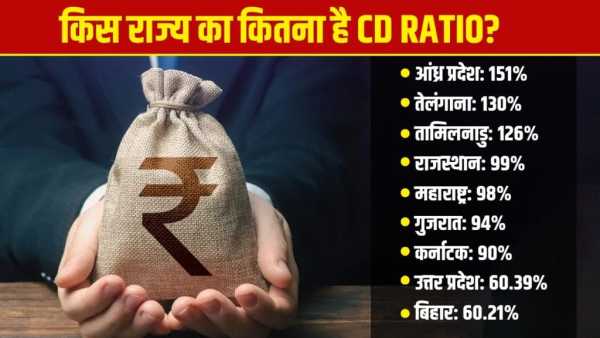
At present the national average CD ratio is about 82 percent. In states like Maharashtra, Telangana, Andhra Pradesh and Tamil Nadu it is more than 100 percent. According to state level bankers' committees, the CD ratio is 155 percent in Andhra Pradesh, 130 percent in Telangana, 126 percent in Tamil Nadu, 98 percent in Maharashtra, 99 percent in Rajasthan, 87 percent in Gujarat and 77 percent in Karnataka.
Headlines
- The CD ratio of UP-Bihar has improved in the last few years.
- 7 to 8 years ago the CD ratio was less than 50 percent.
- Having 100 percent CD ratio can help in the development of UP-Bihar.
CD ratio of UP is 60 and Jharkhand is 52 percent.
The CD ratio of Uttar Pradesh is also not very high. According to a post made by the Chief Minister's Office on February 7, the CD ratio of the state's banks was 60.39 percent. This means that only 61 percent of the money deposited in the banks of the state was given only to the citizens of the state. The remaining 39 percent of the funds were transferred to states with good CD ratios. At the same time, the CD ratio of Jharkhand is only 52.19 percent. That means only 52 percent of the amount deposited in the banks here is given to the people as loan.
According to the State Bankers Committee, till the end of March 31, 2026, Rs 6 lakh 15 thousand 428 crore were deposited in the bank branches of Bihar. Out of this, Rs 3 lakh 70 thousand 563 crore was given as loan. Out of this, Rs 2 lakh 44 thousand 865 crores were sent to banks of other states for giving loans.
Such banks transfer money to states with higher CD ratio.
One question is that when money is deposited in the banks of Bihar or Uttar Pradesh, how is it transferred to give loans to other states. Actually, the money deposited with banks goes into a central pool. Then the states which have higher CD ratio. Now banks in these states have distributed loans more than the amount deposited there. It is natural that in such a situation the additional loan amount will be transferred from states with lower CD ratio.
Why do banks shy away from giving loans to the people of UP-Bihar?
The CD ratio of UP-Bihar has improved in the last few years. A few years ago it was stuck between 40 to 50 percent. In fact, there is reluctance in giving back loans in these states. He believes that the loan recovery rate here is very poor compared to states with good CD ratio.
There is shortage of industries in states like Bihar. At the same time, industry has started coming up on a large scale in Uttar Pradesh after 2017. The highest demand for loans comes from big industries and infrastructure projects. At the same time, this is not the case in the southern states. There are big industries there. In such a situation, due to lack of industries in Bihar, the loan absorption capacity is low.
Bihar, Jharkhand, and UP have a significant number of population working in the unorganized sector. Besides, disasters like floods keep occurring in many areas here. In such a situation, the documents of many people go missing, due to which their loan gets rejected. Apart from this, due to lack of information about loan procedures and government schemes, most of the people remain deprived of it.
What will be the benefit if CD ratio of Bihar-UP becomes 100%?
If the CD ratio of any state becomes 100 percent, then the entire amount available in the banks there will be spent as loans on the citizens of the state. This clearly means that capital migration to other states will stop. The state whose people's hard-earned money is deposited in banks will develop only. Agriculture, MSME and startups will get adequate loans. Due to this, new industries will be established in that state. Employment opportunities will increase. Economic inequality will go away.


-
‘Don’t let the celebration turn into a medical crisis’: England supporters cautioned before World Cup clash amid searing heatwave

-
ICC Player Protection Programme Shields Women Cricketers From Rising Social Media Abuse
-
ICC Women's T20 World Cup 2026: 'They Never Let You Settle,' Says Jemimah Rodrigues Ahead Of Crucial Clash Against Australia At Lord's

-
Ministry Of Education Invites Applications For National Teachers Awards 2026; School Teachers Can Apply Till July 10

-
AP EAPCET 2026 Result: CBSE Candidates Must Submit Declaration Form By Tomorrow