
To enhance the guardrails of AI’s use by banks and financial institutions, the Reserve Bank of India (RBI) has proposed a comprehensive framework for managing risks arising from AI.
Under the RBI’s “Guidance on Regulatory Principles for Model Risk Management, 2026”, key proposals include regulated financial institutions to establish explainability thresholds for AI, implement safeguards against its hallucinations, test systems under abnormal scenarios and adversarial attacks, monitor bias and discriminatory outcomes, and continuously assess model behaviour.
The RBI has invited feedback on the draft guidelines by July 24.
At the centre of the framework is a requirement that banks and financial institutions maintain appropriate risk mitigation measures.
The proposal includes appropriate risk mitigants like human-in-command arrangements, override, suspension, or deactivation mechanisms, including ‘kill switch’ arrangements and periodic review of model outputs and model-driven decisions by humans to identify anomalies.
The RBI has also proposed independent validation of all models, including third-party systems, periodic reviews, stress testing and continuous monitoring throughout the model lifecycle.
An AI kill switch is a fail-safe mechanism that allows institutions to immediately shut down an AI model when it behaves unexpectedly, generates harmful outputs or creates operational risks.
The mitigation framework has become increasingly relevant in the context of the Indian financial ecosystem today. Although the ecosystem has increased reliance on AI, the inherent risks associated with AI hallucinations and data privacy bring with them more damning consequences.
Imagine a chatbot giving incorrect financial advice to thousands of customers, an underwriting model unintentionally discriminating against certain borrowers.
To ensure safety, the proposed guidelines seek to bring every model used by financial institutions under a formal governance framework. This could include an LLM powering a customer support bot, a third-party fraud detection engine, a credit underwriting model or even a spreadsheet-based loan-pricing calculator.
AI utilisation by commercial banks, small finance banks, payment banks, cooperative banks, NBFCs, asset reconstruction companies and credit information companies would be regulated under the proposed AI frameworks.
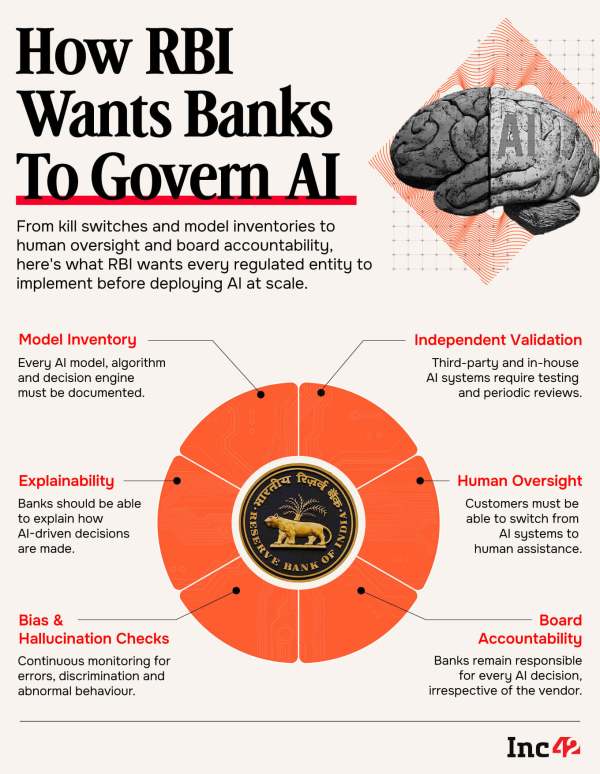
In essence, the framework bids to enhance the accountability of all models used by regulated financial entities, irrespective of whether these systems are developed internally or procured from third-party providers.
Under this, these institutions will be required to maintain a comprehensive inventory of every AI model deployed across the organisation and ensure that no model is used unless it is formally documented and included in that inventory.
This requirement could prove to be one of the most challenging aspects of the framework. Industry executives Inc42 spoke with underline that the framework extends the scope of AI beyond GenAI.
“The draft defines a ‘model’ so broadly that a spreadsheet pricing calculator counts if it drives decisions. This isn’t a GenAI rule; it pulls in every legacy scorecard and rule engine, and most institutions don’t have a complete model inventory today. That inventory is the real day one work,” Redacto’s cofounder Shashank Karincheti said.
As a result, banks and NBFCs may now have to identify and document decades of legacy decision systems and internally developed tools that were never previously viewed through the lens of AI governance.
Customer-facing AI systems would also need to disclose that users are interacting with an AI system and provide an option to switch to human assistance whenever requested.
A Nuanced Approach Towards AI RegulationThe RBI’s draft reflects a broader shift in how regulators around the world are approaching AI.
Instead of viewing AI as merely another tech tool, regulators increasingly see it as a source of operational, consumer and systemic risk that requires dedicated governance frameworks.
At the same time, the RBI has stopped short of imposing blanket restrictions on AI deployment. The financial industry views the guidance as an effective turnkey that elevates the governance of AI. It effectively slows down reckless deployment and puts a guardrail around the risks associated with such dependence.
Blockchain-based loan lifecycle management company New Street Technologies’ CEO Sajeev Viswanathan believes that the draft reflects a more nuanced regulatory approach.
“Rather than imposing blanket restrictions on AI, the RBI has proposed a tiered risk framework that differentiates between low- and high-risk use cases. Combined with board-level accountability and human oversight mechanisms, the framework seeks to enable innovation while preserving financial stability,” he said.
The RBI has also indicated that additional requirements specific to AI models could be introduced in the future.
For India’s financial sector, the model accuracy alone is no longer enough. Banks and financial institutions will now need to explain, monitor, audit and, when necessary, instantly shut down the AI systems they deploy.
Edited by: Akshit Pushkarna
Creatives by: Abhyam Gusai
The post Project ‘Kill Switch’: Can RBI Protect Banks, NBFCs From Rogue AI Actors? appeared first on Inc42 Media.
-
AIIMS BSc Nursing Exam 2026 Tomorrow: Check Exam Timings, Documents Required And Important Exam Day Instructions

-
Assam CEE Result 2026 Declared At astu.ac.in; Download Rank Card Here

-
MPSC Group C Notification 2026 Out For 2,619 Posts; Applications Open From Tomorrow

-
Rashami Desai Reacts To Mumbai Local Train Murder: 'I Don't Feel Safe At All, This Is Not New India'

-
Mateus Fernandes Prefers Manchester United as Red Devils Seek to Avoid Bidding War with Tottenham