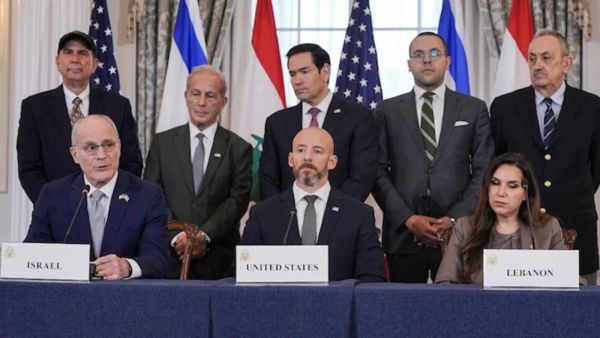
The United States, Israel and Lebanon on Friday, June 25, signed a trilateral framework agreement that lays the groundwork for future peace negotiations, in what Washington described as an important step towards long-term regional stability.
Speaking at the signing ceremony, US Secretary of State Marco Rubio said the framework was achieved through American mediation and would provide a basis for advancing peace and security between Israel and Lebanon, AFP reported.
“We are happy to announce a framework agreement between the sovereign government of Lebanon and of course the government of Israel, with a mediation and support of the United States of America,” Rubio said.

He said the agreement “begins to put in place a framework for lasting peace and security.”
Trump blames Iran for drone strike on cargo ship in Hormuz
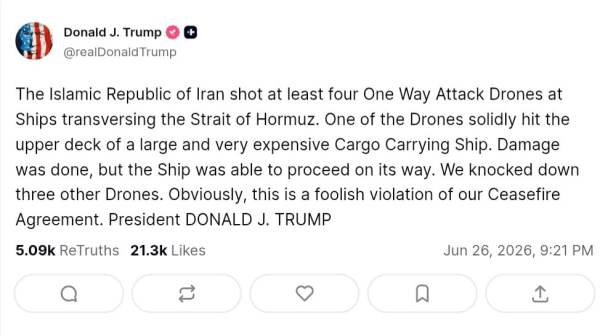
US President Donald Trump on Friday blamed Iran for carrying out a drone strike on a cargo ship in the Strait of Hormuz, calling it a “foolish violation” of the ceasefire agreement with the United States.
One drone damaged the upper deck of the ship, but the vessel was able to proceed, Trump said. The US shot down three other drones aimed at the ship, he said.
Trump’s post on social media did not identify the ship or the time of the strike, but on Thursday the British military said a vessel was hit by a projectile off the coast of Oman.
The development came during a fragile time for the US and Iran as they work to negotiate a permanent end to the war. Iran has increasingly challenged the region and the US over its control of the Strait of Hormuz, even with the current interim deal it reached with the US last week.
The attack on the cargo ship happened while a United Nations maritime agency was beginning an operation to move stranded ships out of the strait this week, using an alternative route, hugging the shores of Oman rather than sailing through the central part of the strait.
The International Maritime Organisation halted the evacuations after the attack and said on Friday they won’t resume until there are guarantees that the other ships won’t be attacked.
About 115 ships were able to move out of the strait in recent days, leaving about 500 still in the area, said Arsenio Dominguez, the agency’s secretary-general.
The opening of the alternative passage through the strait was expected to relieve pressure on the world economy and remove Iran’s main source of leverage in ongoing peace talks with the US.
The US and Iran are still negotiating terms of the deal, including issues such as getting ships through the key strait and addressing the future of Iran’s stockpile of highly enriched uranium. Under the interim deal, the two sides have 60 days to work out the details.
Cargo ship attack poses a test for shipping
Shipping analysts said the drone strike cast a shadow over what had been a growing stream of trapped vessels finally leaving the Gulf and an increasing flow of tankers carrying crude oil.
“A week of widening commercial confidence in the Strait of Hormuz has hit its first significant test,” said marine data company Windward on X. It said that while the strait remains operationally open with 43 transits recorded after the incident, “the pace of normalisation has slowed.”
On Wednesday before Thursday’s drone strike, 78 vessels transited the strait, the highest since the war began, although below the prewar averages of 130 or more per day.
At least two tankers reversed course while attempting to transit the strait on the UN-backed route near Oman after Iran insisted vessels use only the Teheran-approved routes, according to marine data and analytic firm Lloyd’s List Intelligence.
Missile warning startles UAE
Earlier on Friday, a missile warning in the United Arab Emirates caused by a technical glitch underscored the ongoing tensions in the region, following the attack on the cargo vessel and Israeli strikes in Lebanon over the past few days.
The mobile phone alert startled many across the country, the first such alert since the interim ceasefire.
A short time after the alert, the Emiratis said there was a telephone call between Foreign Minister Sheikh Abdullah bin Zayed Al Nahyan and Iranian Foreign Minister Abbas Araghchi. It quoted Sheikh Abdullah as telling Araghchi that the UAE “emphasised the importance of full commitment” to the interim deal between Iran and the US.
“Serious diplomacy and responsible dialogue are the optimal path for addressing all regional and international crises,” it said.
With inputs from AP
-
22 more Iranian crew repatriated via Pakistan after US seizure
-
Dominant India drub Pakistan 7-1 in FIH Pro League

-
From Dh6 per kilo: Khor Fakkan festival showcases over 50 mango varieties

-
India Drops 20% Local Sourcing Rule, Keeps Security Guardrails For Satcom

-
Maharaja Trophy KSCA T20 Tournament: Hubballi Leg Kicks Off with Exciting Matches