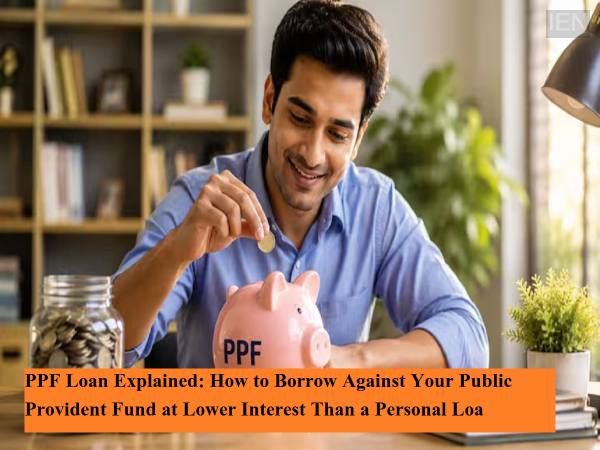
A financial emergency often leaves people choosing between a personal loan and a credit card, both of which usually come with relatively high interest rates. However, many Public Provident Fund (PPF) account holders may not realize that they already have access to a much more affordable borrowing option.
A loan against a PPF account allows eligible investors to borrow money using their own savings without pledging additional collateral or going through lengthy approval procedures. Since the loan is linked to your PPF account, the borrowing cost is generally much lower than that of unsecured loans offered by banks and financial institutions.
Here is everything you need to know about eligibility, loan limits, repayment rules, and why a PPF loan can be a smarter choice during short-term financial emergencies.
What Is a Loan Against a PPF Account?
The Public Provident Fund is one of India's most popular long-term savings schemes, known for offering tax benefits and guaranteed returns. Besides helping individuals build retirement savings, the scheme also provides a facility to borrow against the accumulated balance during a specific period of the account's tenure.
Unlike personal loans, a PPF loan is backed by your own investment, making it easier to obtain and significantly cheaper in terms of interest costs.
When Can You Apply for a PPF Loan?
A PPF account does not allow borrowing throughout its entire 15-year maturity period. The loan facility is available only during a limited eligibility window prescribed under the scheme's rules.
An account holder can apply for a loan starting from the beginning of the third financial year after opening the account and up to the end of the sixth financial year.
For example, if a PPF account was opened during the 2023–24 financial year, the loan facility would generally be available from FY 2025–26 through FY 2028–29. After this period expires, the loan option is no longer available. Instead, eligible account holders may qualify for partial withdrawals as permitted under the scheme.
How Much Can You Borrow?
The maximum loan amount depends on the balance available in your PPF account, but it is not calculated using the current account balance.
Under the rules, the loan amount can be up to 25% of the balance standing at the end of the second financial year immediately preceding the year in which the loan application is made.
This means the eligible loan amount may be lower than expected if your account balance has increased significantly in recent years, as the calculation is based on an earlier balance rather than the latest one.
Why Is a PPF Loan Cheaper Than a Personal Loan?
One of the biggest advantages of borrowing against a PPF account is its lower borrowing cost.
Since the loan is secured by your own savings, the applicable interest rate is linked to the PPF scheme rather than the higher rates generally charged on unsecured personal loans or credit card borrowing.
Other benefits include:
-
Lower interest rates compared to most personal loans.
-
No requirement for additional collateral or guarantors.
-
Minimal documentation and simplified approval process.
-
Suitable for meeting temporary financial requirements without relying on expensive credit.
These features make a PPF loan an attractive option for individuals who need funds for a short duration while preserving their long-term investments.
Repayment Rules You Should Know
A loan against a PPF account is designed to meet temporary financial needs rather than long-term borrowing requirements.
Here are the key repayment conditions:
Repayment Period
The principal amount generally must be repaid within 36 months. The repayment period starts from the first day of the month following the month in which the loan is sanctioned.
Interest Payment
Once the principal has been repaid, the applicable interest on the loan must also be paid. Delayed repayment beyond the prescribed period may attract a higher rate of interest under the scheme's rules.
Can You Take Another Loan?
A second loan against the same PPF account is allowed only after the previous loan has been repaid in full. Additionally, the account must still fall within the eligible loan period specified under the PPF rules.
Is a PPF Loan the Right Choice?
For investors facing an unexpected financial requirement, borrowing against a PPF account can be a cost-effective alternative to taking a personal loan or using a credit card. The lower interest burden, straightforward process, and absence of collateral requirements make it a practical solution for short-term funding needs.
However, account holders should remember that the loan facility is available only during a limited period after opening the account. Before applying, it is advisable to calculate the eligible loan amount and understand the repayment obligations to avoid additional interest charges.
If your PPF account qualifies, using this facility may help you manage a temporary cash crunch without taking on expensive debt.
Disclaimer: The information provided above is for educational purposes only and is based on the applicable PPF loan provisions. Individuals should verify the latest government guidelines and consult their bank or post office before making any financial decisions.
-
US may relocate military bases from Kuwait, Saudi Arabia: Report

-
Beyond tokenism: CJP and the Muslim youth question
-
Chicken-beer party on Ganga: Five accused granted bail in 24 hrs

-
Maharashtra cop caught profiling truck driver over religion

-
Telangana will emerge as the hub for blue-collar jobs: Revanth