While most eyes were fixed on two other superstars, Ousmane Dembele decided to take centre stage and shine brighter than anyone else.
By breaking away from the narrative surrounding Kylian Mbappe and the absent Erling Haaland, Dembele’s stunning hat-trick not only lifted France to victory but also revealed the deeper story of a team built on collective brilliance rather than sole dependency on stars.
For France, if one player doesn’t get you, another surely will. That rule applied not just to Dembele and Mbappe, but also to the lively Michael Olise, Bradley Barcola, and Desire Doue, who scored the fourth goal in Foxborough.
It seemed fitting that the prospective champions displayed such an abundance of attacking flair in a country known for excess.
It was equally appropriate that the current Ballon d’Or winner stepped up in the race for the Golden Boot, filling the void left by the much-anticipated but unrealised showdown between Mbappe and Haaland, which was spoiled by Norway’s tactical decision.
Stale Solbakken’s controversial strategy to rest all ten of his outfield players in this 4-1 defeat—when Norway still had a chance to top the group—will only be judged in hindsight, depending on subsequent results.
While there is some merit in ensuring all squad members get World Cup minutes, Norwegian fans who spent thousands of Krone to travel to “Boston” (actually Foxborough, several miles away) were unlikely to feel pleased. Early chants of “we want Haaland” echoed through the stands, but instead of a duel, spectators were treated to a one-man spectacle.
Dembele dominated the first half, scoring a rapid 25-minute hat-trick. His goals were strikingly similar—each one featuring a trademark cut inside and a powerful left-foot finish beyond goalkeeper Egil Selvik’s right side.
The opener, arriving after just seven minutes, set the tone for the match and was arguably the pick of the trio.
It was beautifully assisted by Mbappe, whose precise pass embodied France’s unpredictability in attack. The same could be said for Olise’s creative distribution and Doue’s intelligent off-the-ball movement, which earned him his first World Cup goal late on, ensuring Dembele didn’t completely steal the spotlight.
With Dembele’s three goals and Mbappe failing to find the net, the winger drew level with his teammate in the scoring charts—pushing France to another statistical milestone.
France became the first team since Poland in 1974 to have two players net four goals each in the group stage, matching Grzegorz Lato and Andrzej Szarmach. This expanded tournament also made history as the first World Cup to feature five different players scoring four or more goals in the group phase.
That Golden Boot race could well influence the path to the trophy.
Norway now find themselves on what appears to be the easier side of the knockout draw, though that’s open to debate. France’s potential route to the final might include clashes with Germany, the Netherlands or Morocco, and possibly Spain. Yet, judging by their confidence, France seem unconcerned—and rightly so.
Their immense talent is well known, but this match once again demonstrated their ability to overcome challenges—including their own defensive lapses. Norwegian forward Jorgen Strand Larsen missed a penalty saved by Mike Maignan, while Thelo Aasgard scored a fine consolation goal.
The relatively low stakes of the fixture exposed some defensive looseness in Didier Deschamps’ side. The French coach was absent, attending his mother’s funeral, and this commanding win may have provided a measure of comfort during a difficult time. In a surprising revelation, the French Football Federation disclosed that FIFA had denied their request to wear black armbands in her memory.
Instead, the team dedicated their performance to her.
Amid the solemn backdrop, there was a touch of irony to France’s attacking wealth. Playing in this frontline must feel like walking into a Whole Foods in America—overwhelmingly full of choice.
This overwhelming depth isn’t born from commercialism but from years of national policy and investment in sports infrastructure. Local governments across France have built facilities in every region, nurturing generations of young players, many from immigrant backgrounds.
That’s why Paris now ranks among the top three football talent hubs globally, alongside South London and São Paulo.
As a result, France’s attackers instinctively know how to make the most of their choices, and their technical expression on the pitch was often breathtaking.
Considering France’s long-standing commitment to technical development, it’s remarkable that recent debates in Scotland have revisited the outdated idea of prioritising physicality over skill—an argument that nations like France and Spain settled long ago.
Yet, there remains an intriguing paradox. Despite France’s wealth of talent and status as one of Western Europe’s richest nations, its domestic league remains underwhelming compared to its resources.
Paradoxically, that may actually strengthen the national team. Players like Dembele, Doue, and Barcola arrived at this World Cup fresh and full of energy.
For someone like Thomas Tuchel, it might be worrying to see Dembele firing goals out of nowhere while he relies on the less proven Noni Madueke. But this difference stems largely from France’s ability to rotate and manage player workloads.
France, though, won’t be dwelling on any of that.
This tournament increasingly looks like theirs to lose—because they possess a galaxy of players capable of going supernova at any given moment.
-
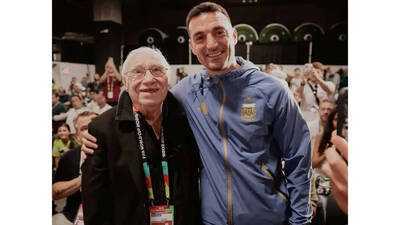
Lionel Scaloni Honors Veteran Journalist at FIFA World Cup 2026
-
Resignations at Ram Mandir Trust Amid Donation Mismanagement Investigation

-
Yogi Adityanath Launches Electronics Manufacturing Hub in Uttar Pradesh
-
Bihar Home Guard Bharti 2026: Registration for the posts of Bihar Home Guard Company Commander starts from this day..

-
Europe faces scorching weekend as heat wave moves east