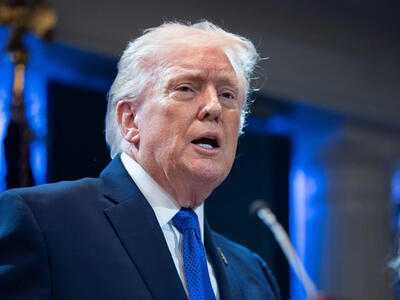
In a landmark decision on Monday, the Supreme Court significantly broadened the scope of presidential authority, affirming President Donald Trump's ability to dismiss heads of independent federal agencies, with one notable exception: the Federal Reserve.
The court ruled that Fed governor Lisa Cook can retain her position while contesting Trump's attempt to terminate her employment over alleged mortgage fraud, which she has denied.
Aside from the Federal Reserve, the ruling grants presidents the latitude to remove agency leaders without cause, despite existing federal regulations that typically necessitate justification for such actions and a precedent set nearly a century ago that restricted executive power.
With a majority of six conservative justices, the court overturned its previous unanimous ruling in Humphrey's Executor, which had aimed to protect agency decision-making from political interference.
Chief Justice John Roberts articulated the court's stance, stating that such protections against removal contradict the Constitution's separation of powers.
Backing for Trump's Authority
The justices' ruling stemmed from the case involving Rebecca Slaughter, a former Federal Trade Commission member whom Trump dismissed without justification, despite federal law requiring a valid reason for such actions. This ruling extends to other agencies, including the National Labor Relations Board and the Consumer Product Safety Commission, where Trump has similarly removed board members.
Trump expressed his satisfaction with the ruling on Truth Social, calling it a historic affirmation of presidential powers.
The court had previously indicated its support for Trump's administration by allowing the removal of Slaughter and other agency members while their legal challenges were ongoing.
No previous president had attempted to assert such control over regulatory agencies that govern critical aspects of American life, including labor relations and product safety. During the December arguments in Slaughter's case, the conservative justices appeared more focused on establishing a lasting precedent than on granting excessive power to Trump.
Justice Neil Gorsuch remarked that the court was crafting a decision 'for the ages.' In dissent, Justice Sonia Sotomayor warned that the ruling could lead to 'submission, instability, and even oppression,' emphasizing that the president's newfound power was conferred by the court rather than the electorate or the Constitution.
The Case of Fed Governor Cook
In Cook's situation, the court narrowly voted 5-4 against the Trump administration's attempt to remove her immediately. Roberts, along with Justice Brett Kavanaugh and the three liberal justices, formed the majority.
Roberts noted that allowing Cook's removal at this stage would enable the president to dismiss a Federal Reserve member at will, undermining the intended protections against arbitrary dismissal.
He did, however, mention that Trump could attempt to fire Cook again, provided she receives proper notice and an opportunity to contest the decision.
Trump indicated he might pursue this route, stating on Truth Social that he would take 'appropriate action' to ensure that someone accused of wrongdoing does not influence critical decisions affecting the nation.
Cook, nominated by Biden, will remain in her role at least until her lawsuit against her dismissal is resolved, as the court acknowledged the ongoing appeal from the Trump administration.
Trump's Tensions with the Federal Reserve
Critics argue that Trump's motivation for attempting to dismiss Cook is his desire to control U.S. interest rate policy. If successful, he could replace Cook, the first Black woman to serve as a Federal Reserve governor, with an appointee of his choosing, potentially gaining a majority on the board.
This case is being closely monitored by Wall Street investors, as it could significantly impact financial markets and the broader U.S. economy.
Cook stated that her case was never about the mortgage documents in question but rather an effort to remove her based on a fabricated pretext due to her refusal to yield to political pressure.
Trump has been vocal about his desire for lower interest rates to facilitate cheaper government borrowing and reduce costs for consumers, despite concerns that rapid rate cuts could lead to inflation.
While the Federal Reserve has maintained its key interest rate this year, there is growing apprehension among policymakers regarding persistent inflation, with discussions about potential rate hikes in the near future.
During the review of Cook's case, Trump escalated his conflict with the Fed, prompting a criminal investigation into Powell, which concluded in late April, clearing a significant hurdle for Warsh's confirmation as Powell's successor.
Allegations Against Cook
The allegations against Cook involve claims that she misrepresented two properties in Michigan and Georgia as 'primary residences' in 2021, prior to her appointment to the Fed board. Such misrepresentations could lead to more favorable mortgage terms.
Solicitor General D. John Sauer argued that these applications demonstrated 'gross negligence at best,' providing grounds for Trump's dismissal of Cook. He contended that courts should not interfere with the president's decision and that Cook had no entitlement to a hearing.
-
Manchester City Chairman Reveals Three Key Qualities That Led to Enzo Maresca’s Appointment as Manager

-
New Zealand Clinches Historic Test Series Victory Over England

-
Trump Plans Action Against Federal Reserve Governor Following Supreme Court Ruling
-
Hostage Situation Unfolds at North Carolina Jail as Inmates Take Control

-
Punjab Kings' Shashank Singh, father booked over physical assault allegations