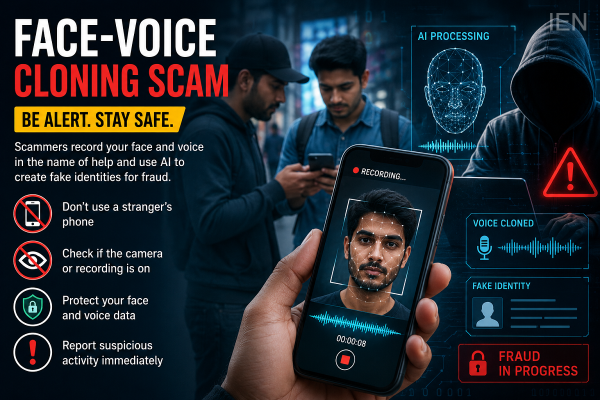
Artificial intelligence has made everyday technology smarter, but it has also opened new doors for cybercriminals. Security agencies are now warning people about a new fraud known as the Face-Voice Cloning Scam, where scammers secretly record a person's face and voice before using AI tools to create convincing fake identities.
Cybersecurity experts say the scam is becoming increasingly sophisticated, making public awareness and caution more important than ever.
What Is the Face-Voice Cloning Scam?
The Face-Voice Cloning Scam is a new type of cyber fraud in which criminals secretly collect short video and audio recordings of unsuspecting individuals. Using artificial intelligence, these recordings can later be transformed into realistic digital replicas of a person's face and voice.
These cloned identities may then be used to impersonate victims during phone calls, video calls, or online interactions in an attempt to deceive friends, family members, financial institutions, or businesses.
Unlike traditional scams that rely on fake messages or phishing links, this fraud uses AI-generated voice and facial data to make impersonation appear highly convincing.
How the Scam Works
According to cybercrime authorities, fraudsters often target people in crowded public places such as railway stations, shopping malls, airports, markets, or bus terminals.
The scam generally follows a simple pattern:
- A stranger approaches and requests help with a mobile phone.
- The person pretends to have limited technical knowledge.
- The victim unknowingly holds or operates the stranger's smartphone.
- During the interaction, the phone is already recording both video and audio.
- Within a few seconds, the victim's facial expressions and voice are captured.
Although the interaction appears harmless, cybercriminals can later use the recorded material to build AI-generated voice and facial clones.
Why Is This Scam Dangerous?
Modern AI software requires only a small amount of voice and facial data to generate highly realistic digital clones.
Cybersecurity experts warn that these cloned identities could potentially be used for:
- Voice impersonation scams.
- Fake video calls.
- Social engineering attacks.
- Identity fraud.
- Financial scams targeting family members or colleagues.
- Bypassing certain identity verification processes.
As AI technology continues to improve, distinguishing between genuine and AI-generated voices or videos is becoming increasingly difficult.
Authorities Issue Public Warning
Cybercrime agencies have urged citizens to remain alert against this emerging threat.
Officials advise people to avoid handling unknown individuals' mobile phones without first checking whether the camera or recording function is active.
Authorities also recommend exercising caution whenever someone unexpectedly requests assistance involving their smartphone, particularly in crowded public locations.
How to Protect Yourself
Cybersecurity experts recommend following these safety measures to reduce the risk of becoming a victim:
Avoid Using Strangers' Mobile Phones
Before assisting someone with their smartphone, ensure that the device is not actively recording video or audio.
Be Aware of Camera Activity
If you notice the camera application is open or recording indicators are visible, avoid positioning yourself in front of the device.
Protect Your Voice and Facial Data
Your voice and face are now considered valuable digital identifiers. Avoid allowing unknown individuals to record them without a legitimate reason.
Stay Alert in Public Places
Scammers often rely on people's willingness to help. While offering assistance is admirable, remaining cautious is equally important.
Report Suspicious Activity
If you suspect an attempt to collect your facial or voice data for fraudulent purposes, immediately report the incident to the appropriate cybercrime authorities or your local police.
Why AI-Based Scams Are Increasing
Artificial intelligence has made it easier than ever to generate realistic voices, facial expressions, and digital avatars. While these technologies have legitimate applications in entertainment, education, and business, cybercriminals are increasingly exploiting them for financial fraud and identity theft.
As AI tools become more accessible, experts expect face and voice cloning scams to become more common worldwide.
The Bottom Line
The Face-Voice Cloning Scam highlights how cyber threats are evolving alongside advances in artificial intelligence. A brief conversation or a few seconds of recorded video may be enough for criminals to create convincing digital impersonations.
Remaining cautious when interacting with strangers, especially those requesting help with smartphones, can significantly reduce the risk of becoming a victim. Staying informed, protecting your biometric information, and reporting suspicious activities promptly are among the most effective ways to safeguard yourself against emerging AI-powered cyber fraud.
-
‘Hopefully I don’t leave again’ – Enzo Maresca aims to build on Pep Guardiola’s legacy as he begins third spell with Manchester City

-
Aston Villa set £130 million British record valuation for Arsenal and Chelsea target Morgan Rogers

-
Aston Martin Vantage Breaks Down in Floodwaters, Internet Nicknames Driver ‘James Pond’

-
‘Mexican Batman’ Vigilante Captures Alleged Motorcycle Thieves and Hands Them Over to Police

-
Can Driving a Manual Gearbox Keep Your Mind Sharp? Japanese Study Suggests It Can