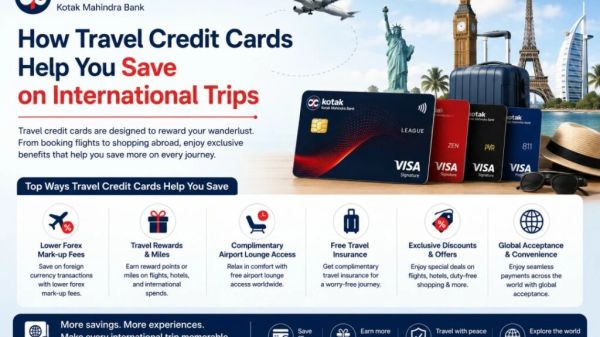
Planning an international trip? Discover how smart travellers save ₹50,000–₹1,00,000 using the right travel credit cards.
Credit cards can feel like a cost when you’re abroad: FX markups, fees, and scattered rewards. However, the right setup flips that: lower forex fees, meaningful rewards, and real perks you’ll use at airports and hotels. We’ll even walk through a trip example to show savings line by line.
Why Travel Credit Cards Are a Game-Changer for International Trips
Regular cards are built for everyday domestic spending. Travel cards are tuned for overseas costs: lower forex markup, transfer partners, hotel/airline tie-ups, and lounge access. That’s where the big wins sit.
Real-Life Example: International Trip on a Smart Budget
Assumptions
- Trip length: 7 days
- Cash flight price: ₹70,000 (Delhi–Paris round trip)
- Hotels: 2 nights at a business hotel (₹50,000) and 2 nights at a premium hotel (₹1,00,000)
- Overseas card spends (food, local transport, shopping): ₹1,00,000
Card roles used:
- Premium miles/transfer card for the flight redemption
- Hotel/partner card for international booking discounts
- Low/zero‑FX card for all foreign transactions
- Lounge/insurance benefits available as part of the stack
At‑a‑glance savings (illustrative)
|
Component |
Cash price |
What you pay with cards |
Savings |
How this saving happens |
|
Round‑trip flight |
₹70,000 |
₹20,000 (taxes/fees after miles) |
₹50,000 |
Redeem miles; pay only taxes/fees |
|
Hotel A (2 nights) |
₹50,000 |
₹40,000 |
₹10,000 |
20% partner discount on international hotels |
|
Hotel B (2 nights) |
₹1,00,000 |
₹80,000 |
₹20,000 |
20% discount via membership/issuer tie‑up |
|
Foreign spends (₹1,00,000) |
₹3,500 fee |
₹0 fee |
₹3,500 |
0% FX vs 3.5% FX markup |
|
Totals |
₹3,20,000 baseline |
— |
₹83,500 |
Sum of savings above |
What this means for your trip
- Baseline outlay without smart card uses: ₹3,20,000
- Savings unlocked by the right cards: ₹83,500
- Net-effective spend after savings: about ₹2,36,500
Note:
- Award tickets still need cash for taxes/fees (we used ₹20,000 as a placeholder).
- FX saving shown as ₹3,500 at 3.5% markup. If your bank also adds GST on the fee, the saving is closer to ~₹4,130; we kept it simple to match the reference style.
- Lounge savings aren’t included in the ₹83,500. If you value 4 lounge visits at ~₹1,000 each, you could add another ~₹4,000 in soft savings.
Why multiple specialised cards work best
- Low/zero‑FX card cuts a silent 3–3.5% leak on every foreign swipe.
- Miles/transfer card turns big purchases into high‑value flight redemptions.
- Hotel/partner card stacks instant discounts and perks (breakfast, late checkout, credits).
- A card with strong lounge and insurance smooths delays, baggage issues, and emergencies.
Key Ways Travel Credit Cards Help You Save
Zero Forex Markup Fees
Most cards charge 3–3.5% on foreign currency spends, plus GST on that fee. Low‑FX or 0% FX cards cut this to 0–1.5%. On ₹2,00,000 overseas, that’s up to ~₹8,260 saved. Best for hotels, dining, local transit, and attraction tickets.
Earning & Redeeming Miles/Points
Travel cards often boost earnings on travel categories and let you transfer points to airlines/hotels. Value ranges:
- Cashback: 1–2% straightforward
- Bank points: ₹0.25–₹0.75 per point (higher via portals)
- Airline miles: ₹0.4 (poor) to ₹1.5+ (long‑haul business/first). Add milestone bonuses and sign-up offers to accelerate your first redemption.
Discounts & Complimentary Perks on Hotels & Flights
- Hotel partnerships: 10–20% off, breakfast credits, upgrades, late checkout soft savings that reduce on‑ground spend.
- Airline co‑brands: Better earn on fares, faster status, and lounge access that replaces airport meals and gives a calmer start.
Travel Insurance & Protections
Coverage can include trip delay, missed connection, baggage delay/loss, overseas medical, and purchase protection. Real claims look like:
- Baggage delay: Essentials reimbursed, say ₹3,000–₹6,000 with receipts
- Flight delay: Fixed payout, e.g., ₹5,000 after threshold hours
- Medical: High‑value, but you must follow pre‑auth steps
How to Maximize Savings – Pro Strategies
Strategy 1: Card stacking for one trip
- Low‑FX card for all foreign POS/online spends
- Airline/hotel card to earn/ redeem at high value
- Perks card for lounges, concierge, and stronger insurance
Strategy 2: Timing your spends and redemptions
- Hit sign‑up/milestone windows before travel
- Transfer points when partners run 10–30% bonus campaigns
- Book award seats early for long‑haul
Strategy 3: Calculate breakeven for annual fees
- Annual fee vs (FX savings, rewards, lounge value)
- If you can’t cross breakeven reliably, downshift to mid/entry tier
Choosing the Best Travel Credit Card for You
Think about how often you travel, where you go, and how much you spend abroad. Also consider whether you’ll redeem miles well or prefer predictable cash value from a cashback credit card.
Comparison snapshot:
|
Tier |
Annual fee range |
FX markup |
Rewards focus |
Typical perks |
For whom |
|
Premium |
₹5,000–₹15,000 |
0–2% |
Transfer partners, miles |
Lounges (international/domestic), hotel perks, concierge, strong insurance |
Frequent travellers, long‑haul |
|
Mid-range |
₹1,000–₹5,000 |
1.5–3.5% |
Mix of cashback/points |
Limited lounges, partner discounts |
1–2 trips a year |
|
Entry-level |
₹0–₹1,000 |
2.5–3.5% |
Cashback/simple points |
Occasional lounge via spends, basic insurance |
Infrequent travellers, first card |
Cashback vs points: If your annual foreign spend is under ₹60,000 or you don’t enjoy planning redemptions, a cashback credit card with low FX is often the calmer choice. If you can pool points and transfer to partners, a top transfer-capable option may be your best travel credit card for premium cabin value.
Step-by-Step Guide to Getting Started
- Apply: Shortlist by FX markup, rewards structure, and fees. Check eligibility and documents.
- Activate before travel: Enable international, contactless, and online spends; set limits/alerts; add to wallets where supported.
- Track rewards: Use your bank app and a simple sheet to note points, transfer partners, and upcoming trips. Move points only when you’re ready to book.
Conclusion
Good travel cards lower friction and add value you can count on. Trim FX costs, earn something you’ll redeem, and put insurance and app controls in place. You don’t need five cards, just a focused setup that matches how you really travel.
FAQs
Do I need the best travel credit card if I travel once a year?
Probably not. A low‑FX, no/low‑fee cashback credit card with a couple of lounge visits is usually enough.
How much can zero FX save me?
On ₹1,50,000 of overseas spends, avoiding 3.5% plus GST saves roughly ₹6,195.
Are miles better than cashback?
If you’ll redeem for long‑haul business/first, miles can beat 5–10% effective value. If not, cashback is simpler and more reliable.
Should I pay in INR at foreign stores?
No. That’s DCC. Pay in local currency to avoid extra hidden markups.
What documents should I carry for insurance claims?
Policy certificate, helplines, tickets, boarding passes, receipts, and medical reports, keep digital and paper copies.
-
‘Makes people keep quiet’: Louis Saha reveals why Cristiano Ronaldo faces more criticism than Lionel Messi

-
How to stream Australia vs Egypt live for free: World Cup 2026 TV and online viewing guide

-
Peter Thiel Critiques Pope Leo XIV's AI Regulation Views

-
Our Yorkshire Farm stars make candid wedding confession 'It could've been a sign'

-
Ange Postecoglou Takes Charge as Head Coach of Al-Nassr