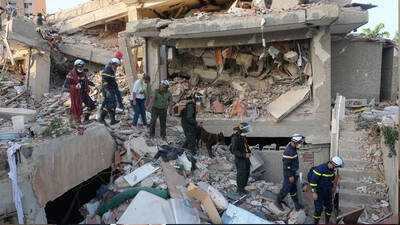
On Wednesday, medical professionals expressed their worries that the aftermath of the catastrophic twin earthquakes in Venezuela could lead to a significant health crisis. This situation is exacerbated by untreated injuries, the spread of infectious diseases, and a healthcare system already in distress. Following the earthquakes on June 24, which resulted in at least 2,295 fatalities and over 11,000 injuries, many displaced individuals are now living in overcrowded shelters or outdoors, lacking access to clean water and facing poor sanitary conditions.
According to aid workers, the situation has escalated into a major medical emergency that, if not addressed swiftly, could result in further loss of life in the coming days and weeks. The crisis has highlighted Venezuela's long-standing shortage of medical professionals, a consequence of years of economic turmoil, underfunding, and emigration. Eugenio Cova, head of the trauma unit at Hospital del Oeste Dr. José Gregorio Hernández in Caracas, noted, “We anticipate infections from patients exposed to the disaster for extended periods.” He added that the region is already grappling with complex trauma, now complicated by the risk of infections.
Furthermore, aid workers have raised alarms about the extensive damage to infrastructure, which could lead to outbreaks of diseases in the most affected areas. Veronique Durroux, spokesperson for the U.N. humanitarian agency for Latin America and the Caribbean, stated, “The heat raises concerns about potential vector-borne diseases. Waste management is a significant issue, and the scale of devastation makes debris management very concerning.”
U.S. Military Assistance in Relief Efforts US military deploys 900 personnel to aid Venezuela
As of Wednesday, the United States has deployed 900 military personnel to assist with relief and rescue operations, according to Steven McLoud, a spokesperson for U.S. Southern Command. The military has repaired a runway at the main international airport in Caracas, facilitating the arrival of humanitarian aid, and has stationed naval assets offshore to assist with airlifting survivors. Additionally, 100 personnel from the U.S. State Department have been dispatched to support these efforts.
The U.S. government has pledged $300 million in aid to Venezuela, distributed through various aid organizations and the United Nations. However, this amount is only a fraction of the estimated $6.7 billion needed to address the material damage caused by the earthquakes, as per satellite analysis by the U.N. Development Program. In recent days, 50 international teams, including those from countries without diplomatic ties to Venezuela, have arrived to assist with search-and-rescue operations. Rescuers continue to find survivors, including a toddler who was rescued after being trapped for six days.
Healthcare System Strained Further Crisis-stricken hospitals dealt another blow
Even before the earthquakes, Venezuela's public hospitals were already struggling with shortages of water, energy, essential medical supplies, and skilled personnel. Since 2013, over 7.7 million Venezuelans have fled the country due to the economic collapse under Nicolás Maduro's administration, which has been marked by mismanagement and corruption. Many of those who left were specialized medical professionals.
The Venezuelan medical association estimates that approximately one-third of the 60,000 registered physicians have emigrated since the onset of the economic crisis. Dr. Huníades Urbina, a board member of the pediatrics association, indicated that the country is short of about half of the 84,000 doctors needed according to World Health Organization standards. A national survey revealed that public hospitals are facing shortages of over 30% in emergency supplies and more than 70% in operating room supplies. Laboratories are mostly non-functional, only able to perform basic tasks.
Challenges in Medical Response Underequipped hospitals face a surge
Those medical professionals who remain are now faced with the daunting task of treating thousands of severe injuries resulting from collapsed structures. The Hospital del Oeste Dr. José Gregorio Hernández in Caracas is lacking essential orthopedic surgery supplies and medicated gauze to prevent infections. Cova mentioned that surgeries are being conducted in makeshift operating rooms due to accessibility issues caused by earthquake damage. Doctors have resorted to social media to request donations for necessary medical supplies.
The government reports that 38 hospitals nationwide have been damaged or compromised. There is also a critical shortage of ambulances, forcing many injured individuals to reach hospitals in pickup trucks. Jaime Lorenzo, director of United Doctors of Venezuela, noted that citizens feel abandoned by the government and have taken on much of the rescue efforts themselves. As the immediate chaos subsides, Lorenzo fears a new influx of patients will arrive at hospitals, including those who have been rendered homeless and have gone without medication for chronic conditions.
Government Response Under Scrutiny Questions over government response
The government led by acting President Delcy Rodríguez has faced mounting criticism regarding its disaster response. Recent social media videos appear to show security personnel looting from the rubble of collapsed buildings, which has incited public outrage. Although these videos have not been verified, the Interior Ministry announced the dismissal and detention of four police officials for exploiting the rescue and humanitarian efforts.
With many individuals still missing, families are left in a state of uncertainty, anxiously waiting by the ruins for news of their loved ones. A non-governmental digital database indicates that over 40,600 people remain unaccounted for. U.S. officials have countered claims that Rodríguez is politicizing the response, attributing the challenges to decades of neglect in Venezuela. Gen. Francis Donovan, head of U.S. Southern Command, remarked that addressing such a significant crisis is a substantial challenge for any leader.
-
Pisces Daily Horoscope Today (Feb 19 - Mar 20), July 2, 2026: Pisces natives will gain respect and should focus on health

-
Sagittarius Tarot Horoscope Today, July 2, 2026: Stay balanced and follow the rules for steady growth

-
Aquarius Tarot Horoscope Today, July 2, 2026: Be patient, stay clear, and avoid needless rigidity

-
Sagittarius Daily Horoscope Today (Nov 22 - Dec 21), July 2, 2026: Financial Growth and Strong Influence Ahead

-
Sarr's Stunner Puts Belgium on Brink of World Cup Exit