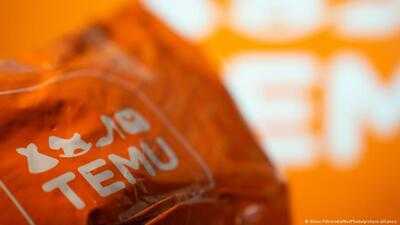
Brussels has ended a customs exemption for low-value imports from China while agreeing with Beijing to monitor trade flows and improve access to rare earth materials.Every day, around 16 million small, low-value packages arrive in the EU, 91% of which come from China. Many of those parcels contain items that European shoppers order from cheap Chinese online shopping platforms such as Temu, Shein and AliExpress. Until now, parcels valued at less than €150 ($171) were exempt from customs duties. However, the EU this week ended that exemption and imposed a €3 levy on low-value imports in a move to curb what it sees as unfair competition, and to keep products that do not meet the bloc's safety standards out of the European market. "Temu and Shein often fail to comply with legal and regulatory requirements, introduce unsafe products into our market that may pose health risks, and are driving many domestic retailers to the brink of ruin," said Alexander von Preen, president of the German Retail Association (HDE). The customs duty exemption cost public finances at least €400 million annually, according to the association. In 2025, Temu overtook Allegro as Poland's most-visited e-commerce platform, according to Mediapanel data. Justyna Szczudlik, a China analyst with the Polish Institute of International Affairs (PISM), pointed to data protection risks, intellectual property violations, and the possibility that Chinese platforms may collect large amounts of consumer data from Polish users. What comes next? The new €3 flat-rate charge is a temporary measure that is expected to remain in place until July 1, 2028, while the EU develops a new digital services platform. Once the new system is operational, standard customs duties based on a product's value, origin and classification will apply. The EU also plans a handling fee to start in November 2026 to help customs authorities with their surging costs as more and more parcels arrive. The amount has yet to be decided. "The status quo is not an option," EU Trade Commissioner Maros Sefcovic said after meeting Chinese Commerce Minister Wang Wentao in Brussels. "My objective from the outset has been clear: to begin balancing the trade relationship between the European Union and China. The gap is widening. China's exports to the EU keep rising while our market share in China keeps shrinking. This trend is not sustainable." Bridging the trade gap In 2025, the EU exported goods worth €199.6 billion to China and imported goods worth €559.4 billion, resulting in a trade deficit of €359.8 billion. Rafael Jimenez Buendia, a senior researcher at the Mercator Institute for China Studies (MERICS), noted that China has been speaking for more than a decade about creating balanced trade relations with Europe. However, the trade data continue to show a growing imbalance. "There is no need to speculate about internal politics. China's own public record is revealing enough," said Buendia. "For a period, the language of rebalancing coexisted with trade data that appeared broadly consistent with it." China's Wang and the EU's Sefcovic have agreed to establish, without delay, a joint mechanism for monitoring trade flows that will help restore balance in bilateral trade. According to Zhao Yongsheng, a professor at the University of International Business and Economics in Beijing, the message is that both sides want to resolve disagreements through dialogue and negotiation, providing a stable basis for long-term cooperation. China criticizes EU legislation China has criticized several recent legislative initiatives by the EU Commission, arguing that they harm Chinese interests. One example is the proposed Industrial Accelerator Act (IAA), introduced in March 2026, which is intended to strengthen European industry and make "Made in EU" a key condition for receiving public funding. Under the current draft, Chinese companies would in most cases be excluded from public procurement projects in Europe. In strategic sectors such as solar power and electric vehicles (EVs), foreign investors would generally be limited to a 49% ownership stake and would require government approval. The German Chamber of Industry and Commerce (DIHK) has criticized the proposal, warning that a "Buy in EU" policy could alienate trade partners and investors from outside the EU. Progress on rare earths Despite their differences, the EU and China have moved closer together on the issue of rare earths. In response to US tariff measures, China introduced export controls on rare earth elements and permanent magnets. Earlier, the United States had restricted exports of advanced semiconductors to China. Europe has felt the consequences because China is the world's largest producer of rare earth materials, which are essential for manufacturing semiconductors, motors and turbines. Wang reportedly assured Brussels that existing export controls would not disrupt EU supply chains. Chen Lingyan, a senior official responsible for import and export controls within China's Ministry of Commerce, explained that European and German companies can apply for export permits for rare earth materials. Authorities review applicants carefully and require assurances that the materials will be used internally rather than resold. According to Chen, approximately 90% of German applications have been approved. German Economy Minister Katharina Reiche emphasized that Germany is pursuing a pragmatic foreign trade policy. She stated that Germany's economic strength and security of supply depend on maintaining strategic partnerships, reliable supply chains, trade routes and investment opportunities. Germany wants deeper cooperation with China while ensuring greater fairness and more balanced trade relations. In keeping with China's fast-paced approach, EU and Chinese officials now plan to begin working-group discussions on concrete measures. Trade Commissioner Sefcovic is expected to travel to China in October, where both sides hope to announce further agreements. This article was originally published in German
-
Haryana launches VB-G RAM G scheme, promises country's highest daily wage of Rs 409

-
Two held after country-made pistol found in bag at Delhi Metro station

-
Lucy Bronze commits to Chelsea with one-year contract extension as updates on Hannah Hampton and Aggie Beever-Jones remain pending

-
Everton show interest in Karl Darlow as Leeds United battle Manchester United for free-agent goalkeeper

-
ENG W Vs SA W Toss Update: South Africa Opt To Bowl First In 2nd Semi-Final Against England At Lord's; Nat Sciver-Brunt Returns