
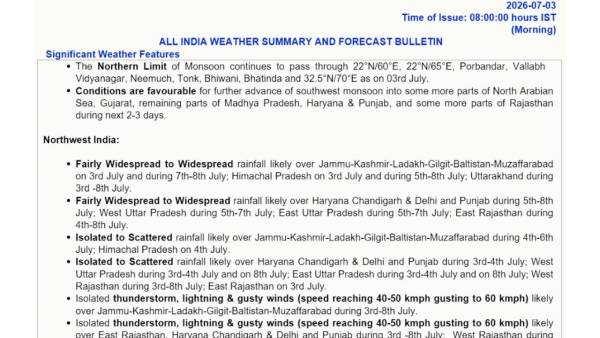
India is likely to witness an intense phase of monsoon activity over the coming days, with the India Meteorological Department (IMD) warning of heavy to extremely heavy rainfall across multiple regions of the country. The latest All India Weather Summary and Forecast Bulletin issued on July 3 indicates that a combination of active weather systems and favourable monsoon conditions could trigger widespread rainfall, thunderstorms, waterlogging and travel disruptions in several states.
According to the IMD, conditions continue to remain favourable for the further advance of the southwest monsoon into more parts of the country. The Northern Limit of Monsoon currently stretches across portions of the Arabian Sea and northern India, and weather experts expect monsoon progress into additional areas of Gujarat, Madhya Pradesh, Haryana, Punjab and Rajasthan during the next two to three days.
Western and central parts of India are expected to face some of the most significant impacts from the current weather pattern. The IMD has forecast heavy to very heavy rainfall, with isolated extremely heavy rainfall likely over Gujarat, Konkan and Goa, Madhya Maharashtra, Odisha and West Madhya Pradesh. Such rainfall events have the potential to create flooding concerns and significantly affect daily life.
West Madhya Pradesh has emerged as one of the key regions under close monitoring. Extremely heavy rainfall has been forecast in isolated locations, with moderate to intense lightning activity also expected across the region. Chhattisgarh, East Madhya Pradesh and Vidarbha are also likely to witness widespread rainfall activity accompanied by thunderstorms and lightning.
In western India, Gujarat and the Konkan coast are expected to receive substantial rainfall over several consecutive days. Saurashtra and Kutch are also likely to experience intense rain spells.
Northern India is also expected to experience a fresh round of weather activity. Heavy rainfall warnings have been issued for Uttarakhand, Himachal Pradesh, Uttar Pradesh and parts of Rajasthan. Punjab, Haryana and Delhi are expected to witness increasing rainfall activity beginning around July 5.
The hill states may particularly remain vulnerable to weather-related risks. Heavy rainfall in mountainous regions often raises concerns over landslides, mudslides and disruptions in transportation networks. Reduced visibility and road blockages can affect both residents and travellers moving through these regions.
Eastern India is also likely to experience an active weather phase. Odisha remains among the states expected to receive the heaviest rainfall over the next few days. Extremely heavy rainfall has been forecast in isolated areas over Odisha on July 3 and July 4. Gangetic West Bengal, Bihar and Jharkhand are also expected to receive significant rainfall accompanied by thunderstorms and gusty winds.
Northeastern states including Assam, Meghalaya, Nagaland, Manipur, Mizoram and Tripura are also expected to continue receiving rainfall during the forecast period. Some areas may witness thunderstorms and periods of heavy rain.
Southern India is unlikely to remain untouched by the current weather system. Coastal Karnataka, Kerala, Telangana and parts of Andhra Pradesh are expected to receive widespread rainfall activity. Heavy rainfall has also been forecast for parts of Karnataka and Kerala, while strong surface winds are expected in some areas.
The IMD has highlighted possible impacts associated with the expected weather conditions. Localised flooding of roads and waterlogging in low-lying urban areas could lead to traffic congestion and increased travel time in major cities. Underpasses and vulnerable routes may become temporarily inaccessible.
The department has advised people to check traffic conditions and weather updates before beginning travel. Citizens have also been urged to avoid waterlogged areas and remain cautious during periods of thunderstorms and lightning activity.
Apart from rainfall, thunderstorms accompanied by gusty winds of up to 60 kilometres per hour are expected in several parts of the country, including Delhi, Rajasthan, Punjab, Jharkhand, Gujarat and Andhra Pradesh. Strong winds can lead to broken tree branches, damage to power lines and disruption of communication infrastructure.
Marine conditions are also expected to remain rough over several coastal areas. Fishermen have been advised against venturing into parts of the Arabian Sea and Bay of Bengal due to squally weather and strong winds.
-
Overdependence on big names, Laura Wolvaardt's form and more: What went wrong for South Africa at the Women's T20 World Cup

-
BBC Line-up: Presenters, Commentators and Pundits for Mexico vs England Clash

-
How Enzo Maresca Could Shape the New Manchester City Era

-
Newcastle confirm signing of promising Ivorian winger Bazoumana Toure

-
Why Folarin Balogun’s World Cup suspension has been lifted after USA red card