
The 57-day-long Amarnath Yatra , the annual pilgrimage to the Shiva shrine in the Amarnath Caves in the Anantnag district of Jammu and Kashmir, begins Friday. Every year, lakhs of Hindus trek to the Himalayas where the Shivlingam forms out of ice and stays for most of the holy month of Shraavan before it begins to melt, until it forms again next year, around the same time.
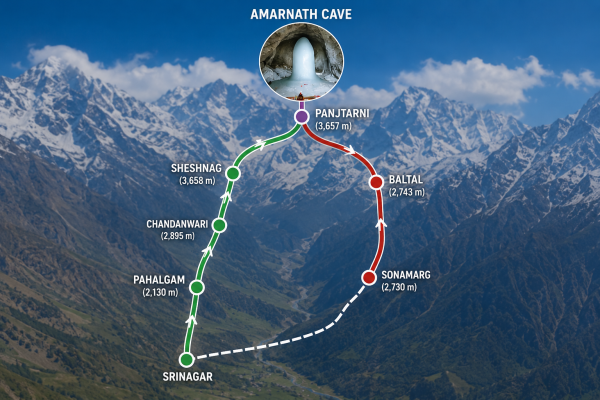
One question almost every pilgrim asks before planning the Amarnath Yatra is whether to take the Baltal route or the Pahalgam route . The route one chooses depends on the budget, time and fitness level one has. One is shorter, but much steeper and physically demanding, while the other is longer, more gradual, and considered the traditional route.
If you've watched the film Kedarnath, you'll remember how pilgrims go through these mountains. A similar sight greets devotees on the Amarnath Yatra on the Pahalgam route. Porters and palki bearers like Sushant Singh Rajput in the movied, become a lifeline for elderly pilgrims and those unable to complete the trek on foot.
If time is not a constraint, one should take the traditional Pahalgam route as the trail passes through breathtaking Himalayan landscapes, lush meadows, sparkling streams and snow-capped peaks, making the trek a deeply spiritual as well as scenic experience.
And if time is a constraint for you and fitness is not, then the Baltal route is for you. Here's how:
The traditional route
Pilgrims can reach Pahalgam either from Jammu, which is 315 km away, or from Srinagar, which is 96 km away, a preferred option for those arriving by air.
From Pahalgam, one needs to reach Chandanwari by bus, which goes alongside the Lidder River, offering fabulous scenic views.
Along the way, you reach Pissu Top, a height which is said to have formed after the Devtas and Rakshasas fought about who would have Shiva's darshan first. The top is believed to have formed from the Rakshasas killed by the Devtas with the blessings of Shiva.
Devotees camp on the second night at Sheshnag, overlooking the deep blue waters of Sheshnag Lake and the surrounding glaciers.
From Sheshnag, one has to climb a steep height across Mahagunas Pass at 4,276 m (14,000 ft) for 4.6 km and then descend to Panjtarni at a height of 3,657 m, where you camp for the third night before going for the darshan of the holy shrine the next morning.
All along the way, free langars are offered to the yatris.
The Baltal route
It's the shortest route to the Amarnath Cave, but also the most difficult one, and only the fittest pilgrims are recommended to take it.
One can go and come back on the same day by trekking 21 km. One can also hire ponies and palkies. To reach Baltal, one has to travel by road to Srinagar and then reach Baltal via Sonamarg.
Devotees believe that completing the Amarnath Yatra with faith brings Lord Shiva's blessings, washes away past sins and helps one move closer to moksha, or liberation from the cycle of birth and death. Many pilgrims describe the difficult trek itself as an act of devotion.
What should you choose?
Baltal Route
Pahalgam Route
The quickest option: Helicopters
Pilgrims who do not wish to, or cannot, undertake the full trek can also opt for helicopter services from Pahalgam to Panjtarni, which is just 6 km away from the cave. Helicopter services are also available from Neelgrath, near Baltal, to Panjtarni.
-
Egland beat Mexico 3-2 to reach FIFA World Cup quarterfinals

-
Petrol and Diesel Prices Today: Fresh Fuel Rates Released for July 6; Check Latest Prices in Delhi, Mumbai, Patna and Other Cities

-
6 Fours, 6 Sixes! This Batsman Unleashed Absolute Carnage In MLC

-
Government Warns Against Fake Cyber Crime Complaint Websites; Know How to Spot Online Scams

-
Asia Cup 2027 Dates Revealed: Bangladesh To Host ODI Edition But Will India Participate?