
There are moments in life when everything seems to converge on a single outcome, regardless of how hard a person tried to avoid it. The job that fell through and led, unexpectedly, to a better one. The relationship that ended painfully and made room for something more honest. The door that closed firmly and turned out to be pointing somewhere else entirely. Looking back, people sometimes say it was meant to be. This old Turkish proverb says something similar, and has been saying it for a very long time.
Turkish proverb of the day
"What is written on the forehead will be seen by the eyes."
Where the proverb comes from
The image of fate written on the forehead is one of the oldest in human storytelling. Scholarly research traces the motif back to ancient Indian literature, specifically the
Panchatantra and
Hitopadesha, texts that are among the earliest collections of wisdom literature in the world. In these Sanskrit works, the idea appears repeatedly that what has been written on the forehead by the creator cannot be erased by human effort.
The concept travelled westward across centuries of cultural exchange, passing through Persian tradition and into the Arabic and Turkish worlds, where it merged with the Islamic concept of
kismet , fate or destiny as decreed by God. In Turkish, the forehead became the site where this decree was inscribed, invisible to others but ultimately inescapable by the person who carried it.
The proverb is therefore not simply a Turkish saying. It is the distilled endpoint of a journey that crossed several of the oldest civilisations in the world before settling into the form most people recognise today.
What the proverb means
The image works on two levels simultaneously.
The forehead is the most visible part of a person, and yet what is written on it in the proverb's world cannot be seen directly by the person who carries it. They cannot read their own forehead. They do not know in advance what their fate contains. They live their life, make their choices, face their difficulties and eventually, through the eyes, they see what was always already determined. The destination reveals itself through the living of it.
The eyes in this proverb are not passive. They are the instrument through which fate becomes known not by reading what was written, but by experiencing it. What is fated does not announce itself in advance. It unfolds and is recognised only in the experiencing.
Fate and effort
It would be easy to read this proverb as an argument against trying. If it is already written, why work, why plan, why resist?
That reading misses something important about how the tradition from which this saying comes actually understands fate.
In both the Turkish and broader Islamic tradition , the existence of destiny does not remove human responsibility . A person is still expected to act, to make good choices, to work hard and to live well. The idea is not that effort is useless but that the ultimate outcome belongs to something larger than individual will. You plant, you tend, you water. What grows is not entirely yours to decide.
This is a different relationship with uncertainty than the one most people are accustomed to. It does not promise control. It offers something else instead a kind of peace with the unpredictable, a permission to do your best without requiring that your best always produces the outcome you planned for.
Why acceptance is not the same as passivity
The proverb is sometimes misread as an invitation to do nothing and wait for fate to sort things out. That is not what it says.
What it offers instead is a way of holding effort and outcome separately. You can work with full commitment and still accept that the result is not entirely in your hands. You can care about what you are doing without needing to control every consequence. You can try hard and still make peace with what happens.
This separation between the quality of your effort and the outcome that follows is something most people find genuinely difficult. The instinct is to believe that working hard enough guarantees the result you want. The proverb gently disagrees. It says that what is written is written, and it will be seen. But it does not say anything about sitting still in the meantime.
Why this proverb still holds true
The modern world is uncomfortable with the idea of fate. It prefers agency, strategy and the reassuring belief that the right combination of effort and planning produces the desired outcome.
Sometimes it does. Often enough, it does not.
The proverb does not gloat about that. It simply acknowledges it, as people in many centuries and many places have found themselves acknowledging it that life has a way of arriving at its own conclusions regardless of how carefully the route was planned.
What is written on the forehead will be seen by the eyes. Not because effort is pointless. But because some things were always going to happen, and the wisdom is in knowing the difference between what can be changed and what will simply, in time, be seen.
-
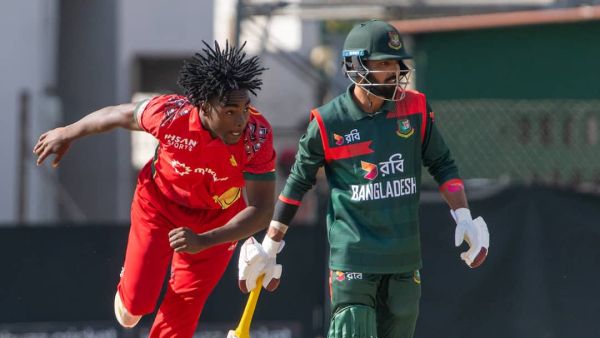
Zimbabwe Stun Bangladesh, Defend Just 141 In Unbelievable ODI Thriller
-
Tata Sierra EV Comes In QWD And RWD: Which One Is Worth Your Money?

-
CBSE Class 10 Second Board Result 2026 Today? Students Await Big Update, Check Direct Link To Download Scorecard

-
Cristiano Ronaldo Knocked Out Of FIFA World Cup 2026 As Spain Beat Portugal 1-0 In Round Of 16 Clash

-
Brazil's World Cup Woes Deepen As Norway Shock Exposes Tactical Decline And Penalty Failure Since 1986