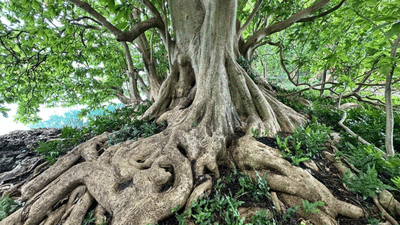
According to a new study, by Oxford researchers, an underlying network of fungi beneath the soil of one of the world's most isolated island ecosystems is functioning in a way which sustains its forests, seabird colonies and coral reefs .
Pisonia trees (Pisonia grandis), which are native to the desolate island, provide nesting sites for thousands of seabirds that gather on the island.
The birds deposit nutrient-rich guano, which contains large amounts of nitrogen and phosphorus. These trees again are dependent upon a kind of symbiotic mycorrhizal fungi known as Tomentella, to survive.
Scientists have found that Tomentella fungi capture these nutrients from the soil before they are washed into the surrounding ocean, making them available to the trees while helping maintain the delicate balance of the island's ecosystem.
The research team mapped fungal diversity across the atoll and found that every Pisonia tree sampled had a 100% association with Tomentella fungi highlighting the trees to be heavily dependent on these fungi for survival.
"Most ectomycorrhizal fungi struggle in extremely nutrient-rich soils, but the Tomentella fungi associated with Pisonia appear to be adapted to the high phosphorus levels created by seabird guano," study co-author Alex Wegmann told Mongabay.
"This suggests a long evolutionary partnership between the fungi, the trees and the massive seabird colonies that shape these atoll ecosystems."
The discovery has significant consequences for ongoing conservation efforts aimed at restoring Palmyra's native forests.
The Conservationists are working to remove nearly 1.5 million invasive coconut palms that have displaced native vegetation over decades.
However, the study found that Tomentella fungi was much more prone to be less common at distances greater than 250 metres from existing Pisonia trees.
This reflects the fact that simply removing invasive palms may not be enough to restore native forests in areas where the essential fungi are absent.
According to Wegmann, future restoration efforts may require introducing beneficial (inoculate fungi) of fungi into the soil to improve the chances of successful forest regeneration.
He told “Especially in areas far from existing Pisonia forests where Tomentella becomes much less common or in atoll forest systems where Pisonia has been absent for long periods due to legacy coconut palm agriculture or other impacts,” Mongbay.
“However, we still need additional field experiments to determine whether fungal inoculation significantly improves seedling survival and growth,” he added.
Beyond the tree-fungus partnership, researchers also uncovered an unexpected diversity of fungi across the atoll.
Many of the fungal species detected have never been recorded in global databases, suggesting Palmyra may be home to numerous rare or previously unknown microorganisms.
Some fungi were even found growing on aerial roots hanging more than 1.5 meters above the ground, indicating they may disperse through wind or be transported by birds.
Palmyra's giant land crabs also play an important ecological role in by digging burrows and mixing soil. It increases the fungal diversity underground, effectively acting as ecosystems engineers that help maintain healthy microbial communities.
"Atoll forests may contain unique microbial communities found nowhere else on Earth,” Wegmann said. “Protecting this hidden biodiversity is important because these microbes can play critical roles in ecosystem health, resilience, and forest regeneration," he concluded.
-
Liam Rosenior appointed Paris FC head coach after brief Chelsea stint

-
Johan Manzambi ruled out of Switzerland’s World Cup Round of 16 clash with Colombia due to knee injury

-
Do not make this mistake in home construction? Vastu’s deadly lumps cause death!

-
Food Authority Sends Notice To Heritage Paneer Over Misleading Fresh, Healthy Claims

-
What will end the drought of 5000mAh battery in Samsung Galaxy S27 Ultra? Leaked reports increased the stir