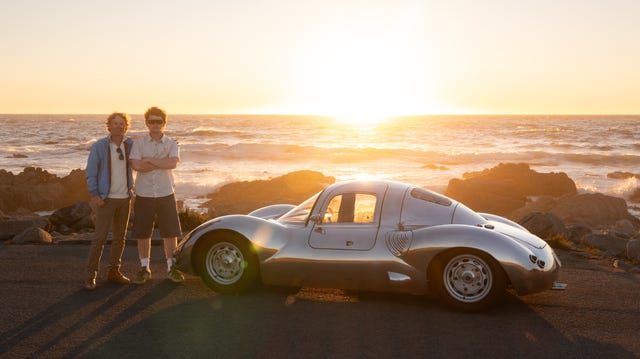
If you haven’t yet come across the craftsmanship of Rünge Cars based in Alexandria, Minnesota, you’re missing out on something special. This small-scale company is dedicated to the art of traditional coachbuilding, creating custom vehicles using hand-shaped aluminum panels mounted over bespoke tubular chassis. Each creation is a visual masterpiece, with design cues that subtly nod to a certain renowned automaker from Stuttgart.
But Rünge Cars doesn’t stop at bodywork alone. The company manufactures nearly every major component in-house. Their upcoming flat-8 engine project is a collaborative effort across two generations of the Rünge family. Founder Christopher Rünge recently shared with Road & Track how his son Fin has brought a modern perspective and new technology to the workshop, changing his approach to design and production.
Although Porsche proved the potential of the flat-8 engine in its race cars during the 1960s, it never installed one in a production model. Christopher Rünge has long been intrigued by what such a configuration might have offered. Back in 2017, a client approached him about building an eight-cylinder engine based on a pair of “twin” 356 motors, though that plan never materialised. The idea resurfaced after Rünge collaborated with Swindon Powertrain in the U.K. on their 911-4 engine project.
While the concept of a modified four-cylinder 911 engine isn’t new, the real innovation lies in the 16-valve, four-cam heads. This engine became the foundation for Rünge’s new flat-8 unit, internally codenamed “Hetzer.” The 5.3-litre engine features four camshafts, 32 valves, and revs up to an impressive 9000 rpm, with an electronic limiter set at 10,000 rpm for the truly daring. Expected to produce around 600 horsepower, it far surpasses the capabilities of the original air-cooled flat-6 engines.
Under the terms of their collaboration, Rünge Cars won’t hold exclusive rights to the engine. To broaden its appeal, the powerplant needed to fit vintage Porsche models with minimal modification. This is where Fin Rünge and collaborator Jeff Langendoerfer entered the picture. Langendoerfer, known for crafting the intricate hand-made badges found on Rünge creations, introduced Fin to CAD design. Together, they worked with the U.K.-based team to 3D-scan and digitally model both classic Porsche engine bays and the prototype engine.
“I resisted for a long time,” admitted Christopher Rünge. “I’m old-school — I believe in dirty hands and tired muscles. Sitting at a computer didn’t feel like real work. But then Jeff came in, making our Cloisonné glass enamel badges, learning CAD, and printing little parts for me. That really opened my eyes and bridged the gap.”
Using advanced scanning, Rünge and Swindon managed to package the Hetzer engine within just 2 mm of the dimensions of Porsche’s M64 flat-six engine. For context, the M64 is the 3.6-litre engine first introduced with the 964-generation 911, and it’s a popular swap option in air-cooled models due to its balance of power, reliability, and modern systems. Matching those dimensions was no coincidence — Rünge’s team even 3D-printed a full-scale model of the 911’s engine bay to verify the fit. This means the Hetzer can be installed in most air-cooled cars without cutting into the firewall or altering structural components.
“The full-scale 3D print took more than ninety days of nearly nonstop operation on a small, consumer-grade 3D printer,” Christopher said. “It used about 47 pounds of plastic — incredible to watch it take shape.”
Fin’s growing expertise in CAD has brought significant benefits to the workshop. He’s helped change his father’s perception of digital tools while accelerating the build process. Tasks like shaping headlights, which once took up to three days, can now be completed in just a few hours. A library of reference scans ensures repeatability and higher quality control — a major evolution for the company’s operations.
“The more Fin gets involved, the lighter the load becomes,” Christopher explained. “When industry veterans visit and see our workshop — surrounded by leather, sewing machines, foam, plating systems, and English wheels — they’re amazed. We handle fabrication, rapid prototyping, even design and build our own wheels and engines. Sometimes I have to stop and think — even Pagani doesn’t make their own engines. I never really thought of us as a manufacturer, but that’s what we are now: a low-volume coachbuilder and manufacturer.”
Christopher isn’t pushing his son to follow directly in his footsteps, acknowledging Fin’s broader creative talents beyond automotive work. Together, they also design furniture and interiors. Still, Fin’s deep passion for cars is evident — his personal BMW project speaks to that — though he prefers to stay out of the spotlight. His father, however, strongly believes that Fin’s future will continue to be connected to their shared craft.
“Everything he’s learned here will open incredible opportunities for him wherever he goes,” Christopher said. “But I have a feeling he’ll be around for quite some time.”
-
Shravana month is on the doorstep, Mahadev may be angry if you keep the Akanda tree in the house! What does Vastu say?

-
How To Make Kathal Biryani That Tastes Almost Like Mutton Biryani

-
Zendaya’s elegant look from The Odyssey tour goes viral | the odyssey zendaya white gown look viral photos

-
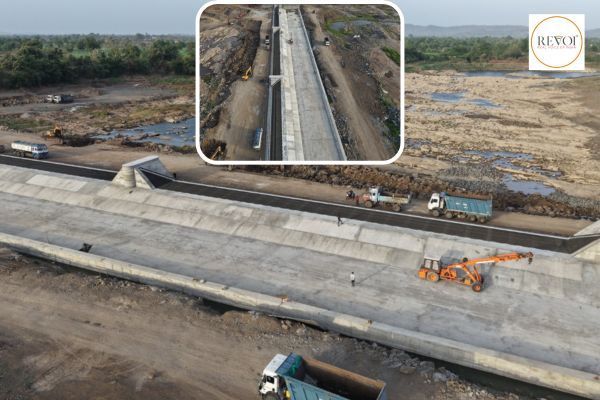
For the first time, two ‘air-field rubber dams’ will be built in the state with South Korean technology.
-
FIFA World Cup 2026: After Neymar, Guillermo Ochoa retires, Ronaldo’s last World Cup too