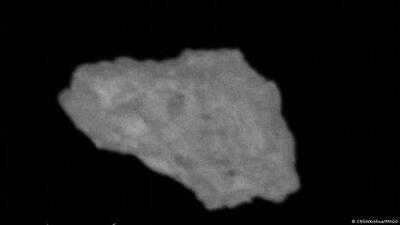
After a yearlong flight of a billion kilometers, a Chinese space probe is set to take samples from an asteroid. The mission is part of what President Xi Jinping calls the country's "space dream."China's Tianwen-2 space probe has reached its target, the near-Earth asteroid Kamo'oalewa, after a journey of about 400 days, the China National Space Administration (CNSA) said on Monday. The mission, which was launched in May 2025, is an important milestone for China as it tries to match or overtake the US and Europe in deep-space exploration and is the first Chinese attempt to collect samples from an asteroid. Scientists believe that samples taken from asteroids — rocky bodies orbiting the sun — could give clues about how the solar system came into being and evolved. What do we know about the Tianwen-2 mission and the asteroid? The CNSA said the Tianwen-2 had successfully arrived at a distance of 20 kilometers (12 miles) from the asteroid — also named 2016 HO3 — which measures just a few dozen meters (yards) in diameter. The asteroid, which was discovered from Hawaii in 2016, travels around the sun at approximately the same distance as the Earth and is a so-called quasi-satellite of our planet, as its orbit is in near synch with it. "The probe will progressively conduct more detailed scientific exploration to acquire data on the asteroid's morphology, material composition and internal structure, laying the groundwork for subsequent sample collection operations," the CNSA said. When the samples have been collected, the Tianwen-2 will release a module that transports them back to Earth, with its arrival scheduled for late 2027. After completing its operations at the asteroid, the main spacecraft is expected to travel on toward a comet in the asteroid belt to continue with a mission that is planned to last about a decade. China boosts its space program China has spent billions of dollars on its space program over the past few years, with President Xi Jinping speaking of his country's "space dream." The current mission comes after Japanese and US missions have already collected samples from different asteroids. Beijing is now trying to catch up notably with the US and the EU, which have recently been pushing ahead with missions beyond the moon. Edited by: Kieran Burke
-
Cristiano Ronaldo hits back at retirement questions ahead of Portugal’s World Cup match against Spain

-
Trump’s intervention in Folarin Balogun red card sparks outrage, raising fears for USA’s World Cup credibility

-
Bengal: Girl gangraped, body found in pond; BJP worker among accused

-
Video: Govinda’s wife Sunita breaks down in Lock Upp 2

-
Fashion against fascism: When trademarks deter neo-Nazis